
















How to Witness Miracles
“Have I ever witnessed a miracle?” is a worthwhile question in our Western culture dominated by rationalism, materialism, and scientism, as many skeptics and agnostics—and even some Christians—believe miracles impossible.
A miracle, according to Merriam-Webster, is “an extraordinary event manifesting divine intervention in human affairs.” The Catechism of the Catholic Church provides a bit more texture in its definition: “A sign or wonder, such as a healing or the control of nature, which can only be attributed to a divine power.” These definitions show us it is possible to cultivate our minds and hearts in a way that the obvious answer becomes a resounding “Yes!” Miracles do occur, and we can know them.
The first step in training our minds and hearts is to examine the biblical record, which is replete with miracles, in both the Old and New Testaments.
Old Testament Miracles
A non-exhaustive list from the Old Testament includes Sarah’s conception of Isaac by Abraham when she was past child-bearing age (Gen. 18:9-15; 21:1-7); the flaming bush on Mount Sinai that was not consumed (Ex. 3:1-2); the Israelites crossing the Red Sea dry-shod (Ex. 14:21-22); the provision of manna from the sky (Ex. 16) and—even more astounding—water springing forth from a rock (Ex. 17); the flow of the Jordan River ceased so Israel could cross into the Promised Land (Josh. 3:15-17); the collapse of Jericho’s walls (Josh. 6); the sun standing still for a whole day (Josh. 10:13-14); the defeat of a well-trained soldier by a young boy with only a stone (1 Sam. 17); Elijah bringing back to life the son of the widow of Zarephath (I Kg. 17:8ff); Elijah’s defeat of the prophets of Baal (1 Kg. 18:20-40). The manifestation of divine power and control over nature is on full display.
Gospel Miracles
The catalogue of miracles is lengthened by the Gospel narratives, which identify Jesus as the fulfillment of the miracles in the Old Testament. The crucial miracle is the Incarnation. “The Grand Miracle,” as C.S. Lewis refers to it in his book, Miracles, is the pivotal moment in salvation history when Jesus, who was “in the form of God,” “emptied himself” and was “born in the likeness of men” (Phil. 2:5-11). This event is certainly a divine intervention in human affairs, a wonderful sign that only God could do to bring healing to humanity. “Every other miracle,” Lewis writes, “prepares for this, or exhibits this, or results from this.”
Even before the Incarnation, St. Luke tells of the miracle of John the Baptist’s conception in the womb of Elizabeth, who was thought to be barren and past child-bearing age (Lk. 1:5-25). That miracle pointed directly toward the conception of the God-Man in the womb of a virgin in Nazareth (Lk. 1:26-38).
Jesus exercises control of nature by turning water to wine, and by walking on water and calming storms. Miraculous healings of blind persons, lepers, and invalids occur throughout all four Gospel accounts. There are multiple feeding miracles, in which Jesus supplies food for large crowds, exhibiting God’s desire to feed the bodies and souls of all people through His Divine Son.
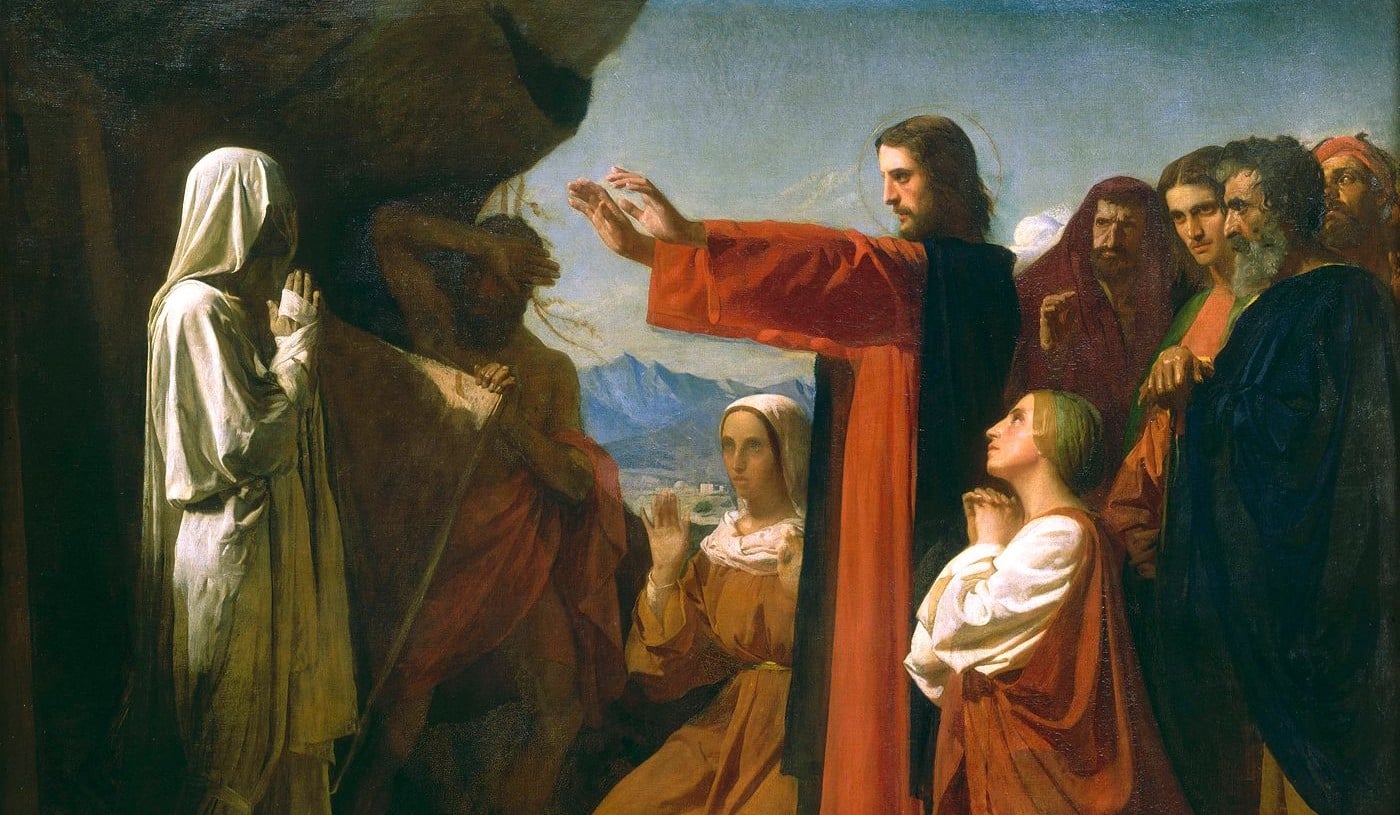
Jesus raised multiple persons from the dead (Lk. 7:11-17; Jn. 11:38-44), which ultimately pointed to the miracle for which He came, His Resurrection. All these miracles exhibit God’s control over nature and, more importantly, His condescension to humans—that is, His climbing down to be with them, to relieve their suffering, and to bring them to eternal life.
The Miracles of Jesus’ Followers
The miracles do not cease with Jesus, though. During the Last Supper, Jesus promises the Apostles, “…whoever believes in me will also do the works that I do; and greater works than these will he do… Whatever you ask in my name, this I will do… If you ask me anything in my name, I will do it” (Jn. 14:12-14). At the end of his Gospel account, St. Mark records Our Lord predicting specific miracles that will be performed by His followers, such as casting out demons, speaking in new tongues, healing sick persons, and being spared the effects of poison (cf. Mk. 16:17-18).
The promise is clear: followers of Jesus will have the ability to manifest divine power in extraordinary ways because of their relationship with Him. Lewis names these the “Miracles of the New Creation” because they are performed by those who have access to the Christian grace and the resurrected life.
The catalogue continues in the Acts of the Apostles, beginning at the Jewish feast of Pentecost. There we witness the Apostles communicating in languages they have never known before (Acts 2:5-6). Soon after, we read of the healing of a lame beggar, which recapitulates several details of Jesus’ healings (Acts. 3:1-10). Many “sick and those afflicted with unclean spirits” are healed by Peter’s shadow as he walked by (Acts 5:12-16). Immediately following those miracles, “an angel of the Lord opened the prison doors [where they were being held] and brought them out…” (Acts 5:17-19). These miracles were not possible because the Apostles exercised their own control over nature, but because Jesus had bestowed the power of the Holy Spirit in which the Apostles were participating. Thus, apostles extend the Lord’s ministry through time and space.
Because of the biblical pattern, we can know that the miraculous work of Jesus extends down through the centuries, even to us. In the early-third century, Origen preached a series of homilies on the Book of Joshua, commenting on the Israelites’ crossing the Jordan River into the Promised Land. “And do not imagine,” he said, “that these deeds are only in former times and nothing so great as this is brought forth in you who are now the hearer of them.” Origen means that we will continue to witness miracles throughout the unfolding of history, specifically because Jesus is at work through His Church, empowering disciples by the movement of the Holy Spirit and the grace of the sacraments.
Training Ourselves to See Miracles
Therefore, if our spirits are trained to see them, we ought to expect to witness miracles. Such training happens by two specific means. First, we ought to pray for miracles, because we believe in an omnipotent God—a God who has power over nature for whom nothing is impossible (see Lk. 1:37). This should be all the clearer to us as Jesus teaches, “Ask, and it will be given to you…” (Lk. 11:9). Yet, at the same time, we must trust that God, in His omniscience, knows better than we what will bring us to perfection.
Beyond asking for miracles, we must train our spirits in gratitude. Without this foundational virtue, we cannot recognize any of the miracles God wants to work in our lives or the lives of others. Here are some easy steps to build a habit of gratitude:
- Spend a few minutes each day cataloguing graces and blessings, even the most basic things.
- Learn to pray the examen prayer, which begins with a disposition of gratitude.
- Use these two prayers regularly, not just before or after meals:
“Bless us, O Lord, and these thy gifts, which we are about to receive from thy bounty, through Christ, Our Lord. Amen.”
“We give you thanks, Almighty God, for these and all thy benefits that we have received from thy bounty, through Christ, Our Lord. Amen.”
Ultimately, reviewing God’s miraculous works in history and cultivating gratitude daily are the first steps towards witnessing the miracles God can and will do for us and through us.
Image from Wikimedia Commons