






![St. Anthony Clare—When it is time for me to leave [the Eucharist], …](https://www.catholicdigest.com/wp-content/uploads/2025/12/15-1024x538.png?#)



Lay leader laments ‘mysterious’ process in stalled Schönborn succession
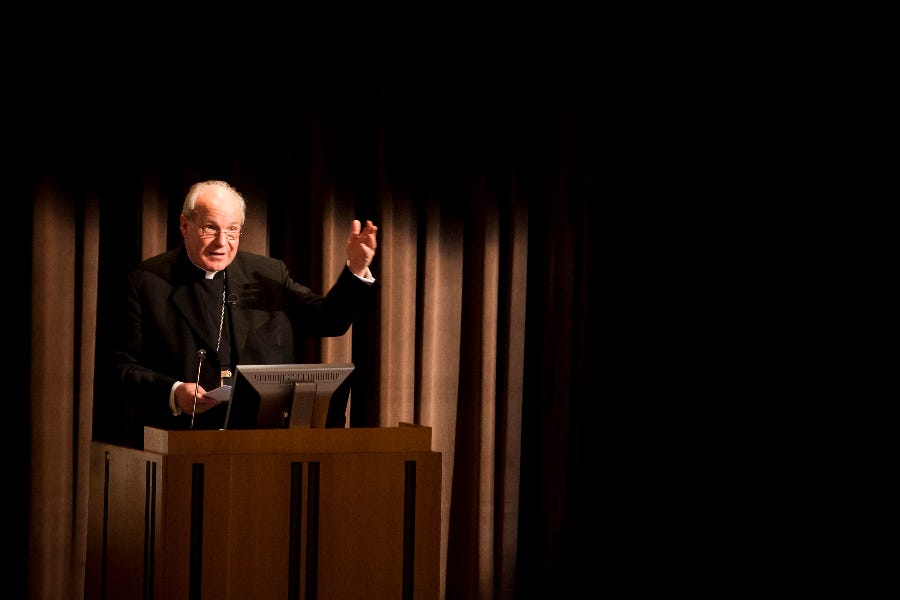
A lay leader in Austria’s Vienna archdiocese criticized Friday the “very mysterious” search for a successor to Cardinal Christoph Schönborn.
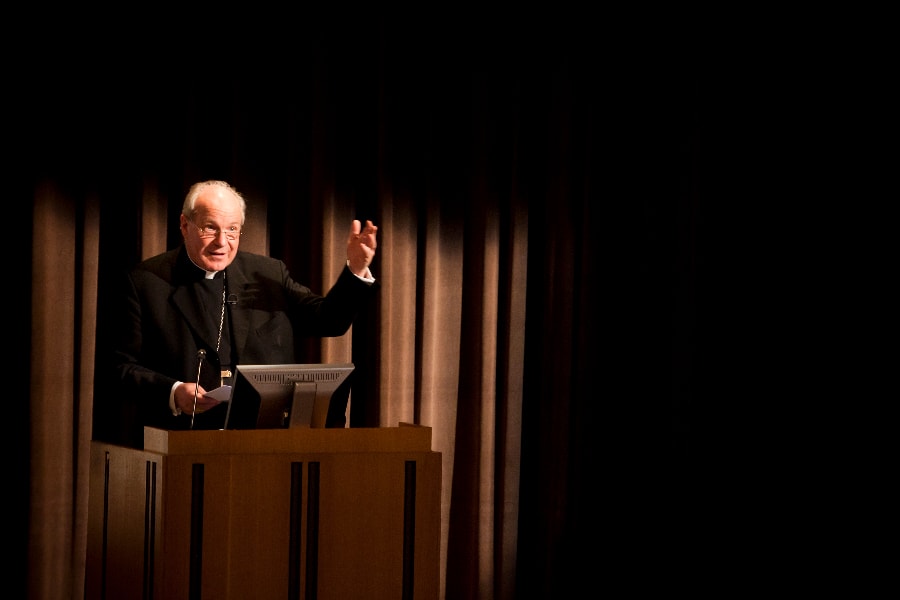
Reinhard Bödenauer, the president of Catholic Action in the Vienna archdiocese, lamented in a July 25 interview with Die Presse newspaper the lack of lay input into the process of selecting a new Archbishop of Vienna.
Schönborn’s successor was expected to be named not long after the cardinal stepped down as Vienna’s archbishop Jan. 22, after 30 years in the post. But six months later, one of Europe’s most prominent sees remains vacant.
Commenting on the succession process, Bödenauer said: “I don’t think much of how it works; it’s all very mysterious.”
Catholic Action serves as an umbrella body for other lay organizations in the archdiocese. But Bödenauer said that Archbishop Pedro López Quintana, the apostolic nuncio to Austria, had not sought his views on the next Archbishop of Vienna.
He stressed he was making a broader point about lay involvement in the episcopal selection process, arguing that a wider circle of consultation would strengthen its transparency and legitimacy.
“We as lay people are ready to put our knowledge and time at the service of the Church,” Bödenauer said.
Describing the qualities he wished to see in the next archbishop, he added: “He must have a sensitivity for a city the size of Vienna, with its significant migration, and for the countryside, where many are experiencing young people leaving communities.”
Lay people play a significant role in the selection of new bishops in some dioceses in the German-speaking world, typically for historical reasons. In many dioceses, the cathedral chapter also has a say in appointments.
In Austria’s Archdiocese of Salzburg, for example, the cathedral chapter elects a new archbishop from a list of three candidates proposed by the Holy See. The candidate must then be approved by the pope.
But a new Archbishop of Vienna is chosen through the standard process in which the nuncio consults with local stakeholders, including clergy and bishops, and then submits a list of three names, known as a terna, to the Vatican. The pope has a free choice of candidates.
Austrian media reported in January that the terna for the Vienna archdiocese consisted of Bishop Hermann Glettler, the Bishop of Innsbruck since 2017, Msgr. Michael Landau, the president of Caritas Europa, and Fr. Bernhard Eckerstorfer, until recently the rector of the Pontifical Athenaeum Sant’Anselmo in Rome.
Austrian media said that Landau and Eckerstorfer had withdrawn from consideration for the post, though neither the Vatican nor the Archdiocese of Vienna has confirmed these reports.
Pope Leo XIV was closely involved in the selection process in Vienna even before his election in May. In his previous role as prefect of the Vatican’s Dicastery for Bishops, he would likely have scrutinized the candidates to succeed Schönborn, a prominent theologian and close collaborator of recent popes.
The future Pope Leo traveled to Vienna in November 2024, visiting the city’s Augustinian Church and meeting with Schönborn.
The hunt for Schönborn’s successor may have been further delayed by Pope Francis’ death in April and the vacancy created at the helm of the Vatican’s Dicastery for Bishops by Leo XIV’s election.
Austrian media have expressed frustration at the pace of the search for a new Vienna archbishop, describing the process as a “farce.”
But Bödenauer commented: “A good decision is more important and takes priority over a quick decision.”
The Vienna archdiocese serves around 1.1 million Catholics, approximately 175,000 of whom attend Sunday Mass.
Austria’s most populous diocese covers not only the capital but also the eastern side of the federal state of Lower Austria. It has more than 1,000 priests, 170 deacons, 242 pastoral assistants, 98 Catholic schools, and 238 monasteries.
Located at the crossroads of Europe, Vienna is also an important center for Eastern Christians.
The Vienna archdiocese is currently under the care of Fr. Josef Grünwidl, who was named apostolic administrator in January.
Asked if Grünwidl, a 62-year-old priest of the archdiocese, could be considered a potential successor to Schönborn, Bödenauer said: “Absolutely, yes.”
What's Your Reaction?
 Like
0
Like
0
 Dislike
0
Dislike
0
 Love
0
Love
0
 Funny
0
Funny
0
 Angry
0
Angry
0
 Sad
0
Sad
0
 Wow
0
Wow
0