










![St. Anthony Clare—When it is time for me to leave [the Eucharist], …](https://www.catholicdigest.com/wp-content/uploads/2025/12/15-1024x538.png?#)



Polish government lodges Vatican protest over bishops’ migration remarks
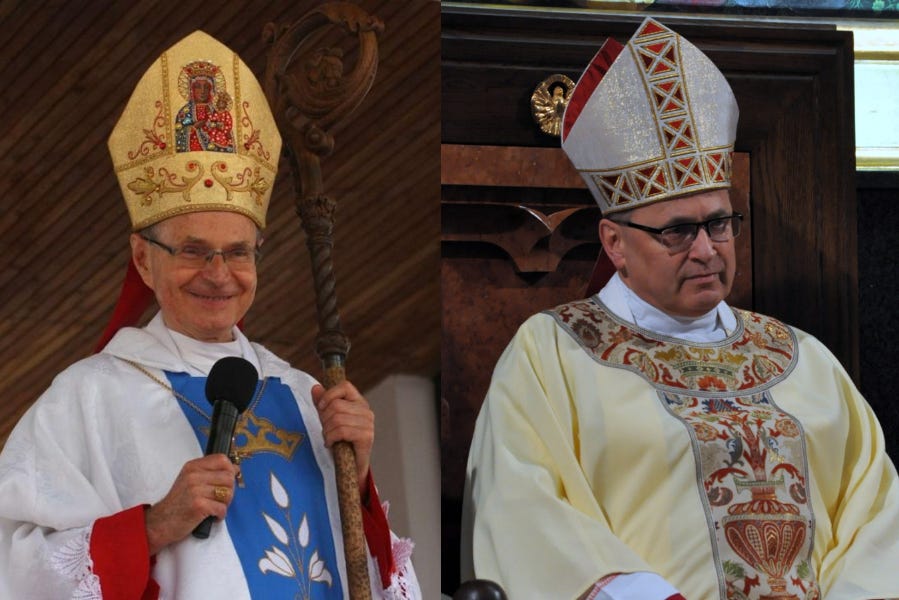
Poland’s government formally complained to the Vatican Tuesday over two bishops’ comments on migration, plunging Polish Church-state relations to their lowest level for years.
Adam Kwiatkowski, Poland’s ambassador to the Holy See, delivered a diplomatic note July 15 to Msgr. Javier Domingo Fernández González, the Vatican Secretariat of State’s head of protocol. The Vatican has not commented publicly on the development.
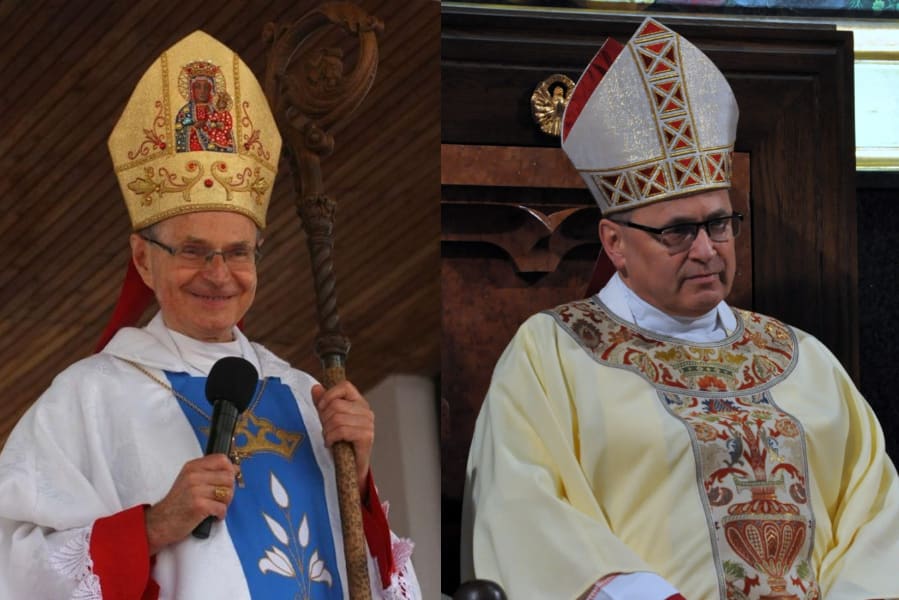
The note expressed “deep outrage” at recent comments by retired bishops Antoni Długosz and Wiesław Mering, amid tensions following neighboring Germany’s decision to adopt a stricter migration policy and return a significant number of undocumented migrants to Poland each month.
The note accused the two bishops of making statements that “undermine good Polish-German relations, slander the government, and indicate clear support for nationalist groups.”
The Polish government argued that the comments violated the 1993 concordat, which governs relations between Poland and the Holy See, and urged the Vatican to take action against the bishops.
The complaint cited a July 11 address given by Długosz as he led the “Call of Jasna Góra,” a daily evening prayer recited at Jasna Góra Monastery in Częstochowa, the country’s most popular Marian shrine.
Jasna Góra is not only a pilgrimage destination but also an important symbol of Polish national identity, housing the famed image of the Black Madonna. It’s not unusual for bishops to address topical themes while leading the evening prayer.
The note alleged that Długosz, who retired in 2016 as an auxiliary bishop of Częstochowa archdiocese, publicly supported Robert Bąkiewicz, founder of the Border Defence Movement.
Bąkiewicz has organized “citizens’ patrols” at border crossings between Germany and Poland. Poland’s Prime Minister Donald Tusk has denounced the patrols as “militias.”
Długosz said: “Today we want to pray for the defenders of our borders, those in the uniforms of border guards, soldiers, police officers, customs officers, the Territorial Defense Force, but also the volunteers of the Border Defense Movement, those who selflessly organize patrols.”
“This is the response of Polish parliamentarians and patriots concerned about the situation on the western border, where German police are flinging illegal migrants to our side like objects.”
The diplomatic note, known as a démarche, also cited a July 13 homily delivered by Bishop Wiesław Mering at a Mass for pilgrims to Jasna Góra. The pilgrimage was organized by the Catholic broadcaster Radio Maryja.
Mering, who retired in 2021 as Bishop of Włocławek, said: “Our country’s borders from the west as much as from the east are under threat. And one politician says, more evil is carried by the Border Defense Movement than immigrants, about whom we know nothing.”
“In my Kuyavian-Pomeranian Voivodeship, there have been two murders of a young woman and actually a young man recently. We are governed by people who describe themselves as Germans.”
“‘As the world is the world,’ said one Polish poet, Wacław Potocki, in the 17th century, ‘a German will not be a brother to a Pole.’ History has proven terribly the truth of this saying.”
The diplomatic note highlighted Mering’s reference to governance “by people who describe themselves as Germans.”
The bishop was possibly alluding to Donald Tusk, whose ancestry has ethnic German elements through his maternal grandmother. The Prime Minister’s critics frequently accuse him of serving German rather than Polish interests, citing both his ancestry and his role as president of the European Council from 2014 to 2019.
Tusk has not responded directly to the claims, but insists that his pro-European Union policies and commitment to Polish-German cooperation are in Poland’s best interests.
The note also criticized Mering for referring to the Polish government as “political gangsters.”
Poland’s foreign minister Radek Sikorski described the diplomatic note July 16 as “an expression of the fact that many Poles are outraged by the appropriation of Jasna Góra, a place dear to the entire nation, for party-political purposes.”
He added: “If the bishop wants to be active in politics, let him cast off his robe and join the Law and Justice party, but as long as he is a bishop we require him to respect the concordat.”
The complaint to the Vatican coincides with a sensitive period for Poland’s government, which is struggling with low approval ratings. According to a poll conducted in June, 47% of Poles said they opposed the Tusk administration, while 32% expressed support.
Also in June, a candidate backed by Tusk’s Civic Platform party narrowly lost a presidential election that he was projected to win. The defeat means that incoming President Karol Nawrocki could veto legislation presented by the Tusk government in the coming years.
Nawrocki, an independent candidate endorsed by the opposition Law and Justice party, has strongly criticized the government’s migration policies, accusing it of failing to offer strong resistance to the return of migrants from Germany to Poland.
“I do not intend as President of the Republic to tolerate the fact that Germany wants to settle its affairs by putting the safety of our women and children on the line,” said Nawrocki, who will succeed current President Andrzej Duda Aug. 6.
The Polish government reintroduced checks at 52 border crossings with Germany this month. Donald Tusk said the temporary step was necessary “to limit and reduce to a minimum the uncontrolled flows ... of migrants back and forth.”
People and traffic previously moved freely across the Polish-German frontier under the Schengen Agreement, which abolished border checks between participating European countries.
Meanwhile, Church-state relations have deteriorated sharply since Tusk became Prime Minister. After winning the 2023 parliamentary election, he assembled a diverse coalition led by his Civic Platform party and including members of the New Left party, which outlined plans to end the “toxic relationship” between Church and state in Poland in the run-up to the election.
Tusk’s government alarmed Poland’s bishops by its commitment to liberalizing abortion laws, its promise to overhaul the Church Fund, through which the state contributes to religious groups’ charitable work, and its decision to reduce religion classes in public schools to one hour a week.
Poland’s bishops asked the Constitutional Tribunal to rule whether the reduction in religion classes was compatible with Poland’s constitution. After the tribunal declared that changes to religion classes were unconstitutional, the Polish bishops’ conference announced it would take further legal action against the government, “including in international institutions.”
The Polish bishops are unlikely to welcome the government’s complaint to the Vatican as they are currently facing internal Church challenges.
The bishops’ conference faced a wave of criticism in June after it announced it was overhauling plans to establish a national independent abuse commission. Critics accused the conference of seeking to reduce the planned commission’s scope and powers, weakening the bishops’ commitment to reckoning with abuse.
The bishops’ conference also recently provoked controversy after it triggered the resignation of Marcin Przeciszewski, the long-serving head of the Catholic Information Agency, a Church news outlet founded in 1993. Przeciszewski objected to what he called “totalitarian” plans to subordinate the agency to the bishops’ conference press office.
The Church is also facing strong secular headwinds. According to a 2021 census, 71% of Poland’s roughly 37 million population identifies as Catholic, down from 88% in 2011.
Mass attendance fell from 47% at the turn of the millennium to 28% in 2021. The number of seminarians dropped from 828 in 2012 to 356 in 2021.
A 2023 report identified a stark generational divide in religious practice in Poland, with considerably lower levels of practice among the under-40s.
What's Your Reaction?
 Like
0
Like
0
 Dislike
0
Dislike
0
 Love
0
Love
0
 Funny
0
Funny
0
 Angry
0
Angry
0
 Sad
0
Sad
0
 Wow
0
Wow
0