





American pope, American Lady: The story behind Our Lady of the Prairie

The land of the Diocese of New Ulm, Minnesota consists of what some might pejoratively call “flyover country.” It has no major cities, no towering mountains or ocean shorelines or many popular tourist attractions. Mostly, it is 9,000-plus square miles of Midwestern prairie and farmland.
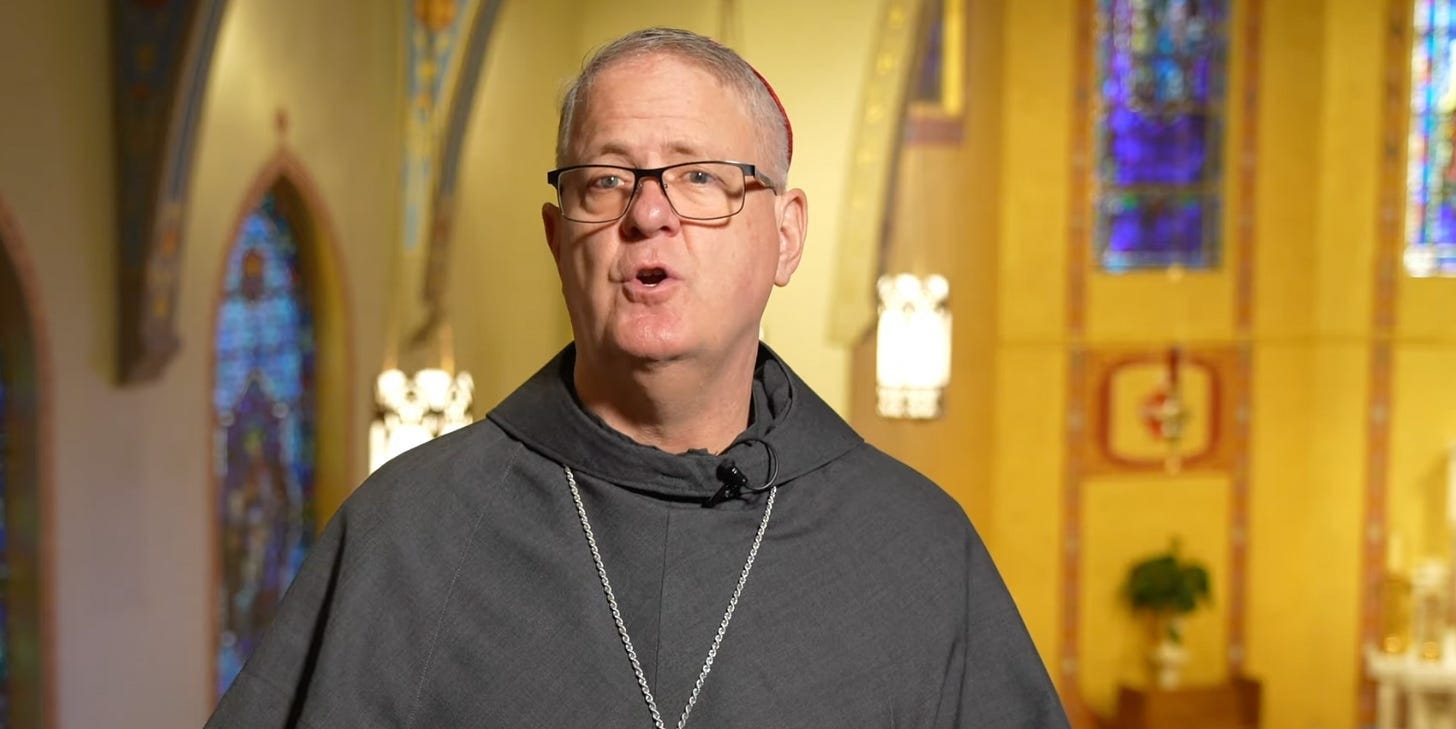
But flyover country though it may be, when Bishop Chad Zielinski was first installed to lead New Ulm in 2022, he drove all four corners of his new diocese and was struck by “the loveliness of the thousands of acres of prairie land.”
This, along with a strong desire to reconsecrate the diocese to the Blessed Virgin Mary, inspired Zielinski to commission a new image of Mary for his diocese, with the title Our Lady of the Prairie.
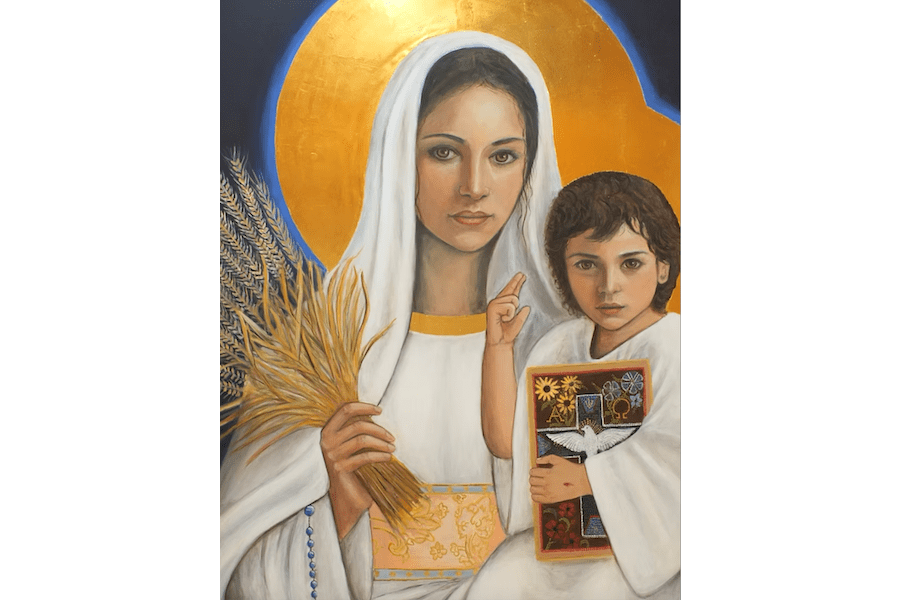
“It’s really helping people to see that she's our mother, she’s the mother of the diocese, of the people here. She knows us, she knows what we need,” Leonard Gutierrez, the director of evangelization for the Diocese of New Ulm, told The Pillar. “She’s helped really bring to life the person of Mary.”
The rural diocese of New Ulm shares the challenges of many rural dioceses in the country - a small population, a small number of vocations, young people who move away from home for school or work and do not return, and a decline in the agricultural economy of the area, Gutierrez explained. Furthermore, there is a problematic past with the way some of the Dakota Nation and other local Native American tribes were treated by some of the Christian settlers of the area in years past.
The new image of Mary, and the diocesan consecration to Our Lady of the Prairie, is helping remind the people of New Ulm that “she hasn't forgotten us. She knows you, she wants you, she loves you. She knows what we need, and we ought to pray to her so that we can come closer to our Lord,” Gutierrez added.
The commissioning of an icon
In a unique turn of events, it was New Zealand artist Damien Walker, who at the time had never been to the United States, who was commissioned to paint the image of Our Lady of the Prairie by Zielinski in early 2024.
Zielinski had been praying for an artist for the icon when he met Archbishop Paul Martin, of Walker’s home diocese in New Zealand. Martin showed Zielinski another commissioned painting of Walker’s, Our Lady of New Zealand. Walker’s depiction of the cultural elements of the people of New Zealand, and care for the theological elements of an icon, caught Zielinski’s attention and prompted him to commission Walker for Our Lady of the Prairie.
“It's his vision, and I've been following it, and building off of that,” Walker said.
In June last year, Walker flew to New Ulm to do a full consultation with the diocese, to get a feel for the land and the people that would be represented in this new piece. He learned about the history of the Native American tribes in the region. He met with people in their homes, visited local museums, and learned all he could about the people and the area.
Walker was excited to note that beloved author Laura Ingalls Wilder, of the famous “Little House on the Prairie” book series, once lived in the bounds of the diocese, near Walnut Grove, Minnesota, as recounted in Wilder’s book “On the Banks of Plum Creek” (Laura and her family were Christians, though not Catholic).
“It's really important for me to go see, smell, touch, hear…I need to hear the wounds, the pain, the challenges of a community and what they're facing, and then using art as a way - through Our Lady, through faith, through theology, through the transcendental - to bring healing and dialogue back to those communities,” Walker said.
He began the sketches of Our Lady of the Prairie in person with Zielinski, using pencils and scrap paper, before flying back to New Zealand to finish his work.
And that’s when strange things started happening, Walker said.
The adventures of a new Marian image
Walker recounted several bizarre (and possibly miraculous) happenings in the course of painting the image of Our Lady of the Prairie and sending it back to the United States.
After Walker had varnished the painting, the varnish on it had turned a strange and unexpected grey and blue. Walker tried numerous times over the course of several months to remove the colored sheen with no luck. Then, he had to travel away from the painting for a few days. Upon his return, he said, the ugly sheen had completely fallen off the image on its own.
“I'm like, you’ve got to be kidding me. It's been like nine months or eight months stuck on there, and it's completely peeled off,” he said.
Once the painting was complete, tariffs almost kept Our Lady of the Prairie from making her journey back to the United States from New Zealand. When Walker tried to ship the painting through the global shipping company DHL, they informed him that they were in the middle of a five-month tariff from the United States. “There’s no way your painting can move,” Walker was told.
Worried, Walker contacted Bishop Zielinski, who was expecting the painting in time for diocesan events centered around the consecration of the diocese to Our Lady of the Prairie.
“(Zielinski) said: ‘Let's pray.’ So he fired up his adoration chapels, he fired up all his incredible nuns around the diocese, he started praying, he started an emergency novena prayer to Our Lady Undoer of Knots.”
Three hours later, DHL contacted Walker. By what they called “an act of God,” Trump issued a temporary lift on the tariffs, and Mary could be shipped to the U.S. after all.
But Mary’s journey was far from over. Somewhere in transit, the oversized seven-foot painting was lost and untrackable. Then, once it arrived in Los Angeles and reappeared on DHL tracking, the painting made a strange, circumvent trip across the United States.
When Walker and other diocesan staff mapped out where the image had gone, they couldn’t believe it.
That summer, the National Eucharistic Congress had facilitated a pilgrimage with Jesus in the Eucharist that took place over four routes throughout the United States, ending in Indianapolis, for the 10th Eucharistic Congress. The image of Our Lady of the Prairie had been shipped to nearly every city in the pilgrimage, crossing the country, before reaching Minnesota.
“She followed Jesus,” Walker said.
A Pilgrimage of Hope
Once Mary arrived in the Diocese of New Ulm, Zielinski consecrated the diocese to Our Lady of the Prairie, and launched a Pilgrimage of Hope, with a copy of the image.
The eight-day pilgrimage, which began June 22 on Corpus Christi Sunday, took place over 90 miles of the rural landscape of the diocese, making stops at various parishes and other destinations for prayer, adoration of the Eucharist, and meeting with people throughout the diocese.
Seven dedicated young adult pilgrims completed the full 90-mile pilgrimage, walking most of it (and driving some). They were occasionally joined by local religious sisters, by Damien Walker, and by others throughout the diocese.
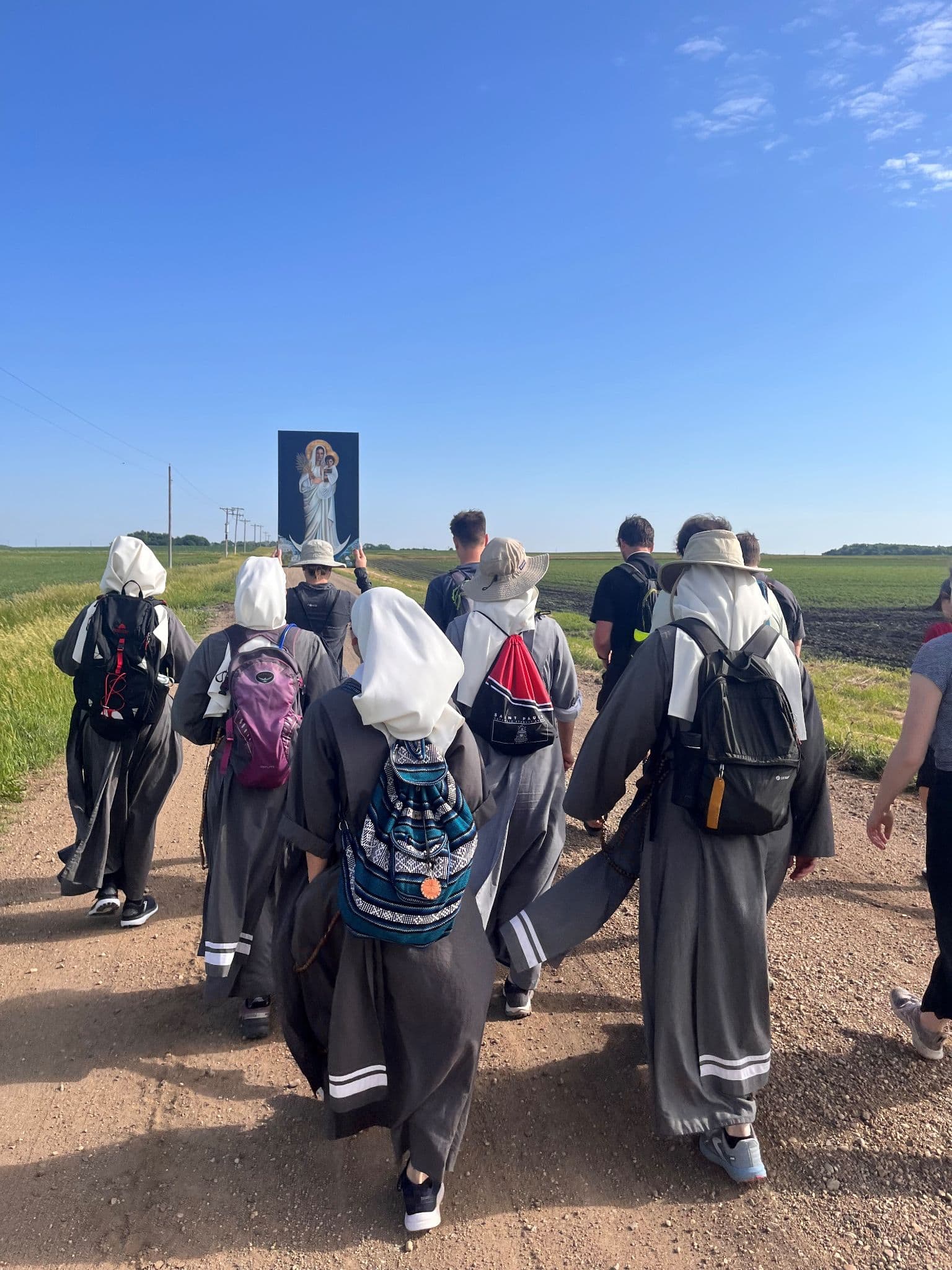
Matthew Collins, a seminarian for the Diocese of New Ulm, was one of the young adults who completed the whole Pilgrimage of Hope.
“This year, (Mary) has really shown herself to be my mother, and she has held me and loved me where I need to be loved, where I needed to grow in faith,” he said. “And as I was walking, it became very clear that she didn't want me to hold on to this love that she was giving me. She wanted me to share it with everyone.”
“This isn't for just one person,” Collins added. “It's not just for the priests who are reconsecrating themselves. No, we're reconsecrating the entire diocese. And that's not even just the Catholics, it’s for everyone who lives here. Mary wants to hold them in her arms.”
Part of the pilgrimage included stopping to talk with people who encountered the pilgrims and the image. Collins said he was struck by how many people were pulled in by the beauty of Our Lady of the Prairie.
“One guy, he was just driving by us on the road, and he turned around to come ask us, ‘What is this about?’ And he was just really, really curious,” Collins recalled.
The man said he was not a churchgoer, “but he really connected with the image of Our Lady. He immediately recognized the beauty of her, and he wanted to know more…the image draws people in,” the seminarian reflected.
At another point, Collins said, they were nearing the end of a long day of walking in 95-degree heat, when a number of people joined the pilgrimage for the last few miles of the walk that day. Hot and exhausted, Collins said that when he tried speaking to the people, he found he could not.
“I just felt so bad because I tried talking, but nothing was coming out. It was really striking to me, because I was able to communicate to them that I was willing to listen to them. So even though I couldn't offer anything, you know, vocally, I was still able to listen to their stories,” Collins said.
That became a turning point of the pilgrimage for Collins, who said he realized that offering up the sufferings of the long, daily walks of the pilgrimage in the heat, and offering his presence and his willingness to listen, was one of the best ways he could help the people he encountered along the way.
Gutierrez said one of the fruits of the pilgrimage that he heard was that “a lot of women throughout the eight days, when they saw the image, a lot of them approached in tears, and some of them had shared with Damien that this was the first time they felt seen and known by Our Lady.”
“Obviously, we don't know all the details of what was going on, interiorly, for them, but tears can a lot of times be a sign of the Lord and Holy Spirit working,” he said.
There were even Protestant pastors who noticed the pilgrimage and related events and called to ask about the image, and about the Catholic faith, Gutierrez added.
Another notable moment of the pilgrimage was the blessing of the headwaters of the Minnesota River by Bishop Zielinski in the early morning of June 25. Roughly 60 people, some of whom traveled a long way, witnessed the blessing, which took place around 6 a.m. in a drizzling rain.
“That’s the water that's running through the entire diocese, that's feeding us and giving us a lot of life,” Collins said.
“As we stand at the headwaters of the Minnesota River asking God to pour forth his blessing, we are reminded of the grace flowing from Our Lady of the Prairie,” Zielinski said at the blessing, during which he dipped a relic of the Cross into the waters.
“I pray that as this blessing joins the Minnesota River flowing through the heart of our diocese that a new era of grace flows into the hearts, minds, homes, farms and parishes of the Diocese of New Ulm. Our Lady of the Prairie has claimed us as her children, and with great joy we claim her as Our Mother.”
Elements of an icon
This river is depicted in the image of Our Lady of the Prairie, with teepees, canoes, and three fish on its banks, “representing the Indigenous peoples of the land, reflecting the three interlocking fish on the coat of arms of the Diocese of New Ulm. The river, which once provided food for the Indigenous communities, now also symbolizes the flowing river of grace in the life of the Holy Trinity, pouring forth into the prairies of the diocese,” Walker explains on his website.
After Zielinski’s blessing, “it’s like holy waters pumping through the heart of America. Now that's … just epic,” Walker said. “And then that flows into the Mississippi River as well. So it kind of shows Mary bringing new life and grace and renewal of the baptismal promise as well.”
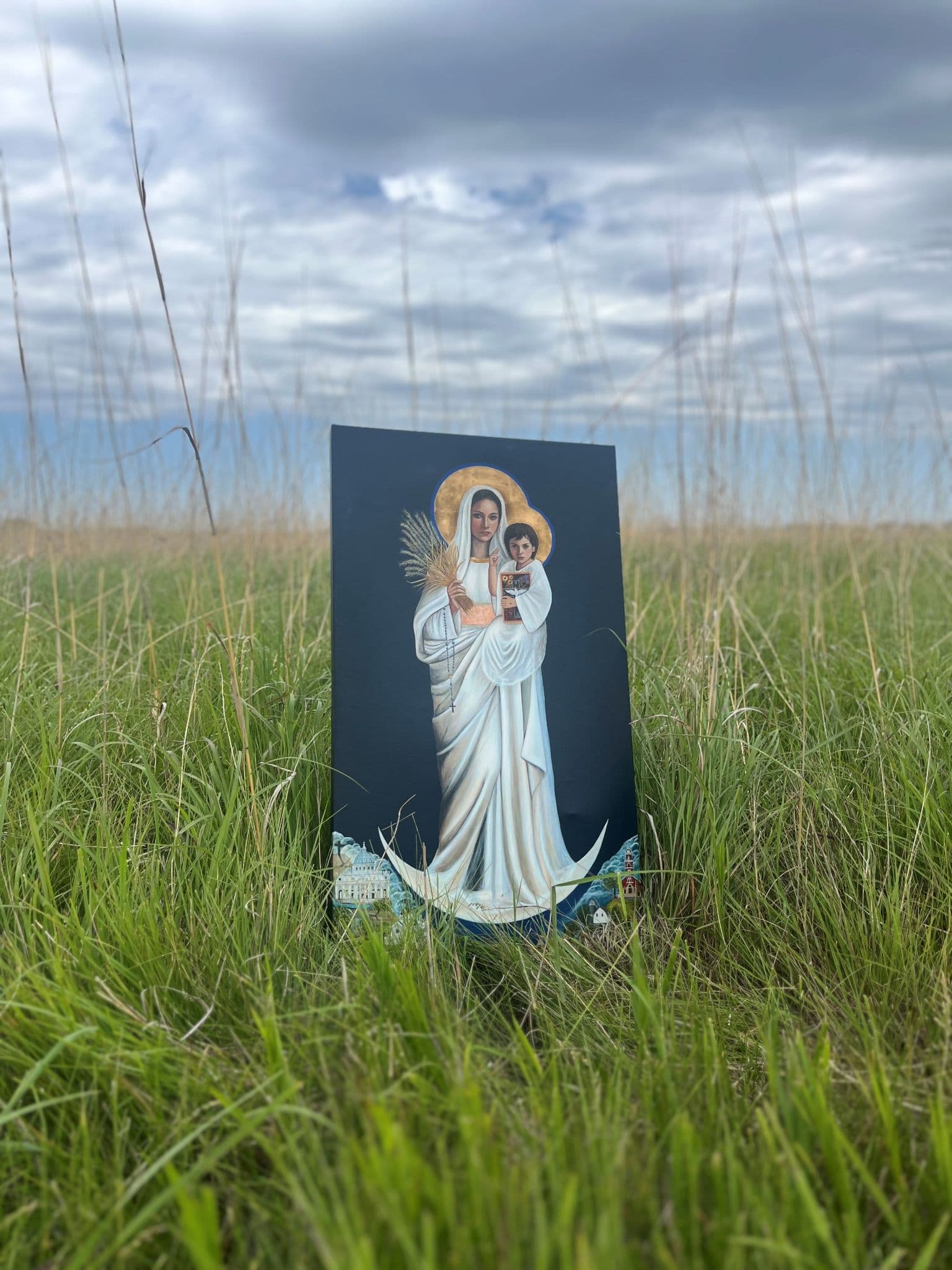
Mary herself is painted in a brilliant white, representing her as the Immaculate Conception and as a beacon of hope. As Walker explains in his description, she stands in contrast against a dark blue background, which “represents the brokenness of the world, sin, death, and despair, but she’s not afraid of it. She stands firm, victorious, and luminous as the beacon of hope.”
Mary’s gaze was painted so that it draws viewers into the image, and leads them to the Christ child, who is seated on her left, his right hand raised in blessing. In his left hand, he holds the Gospel, “adorned in royal purple with Dakota beadwork. It’s not just a book. It’s the Word made flesh. The presence of the beadwork honours culture. It doesn’t erase it, it fulfills it,” Walker noted.
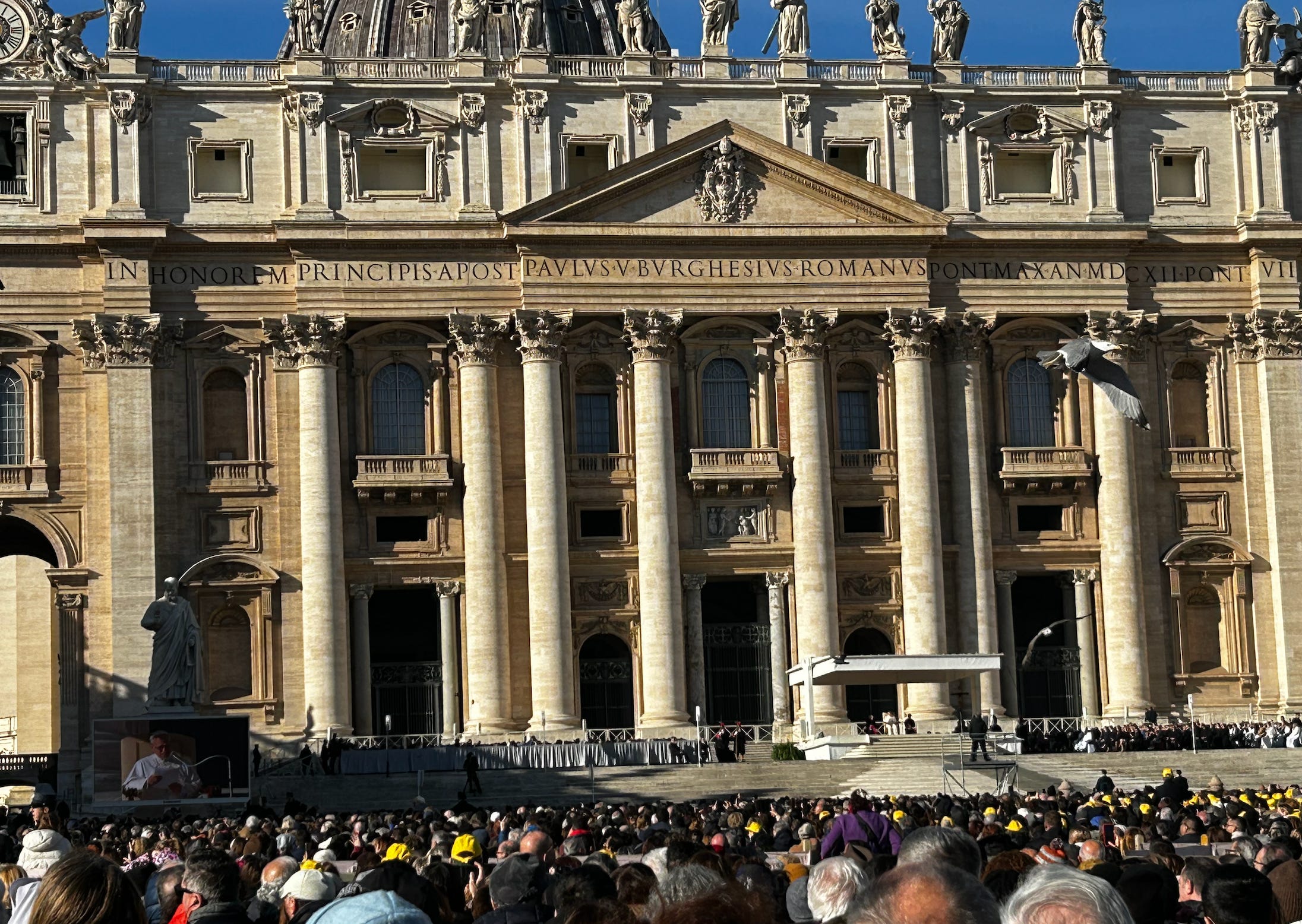
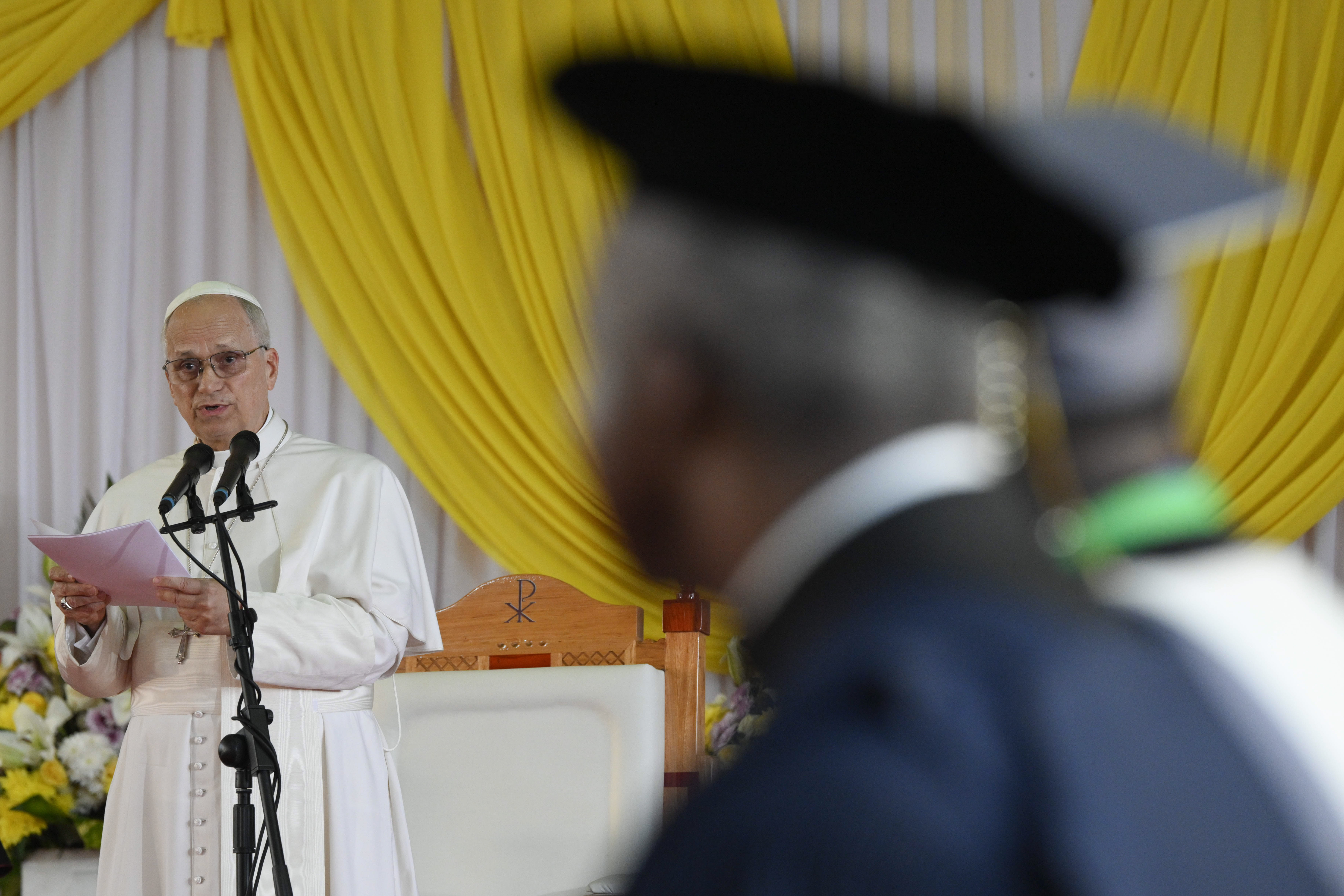
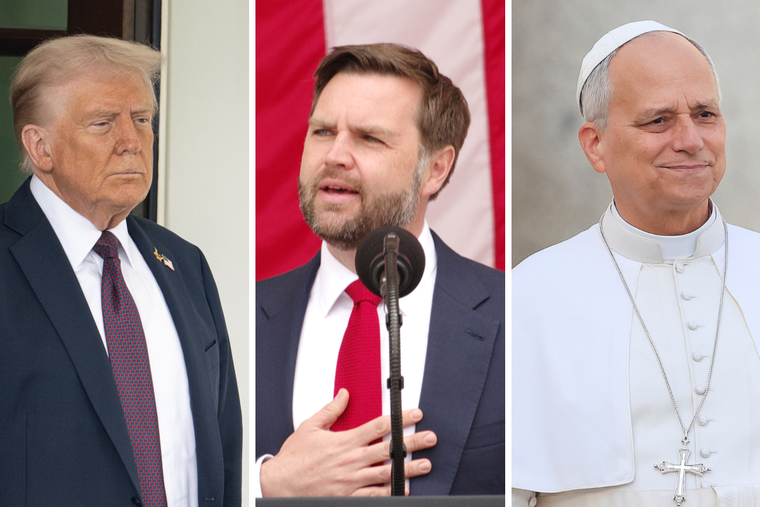
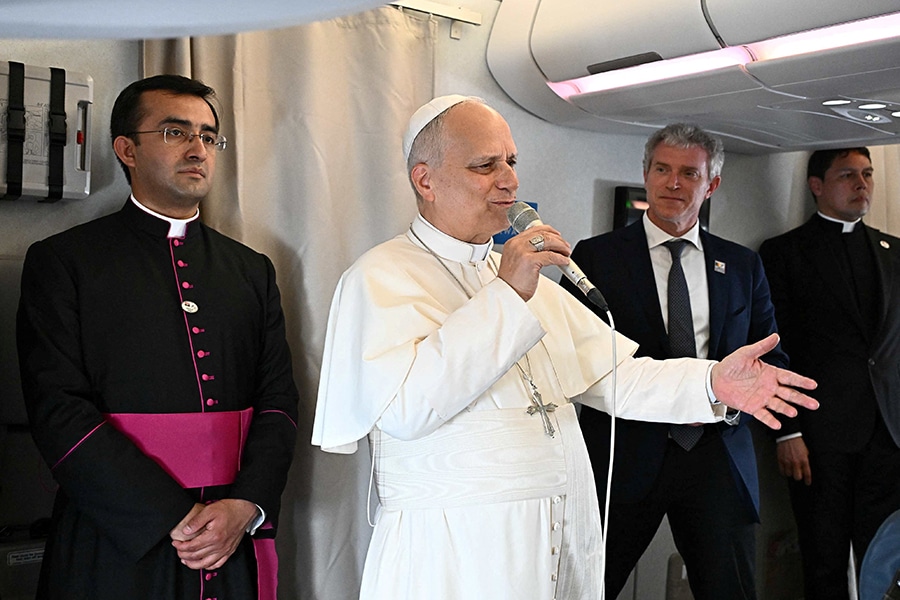
At the base of the image, Walker painted St. Peter’s Basilica, the “spiritual home” of the Church, representing the “heart of Peter.” The basilica sits in the shadow of the Cross of Christ painted on the image, a happy accident that happened when Walker’s brush slipped, he said. He also noted that he started painting St. Peter’s the day Pope Francis died. The day he finished painting St. Peter’s was the day Pope Leo became the first American pope.
Next to St. Peter’s Basilica, Walker depicted the Cathedral of St. Paul in Minneapolis, the archdiocesan seat of the state of Minnesota, and then on the other side of the base of the painting is the Cathedral of the Holy Trinity in the Diocese of New Ulm, with the river between them representing the Minnesota river, as well as the river in the vision of Ezekiel and the water which flowed from the pierced side of Christ at his crucifixion. A house and a barn reflect the domestic church of the diocese, and the land surrounding them depicts the prairie and farmland of the area.
Further explanations of the elements of Our Lady of the Prairie can be found on Walker’s website, at: https://www.thestudioofsaintphilomena.com/our-lady-of-the-prairie
“As for the way that I paint… yes, I'm painting, but I'm always asking Our Lady: What do you want? How do you want to be revealed?” Walker said.
He also added that he believes the image is for all of America, not just for the Diocese of New Ulm.
“This is an image for the whole of America, for everyone. She's calling everyone to herself and to know Jesus,” he said.
In the weeks since completing the pilgrimage and related events in the Diocese of New Ulm, Walker has been traveling the world (largely the United States and Europe) with the image, handing out holy cards of Our Lady of the Prairie and speaking about her to various groups. He has been struck by her universal appeal, he said, and by the miracles that seem to follow in her wake.
“I was at the Jubilee of Youth, and she’s gone off like wildfire there,” Walker said. With permission from the Diocese of New Ulm, Walker traveled with a large replica of the image to Rome for the jubilee, where he said he stayed up until 2 a.m. some nights talking with the young pilgrims from all over the world about Our Lady of the Prairie and handing out holy cards of the image.
Walker ended up giving talks to different groups of nuns about Our Lady of the Prairie during his travels as well, and giving her image to different religious centers that requested the holy cards. Everywhere he went, he brought grocery bags full of her holy card with him. In what Walker said was a miracle from Our Lady, the cards kept multiplying.
“I can tell you for a fact that…Our Lady just multiplied thousands of cards,” he said.
There were miracles that happened when people prayed with the image too, Walker said, including conversions and physical and spiritual healings. While Walker said the specifics of the miracles were private, their impact was “huge.”
“You’ve got an American Mary and an American pope now at the same time,” he noted. “It’s a time of grace now for the States.”