





Apostles' tombs, and what's Notre Dame?
Hey everybody,
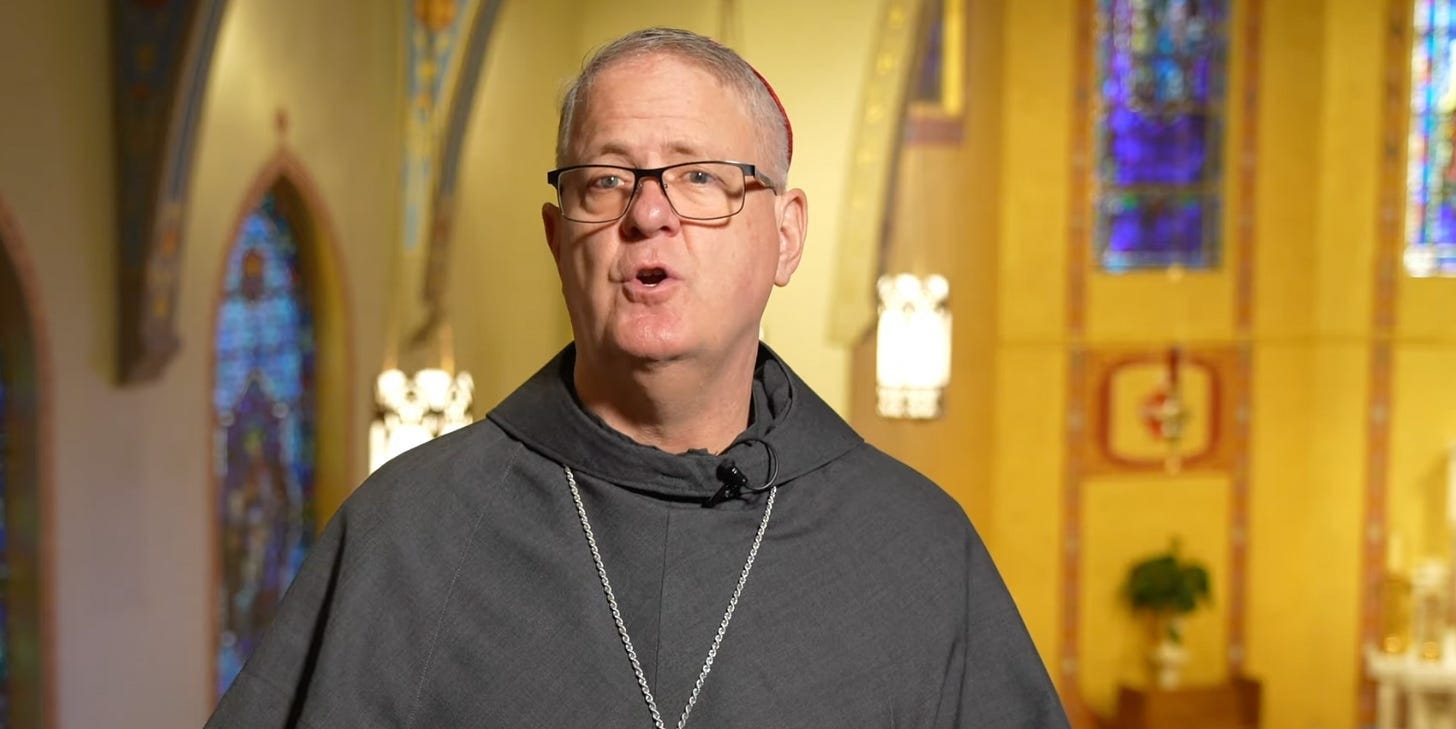
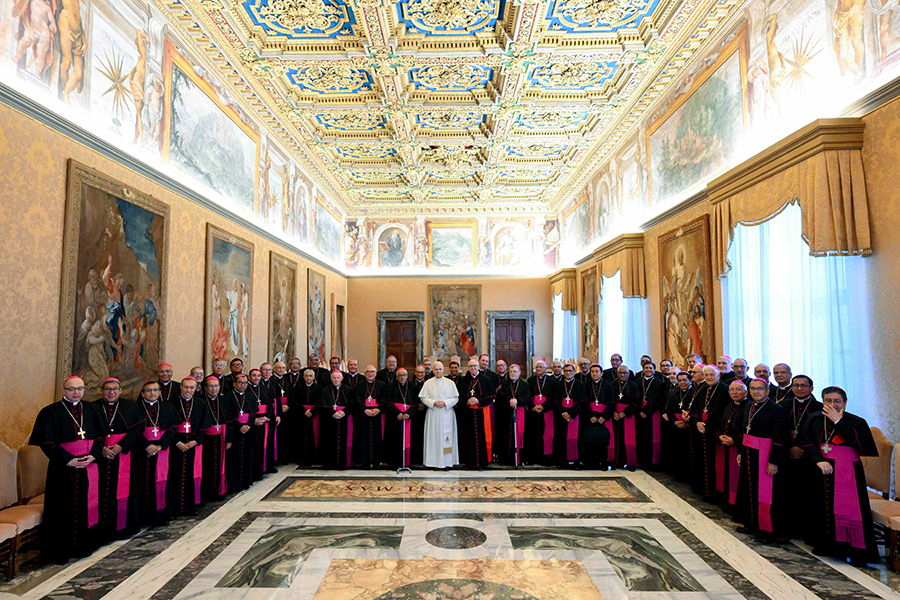
Every diocesan bishop in the world is obliged to make a pilgrimage — every five years — to pray and offer Holy Mass at the tombs of the apostles, Peter and Paul.
It’s an ancient tradition for bishops to make themselves pilgrims at the tombs of those holy men, in the Roman basilica of St. Peter and St. Paul Outside the Walls. And that tradition has been for centuries a normative expectation.
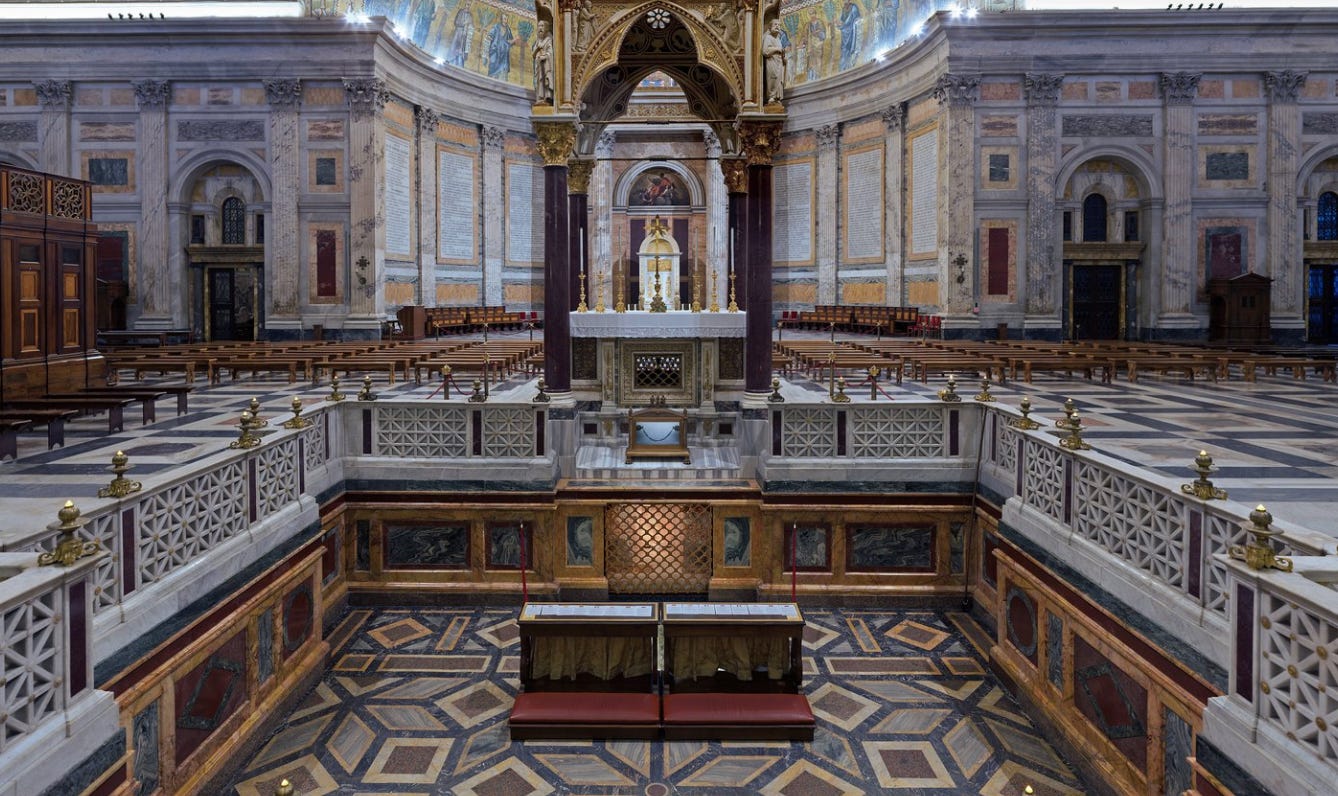
Today, that pilgrimage happens during the ad limina visit of every diocesan bishop to Rome, which is supposed to take place about every five years.
We tend to think of the required ad limina visit to Rome as a meeting with the pope — and, indeed, the diocesan bishop is required to “present himself” to the pontiff every five years or so.
But in a certain sense, we’ve tended in modern times to invert the meaning of that ad limina — framing it as mostly a meeting with the pope, with some liturgical stuff tagged in.
In fact, the liturgical thing is listed as the first obligation in the Code of Canon Law — that each diocesan bishop is required “to venerate the tombs of the Blessed Apostles Peter and Paul,” (usually venerating by offering Holy Mass) and to see the pope while he is there.
That matters. It’s a customary and legal reminder that our communion is sacramental, liturgical, and mystical — that the deepest kind of unity between us is the unity of the altar, at which we’re unified with the entire Church — on both sides of eternity’s veil.
Affective unity — “getting along” — is a fine thing, but it’s not real or lasting unless it comes from the unity which matters most: Our common call to worship God at the altar, and at Calvary.
Today’s the customary feast of the Dedication of the Basilicas of the Apostles Peter and Paul, both of which were built in the fourth century, over the tombs of the apostle saints.
May those apostles intercede for their successors, the bishops of today, and may that intercession bear courage, zeal, and Christian unity to the Church.
—
Today, too, by the way, is the birthday of my beloved, Mrs. Flynn.
Kate is an extraordinary woman, in whom I grow in deeper admiration and esteem with each passing year. God has given our family a vocation which requires near limitless patience, and she has it, to say nothing of ever-creative and generous love. Pray, if you would, that she be given ever deeper joy — the very type she brings to those of us who love her.
Here’s the news.
The news
The concession momentarily resolved a somewhat murmured question among the U.S. bishops about the exact procedure for resolving tie votes — of which there have been three in recent years — but only for the short term, as the conference has had inconsistent approaches to tie votes in years past, and the question will have to be addressed more concretely at some point.
But as to Sis — the bishop told The Pillar this week that he resigned the office as the result of a “kairos moment” of spiritual discernment, and his sense that Sample “is far better suited to lead that committee than I am.”
Sis emphasized to The Pillar that he made the decision in prayer:
“Archbishop Sample and I are brothers in Jesus Christ. We both pour out our lives in service to the Kingdom of God. Both of us had our desire and interest to serve the Church and the world in this very important way as chairman of that committee, but we both approached the matter with prayerful surrender to the will of God.”

You shouldn’t have to pick between getting things done and living a full Catholic life. With The BIG Catholic Planner and Calendar, you don’t have to. Its 3-phase planning funnel helps you identify responsibilities and get tasks done, all through the lens of the life of the Church. Pillar readers get 20% off with code PILLAR at BigCatholicCalendar.com for a limited time.
Rumors hit the internet Friday that the apostolic nuncio to Great Britain had announced among the Welsh and English episcopate a coming “relaxation” of Traditionis custodes, the 2021 Francis motu proprio which the use of preconciliar liturgical texts.
Not content with rumors, The Pillar got the facts — sources in the UK told us that the nuncio had indeed communicated to bishops a papal vision for a more “generous” application of Traditionis custodes.
Going forward, the pope’s general approach seems to be “Todos, todos, todos - including devotees of the TLM,” one source told The Pillar.
And if you’re looking for confirmation of its veracity, look no further. Soon after our report was published, the apostolic nunciature of Great Britain issued a “communication” expressing “regret for the unauthorised disclosure of information from [a] confidential meeting.”
This is not, in other words, a denial. It is instead a lamentation that what the nuncio told the bishop made it to other Catholics so quickly. But on a subject with as much intense interest in this, who can be surprised?
How the pope’s plan for “generous” application of TC will play out remains to be seen — and, in fact, the nuncio’s remarks suggest about a dozen unanswered questions regarding specifics. But a change of approach seems manifestly to be forthcoming, so let’s see what happens.
—
For as long as it’s been doing its thing, the U.S. bishops’ conference has been maligned as a basically partisan operation — tagged variously as “the Democratic party at prayer,” or “the liturgical wing of the GOP.”
I’ve been clear that I think the partisan accusations are reductive of a complex social institution.
But I’ve always kind of chuckled at those descriptions for another reason: Because, for most of the general public, the “at prayer” element of the bishops’ conference is not especially visible.
Sure, public meetings start with prayer, and end with it too, but the ordinary and prosaic deliberations of the bishops’ conference seem usually more administrative than mystical.
This report brings you a sense of the liturgies, chapels, and sacramental life of the bishops gathered in Baltimore — and some insight into how bishops themselves experience that liturgical life.
It’s a good read, and you should check it out.
The Archdiocese of Cologne and the Diocese of Regensburg confirmed Nov. 14 that they agreed with Bishop Stefan Oster of Passau’s detailed critique of the bishops’ conference text, and would seemingly not be implementing its recommendations in their own diocesan schools.
Read the latest from Germany, right here.
After a string of meetings with Nicaraguan bishops, it’s reasonable to ask whether the Vatican is starting to shift its approach to the country, in which the Church has been almost completely silenced by ongoing regime persecution.
In an insightful analysis, Edgar Beltran asks exactly that.
Cheer, Cheer for Old Notre Dame?
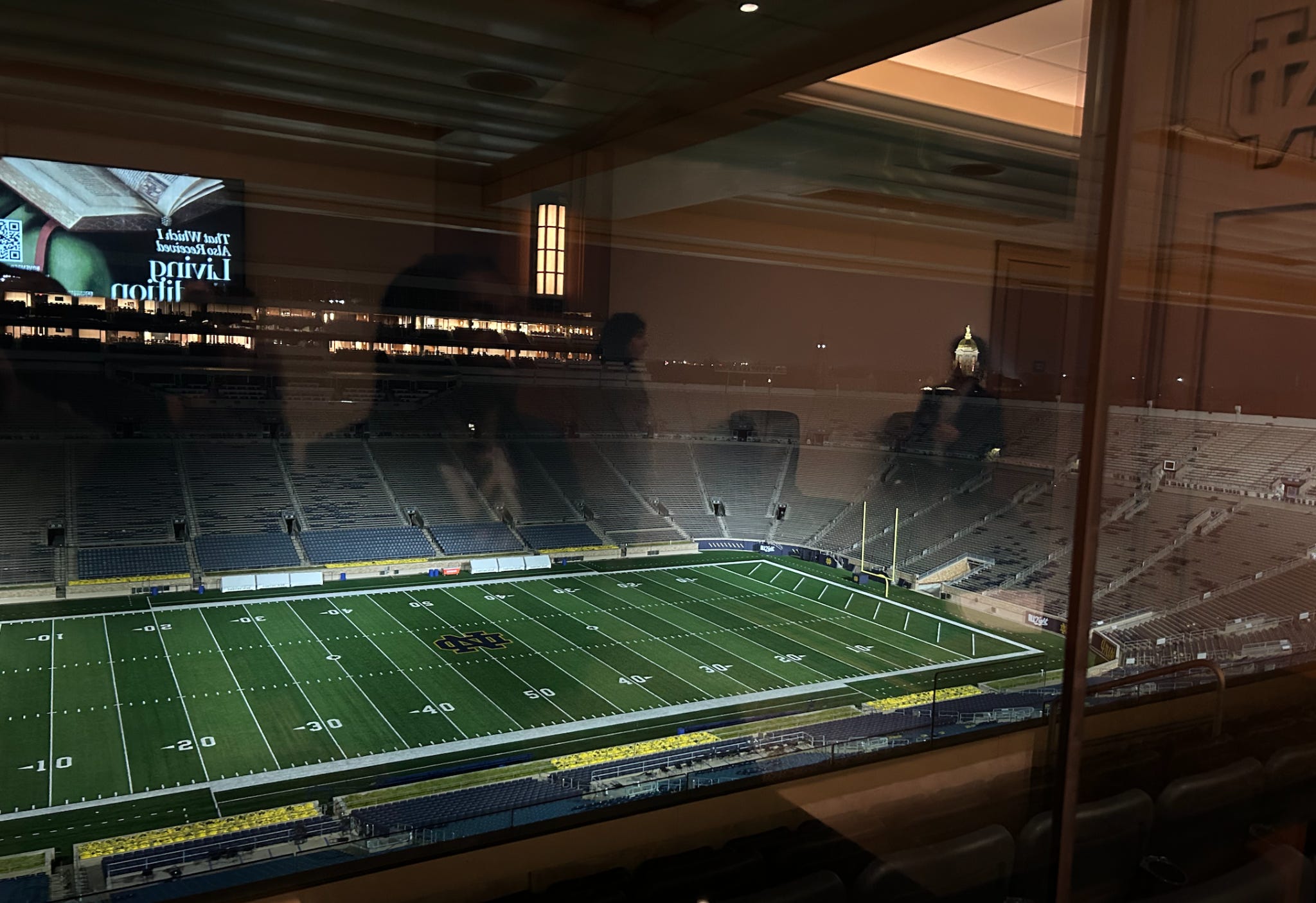
Ed and I spent the last weekend in South Bend, Indiana, on the campus of Notre Dame, for the fall conference of the de Nicola Center for Ethics and Culture, at which we were invited to produce a live podcast.
I came from Baltimore, but Mrs. Flynn was generous enough to fly out with our children, so we could spend the weekend together on the beautiful autumn campus.
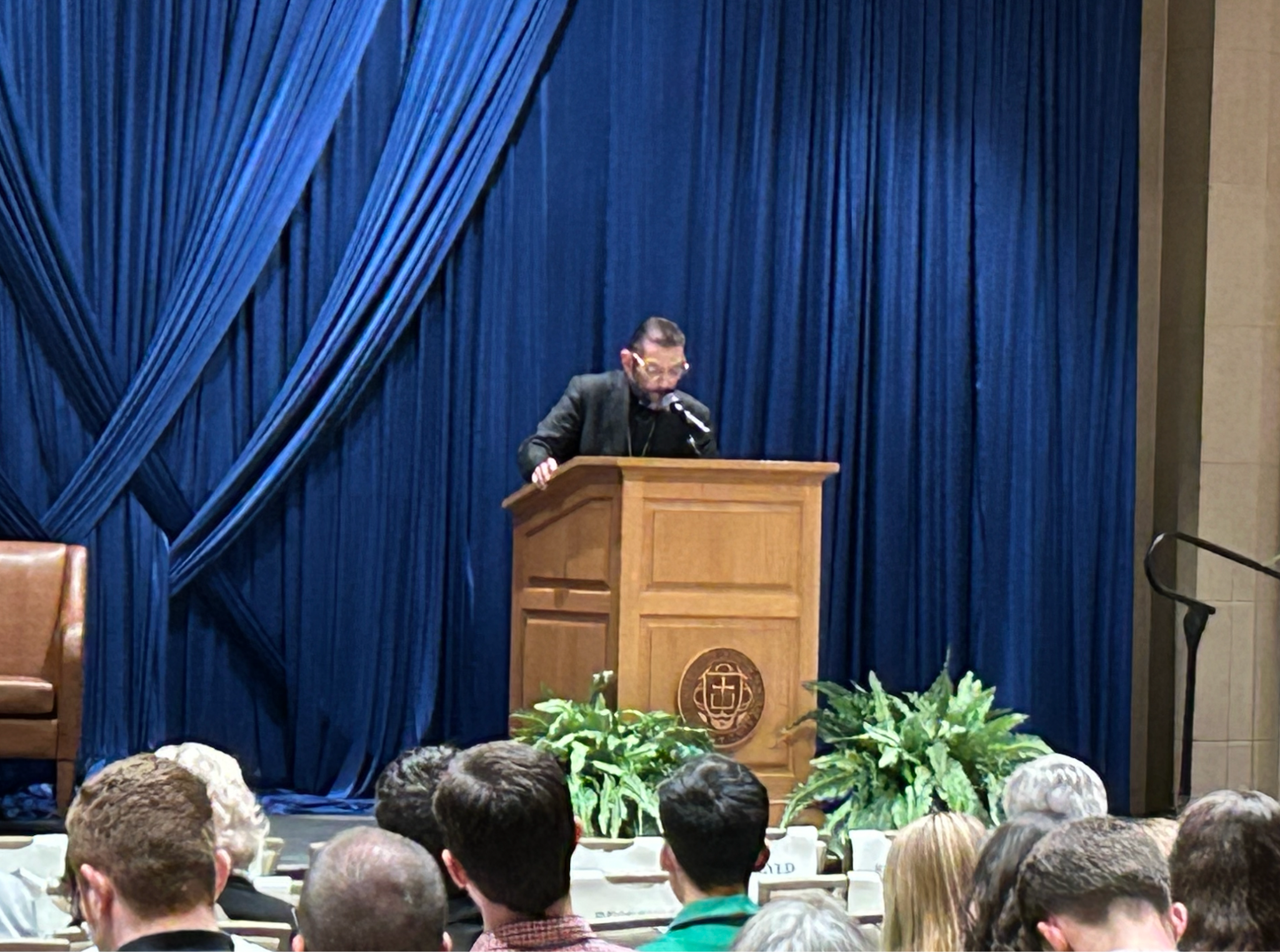
The conference was extraordinary, fertile ground for real and deep conversation — and everywhere I looked, I met some Catholic intellectual or evangelist whom I deeply admire, who had come to speak at the conference — all of which was anchored by a magnificent address, an actually mystical work of theology, from new USCCB vice president Bishop Daniel Flores.
I spent much of the weekend pointing out to my kids or my wife the Catholic writers and scholars I was excited to meet. By Sunday morning, they’d probably had enough. Which is why, when I noted at brunch that a U.S. Supreme Court Justice was seated two tables from us (not in for the conference, I don’t think), my 8-year-old said succinctly: “Well, go meet him or not, Dad, but don’t spend our whole breakfast just talking about it.”
I’d been to Notre Dame only briefly, once before, and this was a much more positively memorable occasion — I’ll tell you why in just a bit — but I spent most it trying to better understand a Catholic university which looms large in the imagination of many American Catholics, even those of us who had never even considered attending it.
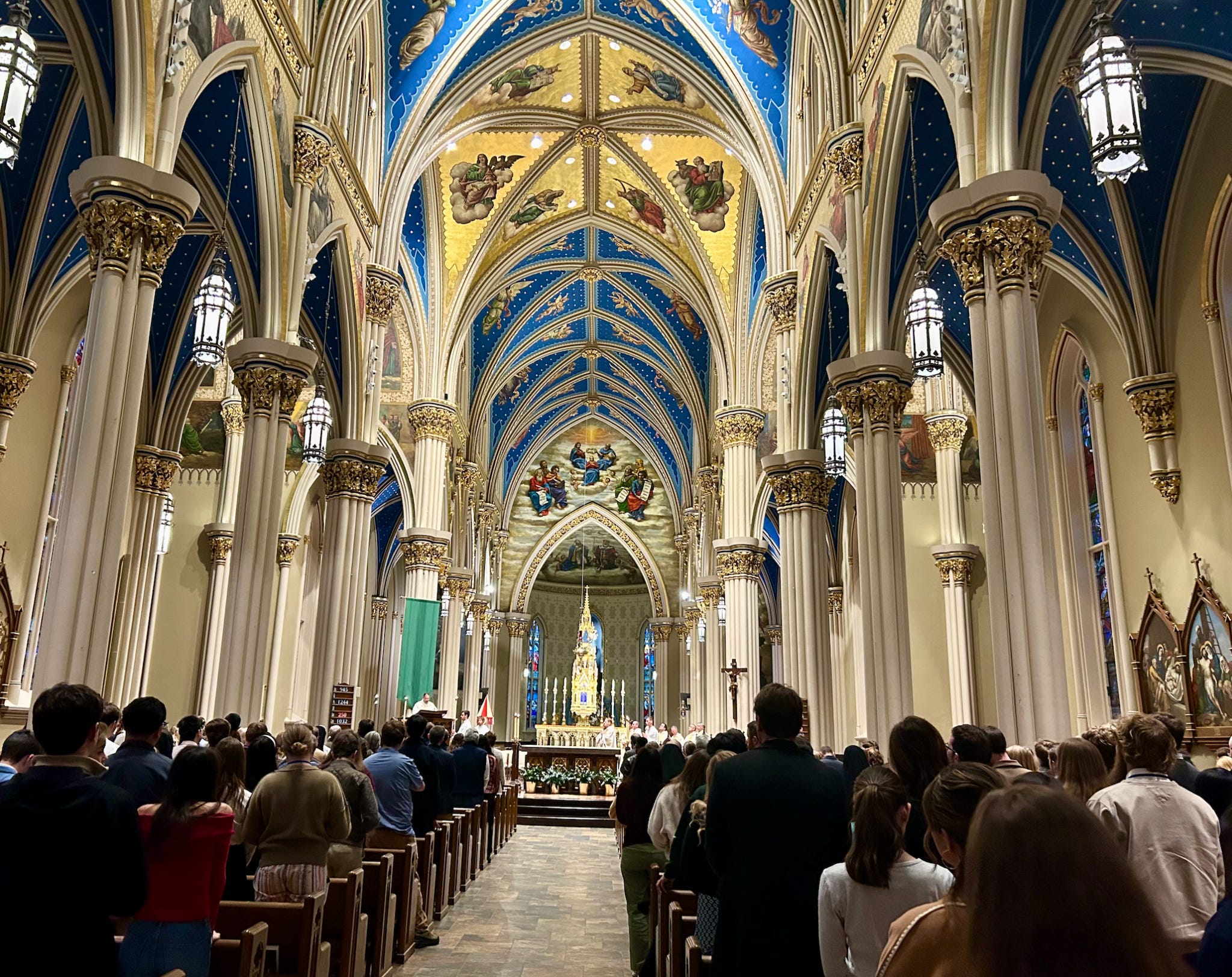
Domers love talking about Notre Dame, so I asked most of them to explain it to me: Is Notre Dame the robust, evangelical, and deeply Catholic culture I experienced at the de Nicola conference, or is it the place with a shaky Catholic identity which I so often read about, giving awards to pro-choice politicians, downplaying its own Catholic character, and giving academic space to a student group which hosts Catholics for Choice and distributes “Safe Sex Bags” on Halloween?
Which place, I wanted to know, was the primary part of Notre Dame — the beautiful basilica, which I saw absolutely packed with students, or the reverence paid to the “other cathedral” across campus, Notre Dame Stadium?
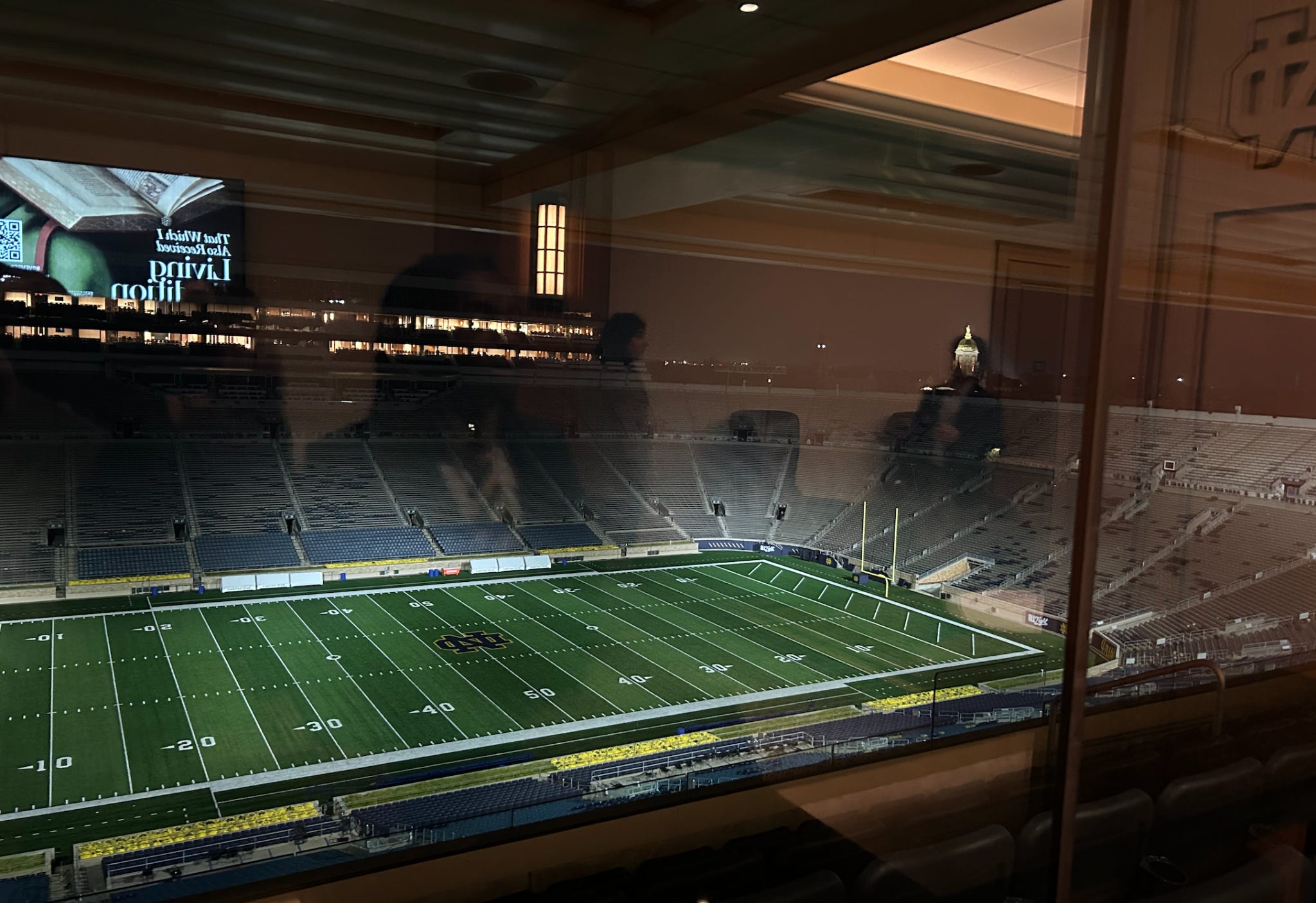
Students told me about the 70 kids in campus RCIA this year, about a robust freshman course focused on the “good life,” and about high attendance at dorm Masses across campus.
But they also told me about having to “fight for their faith” in an environment where practicing Catholicism felt often challenging, and some students, at least, said their faith put them at odds with the university’s chosen campus and academic culture.
—
My own bias is toward the small Catholic colleges in which undergraduate studies form nearly a kind of “lay novitiate” — a deep and intensive period of personal and spiritual formation, alongside the academic.
I’m not naive about the kinds of problems at those kinds of schools — I’ve reported about them frequently. Those problems need attention and accountability. But I do think a model of a small liberal arts Catholic college with an acknowledged aim of serious Christian formation can be transformational — because I’ve seen it.
So when I went to Notre Dame, I found myself wondering whether the university — as a uniquely Catholic apostolate — was leaving a uniquely Catholic imprint on the 9,000 undergraduates on the campus, and whether that impact would translate for many into lifelong discipleship of Jesus Christ. In fact, I found myself wondering if that’s possible at a place as big as Notre Dame, and one as freighted with its complex layers of American cultural significance.
I still don’t know.
Having spent the weekend asking questions, I have both a much deeper appreciation for Notre Dame, and many more questions.
And, if I’m honest, Notre Dame is the first place about which I’d like really to write a book-length treatment, a kind of year-long immersion in the place, in which I try to understand it more fully.
For now I can say that we — Ed, and me, and my family — were welcomed very warmly, by Pillar people, and by a community of people who are firmly committed to Newman’s idea of a university, the Church’s vision of higher education, and a desire for holiness. They are bringing those things to bear in their work at Notre Dame, in encouraging ways.
In that sense, I hope we get to go back.
Especially because my first visit was so lamentably memorable.
Longtime readers of The Pillar might recall my tumble, in June 2023, as I walked a pilgrimage route across the Diocese of Fort Wayne-South Bend, a tune-up for the National Eucharistic Pilgrimages.
I fell off the road while I prayed the rosary, and my ankle swelled up like a piece of sun-baked roadkill. I wrote then that I finished the day’s walk, had some drinks, and made my way the next morning to a physician.
But here’s what I didn’t tell you.