











Can the USCCB move from accidents to great ideas?

When Cardinal Blase Cupich announced Monday that he would not give an award next month to Illinois Senator Dick Durbin, he also offered a statement explaining why he’d offered the award in the first place, and what he hoped would come after a contentious row over the affair.
The cardinal’s statement gave insight into his vision of the Church’s mission to evangelize — a vision that is not likely shared by most of the U.S. episcopate. The distinctions are more than a matter of style or emphasis — it is instead an essentially different vision of how the Church’s voice should speak in the modern world. And it represents one side of an undercurrent which has been part of the Church’s life since the Vatican Council II.
But while differing visions of the Church’s mission can be credited with many of the dustups between bishops in recent years, debate among the bishops often focuses on the accidents at play, rather than essential questions over how the Church understands herself and her mission.
In the aftermath of the Durbin dispute, it is worth asking what might happen if bishops stopped debating the accidents, skirmish after skirmish, and had more substantial conversations about their understanding of what the Church is tasked with doing.
—
Cardinal Cupich’s Sept. 30 statement has won praise even from his most frequent critics for an assessment of the American political landscape in which “Catholics find themselves politically homeless.”
“The policies of neither political party perfectly encapsulate the breadth of Catholic teaching,” the cardinal wrote, lamenting that partisan divisions among Catholics “undermine our calling to witness to the Gospel.”
Cupich also recognized that “there are essentially no Catholic public officials who consistently pursue the essential elements of Catholic social teaching.”
But after making those points, the cardinal expressed a viewpoint far less frequently accepted among American Catholics, including bishops.
Emphasizing the aim of dialogue with Catholic politicians at odds with Catholic teaching, the cardinal explained that “praise and encouragement can open” a path for discussion, “by asking their recipients to consider how to extend their good work to other areas and issues.”
“More broadly, a positive approach can keep alive the hope that it is worth talking to one another--and collaborating with one another--to promote the common good,” Cupich wrote.
“No one wants to engage with someone who treats them as a thoroughgoing moral threat to the community. But people will engage with, and may even learn from, those who recognize them as making some contribution to a common endeavor.”
Cupich’s argument — that pro-choice politicians should receive awards for the sake of dialogue — expresses succinctly a baseline theological perspective on the role of the Church in the contemporary world. That perspective emphasizes that Catholics should engage in dialogue with a broad spectrum of people, in order to find common ground where possible, and to serve as a kind of leaven towards the common good.
In that vision, evangelization is the fruit of dialectical engagement and collaboration, emphasizing the good in the other, which might achieve some social good, inspire a reconsideration of entrenched positions, and, at the same time, convey a witness to a life of Christian discipleship.
That vision is drawn from and informed substantially by Gaudium et spes, the Second Vatican Council’s “pastoral constitution on the Church in the modern world.”
It is also the vision which informs the approach of many Catholic institutions in American culture — including many Catholic universities and colleges, religious communities, and a swath of the American episcopate.
Its critics say that approach does not actually lead to conversion, and rarely leads to fruitful collaboration for the common good, either. Instead, they say, it gives the impression that the Church capitulates sycophantically to contemporary culture, giving a kind of ecclesiastical approbatio to people or organizations which are not at the time called to conversion.
Cupich’s point was that he sees things differently, emphasizing that his “synodal” approach “would undoubtedly serve society by building up the common good.”
Among bishops, a more common perspective on evangelization and the Church’s mission is one that emphasizes a Church which is both in the world and somewhat apart from it, whose principal evangelical function is prophetic — speaking truth, as it were, clearly and unambiguously, in a world of confusion, and calling individuals directly and explicitly to repentance, conversion, and discipleship.
That emphasis is influenced by the vision of the Church’s evangelical mission as articulated in Lumen gentium, the Second Vatican Council’s dogmatic constitution of the Church. It is more typical among bishops, at least in principle, and among many newer movements and apostolates in the life of the Church.
Its critics say that approach can devolve into “culture war” rhetoric, or be reductive of the Catholic faith to rigorism or triumphalism.
Those visions and emphases in evangelization have been in tension with each other since the close of Vatican Council II. And they underscore many of the debates bishops have at the USCCB, and much of the tension between them on ecclesiastical issues. They also undergird many of the tensions between various institutions and tribes among American Catholics, even if they go unspoken.
Those competing visions are not even especially recognized by the Catholics who hold or the other position, especially when conversation about Catholic ideas and culture are dumbed down to ideology and soundbites.
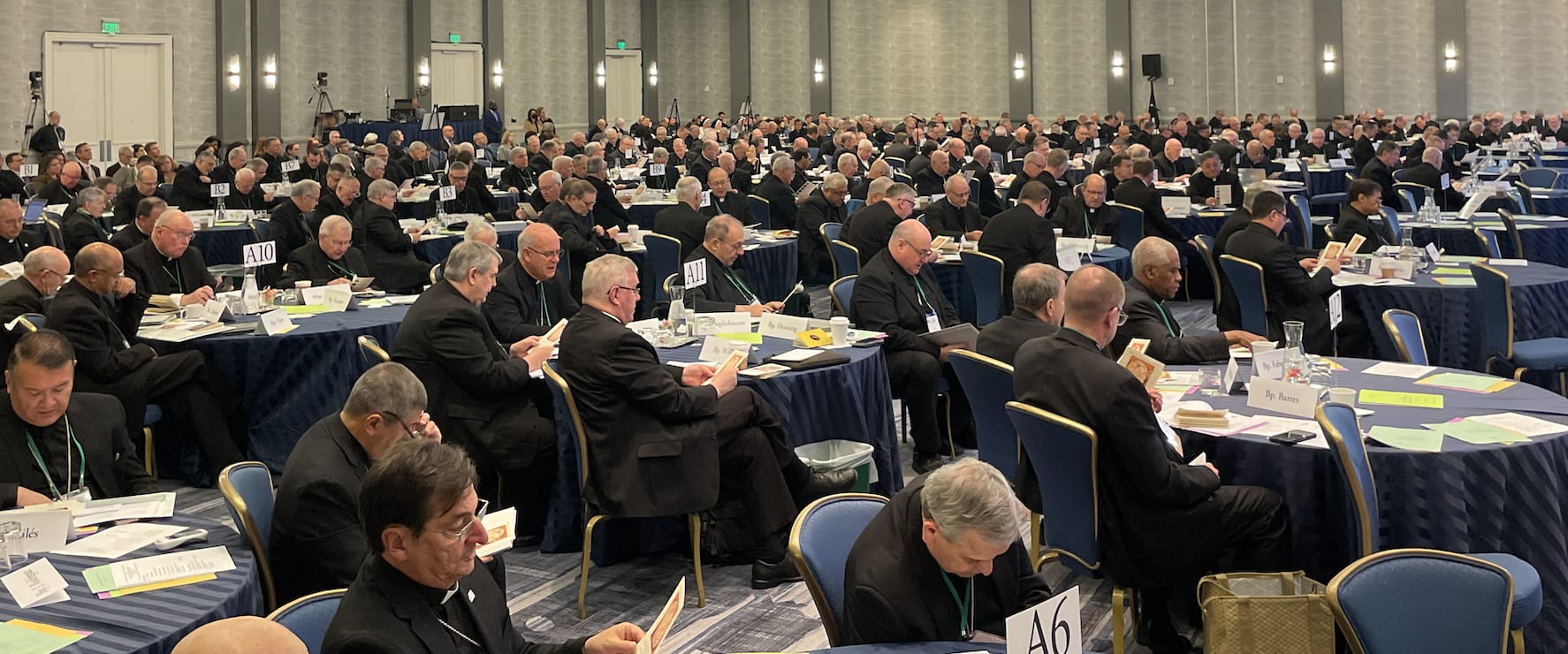
But that they go unspoken may be a missed opportunity for bishops. When they gather in November — and as bishops revise their Faithful Citizenship document in months to come — they will invariably be divided by differences of perspective and emphases.
But their debates will mostly focus on the accidents of those issues — on the specific personalities and issues at play, rather than the competing philosophies which undergird them.
That might sell the potential of the bishops’ conference short. Debates about the accidents tend to devolve into tribal or polarized point-scoring, an “us vs. them” mindset which the conference’s leaders have said they want to overcome. Further, that approach has tended to take the conference from issue to issue, skirmishing here and there — but never getting to the heart of the things which divide them, or the ways in which they might actually learn from one another.
It is worth considering whether Cupich’s Durbin award opens a new door — for the conference to schedule time for the bishops to talk more concretely about the methods they propose for evangelization, and the fruit they’ve seen, and at least by that to come to some understanding of each other.
The conference may be wary of such an open conversation. But some episcopal leaders may well propose that such discussion is what synodality is supposed to be.
A synodal model of conversation could well involve — apart from any specific issue — presentations from some leading bishops on their sense of the Church’s evangelical mission and methodology, followed by table discussion or even debate, with no express purpose other than to identify and acknowledge the varying emphases of the episcopate’s missiology.
Great men discuss great ideas.
The alternative is talking about little things, in little ways, without acknowledging the moving forces behind them — a pattern that seems to be set on repeat among American bishops.
Could a different approach bear different fruit? It would have to be tried to be sure.