







Can’t go to Assisi? Visit a US replica of the tiny church where St. Francis founded order

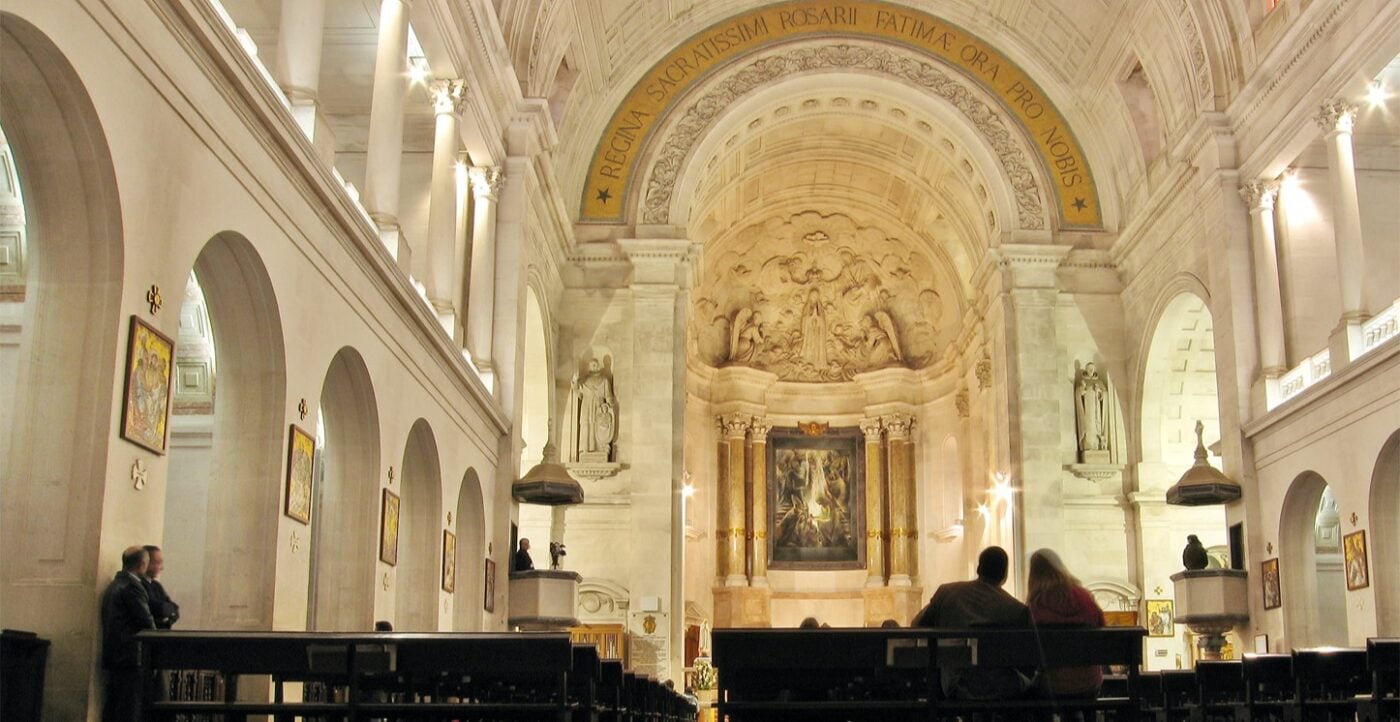
(OSV News) — In Assisi, one of the main pilgrim draws is a tiny church dwarfed by its expansive surroundings, the Basilica of St. Mary of the Angels near Assisi, Italy.
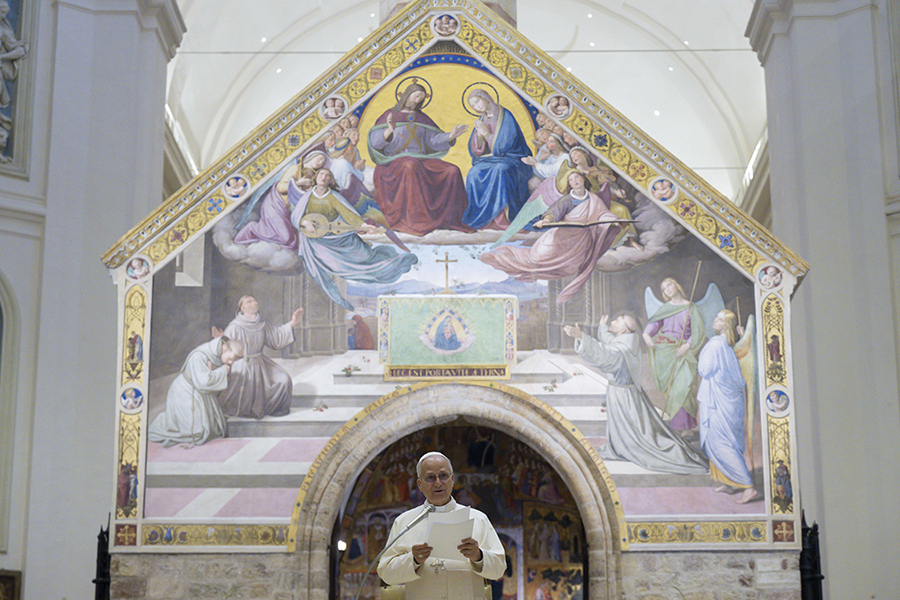
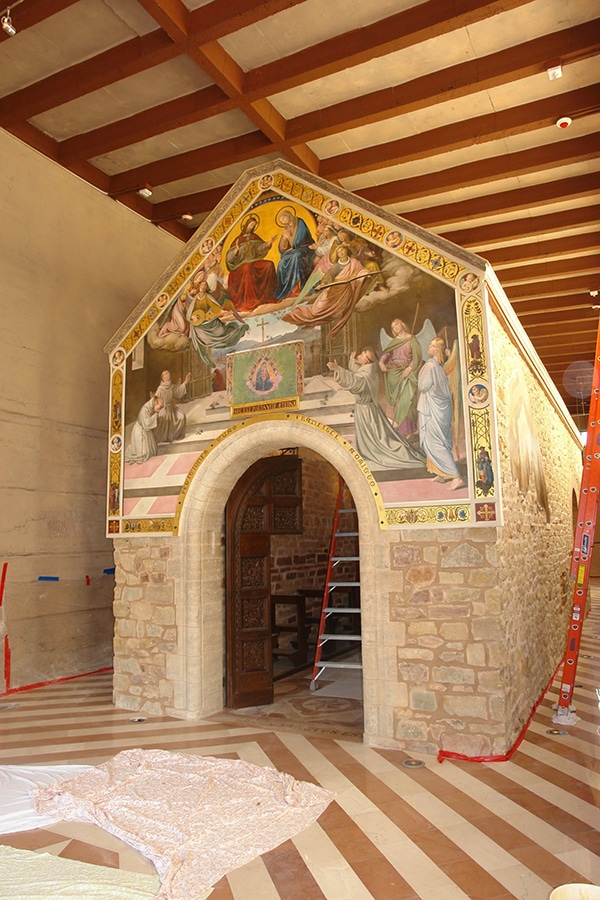
The chapel is just about 18 feet long by 10.5 feet wide, built of tawny colored stones and rustically plain, with the exception of its fresco-decorated upper facade. In the much larger basilica, this unusual church-within-a-church draws multitudes of visitors who jostle for space to spend a few minutes contemplating its austere interior.
Such a small and simple place of worship might be easily overlooked elsewhere, but this one is exceptional — it is the Porziuncola (“little portion” in Italian), and it is considered to be the birthplace of the Franciscan order, founded by St. Francis of Assisi in 1209.
The original Porziuncola — which is also known by its Latin name, “Portiuncula” — takes on particular significance as a pilgrimage destination during the Jubilee Year of St. Francis underway. However, for Americans not traveling to Italy, there are a surprising number of replicas of the famous and holy structure in the United States.
Father Robert “Bobby” Barbato suggests that the Porziuncola at the National Shrine of St. Francis of Assisi in San Francisco, where he is rector, is about as close as a person can get to the real thing. It was dedicated in 2008 by Cardinal William J. Levada, the former archbishop of San Francisco who at the time was prefect of what is now the Dicastery for the Doctrine of the Faith.
Just don’t call the shrine chapel a “replica,” or you’ll answer to the woman Father Barbato both credits with its construction and calls “a force of nature”: attorney and politician Angela Alioto, daughter of San Francisco Mayor Joseph Alioto, who served the city from 1968-1976.
“I don’t think anybody else could have gotten this built,” said Father Barbato, noting Alioto’s fierce devotion to St. Francis. “But she doesn’t like it to be called a replica,” he added, suggesting the word conjures visions of Disneyland.
“It is an exact copy. It’s exactly what you would see if you walked into the big shrine in Assisi — except it’s slightly smaller; 78% size. The reason is because of the size of our building — you’ve got to make it fit. If they reproduced it exactly, there would be no room around it.”
Just as in Assisi, the chapel in San Francisco is found inside another structure, a parish facilities complex near the shrine church.
“People come here — some come on pilgrimage; some don’t know it’s there — but almost everybody is kind of a little overwhelmed, in a good way,” Father Barbato said. “People come with all sorts of different things — joys and sorrows.”
Special events are planned to mark the Jubilee Year of St. Francis, including for the first time on U.S. soil an Oct. 16-Nov. 28 exhibit of relics of St. Francis at the nearby Cathedral of St. Mary of the Assumption.
“Every year, we do the Transitus,” Father Barbato said, referring to ceremonies marking St. Francis’ death. “And this year, we’re going to try to do a really big one, starting in the shrine’s main church and then processing down to the Porziuncola.”
An indulgence is also available. “Pope Benedict XVI gave us the Porziuncola privilege, which means — apart from the indulgence of this beautiful year of St. Francis — that any pilgrim, once a year, on the day of their choosing, can make a pilgrimage to our Porziuncola, and fulfill the conditions to receive the plenary indulgence,” shared Father Barbato. “So it’s a great gift.”
St. Francis is said to have experienced a mystical vision of Christ in the original Porziuncola, then a neglected chapel. There the image of Jesus on a Byzantine-style crucifix chapel urged him, “Francis, Francis, go and repair My house which, as you can see, is falling into ruins.”
Taking the divine injunction literally, Francis asked permission of the chapel’s Benedictine owners to repair it, which they granted.
After building a small hut nearby, he busily went to work. Francis was soon joined by others — who would become the first Franciscans — and around 1211, the Porziuncola was given to Francis on the condition that it be the motherhouse of the new order.
In the U.S., replicas can be visited at Mayslake Peabody Estate in Oak Brook, Illinois (currently closed); the Franciscan Monastery in Washington; the Assumption of the Blessed Virgin Mary Province of Franciscan Friars in Burlington, Wisconsin; the Regina Center in Sylvania, Ohio; the campus of the Cardinal Cushing Centers in Hanover, Massachusetts; and the Franciscan University of Steubenville in Steubenville, Ohio.
Father Jonathan St. Andre, a Third Order Regular Franciscan and vice president for Franciscan Life at the Franciscan University of Steubenville, said a friar returning from an Assisi journey first proposed the idea to build a replica at the school.
“It was completed in October of 1987, and soon, it just became a very special place on our campus,” Father St. Andre told OSV News.
It is a site of perpetual adoration, and even marriage proposals.
“It’s just a very simple chapel,” Father St. Andre said. “Our Porziuncola probably holds about 15 people at the most. Students will come in and sit on the floor. At all hours of day and night, there’s always students there.”
It also stands outdoors, which caused Father St. Andre to reflect on the original Porziuncola.
“I sometimes wonder what St. Francis would think if he came back and saw this church of his inside a huge basilica,” Father St. Andre said. “But that’s OK. It was such a sacred place for him, and it kind of speaks of the poverty of St. Francis.”
So just what is it that makes the faithful want to build copies of sacred places?
“It’s in human nature to re-create something that we’ve known from another place,” Duncan Stroik, an award-winning architect and professor of architecture at the University of Notre Dame, told OSV News. “And of course, people — and especially modern people — love photographs or images of the places we visit, (and) people that we know and love. I think it’s the same impetus to re-create buildings or parts of buildings in other places.”
The Assisi Porziuncola, Stroik observed, “becomes a bit of a relic. It’s a sacred place. We think of relics being in monstrances, and we value the bodies of the saints — the things that have touched the saints or that they used, their garments. And we value, in this case, the buildings where holy things happened.”
Ultimately, the Porziuncola — whether the original or a replica — is a place people feel close to St. Francis and God.
“For Francis, that little church was a thin place,” emphasized Father Barbato, referring to locales where the distance between heaven and earth is thought to be narrowed. “He felt our Lord there, and he felt the intercession of Our Lady — and that’s why he made it the headquarters of his order.”
read more saints