





Cardinal Koovakad: ‘Religions are part of the solution for global conflict’

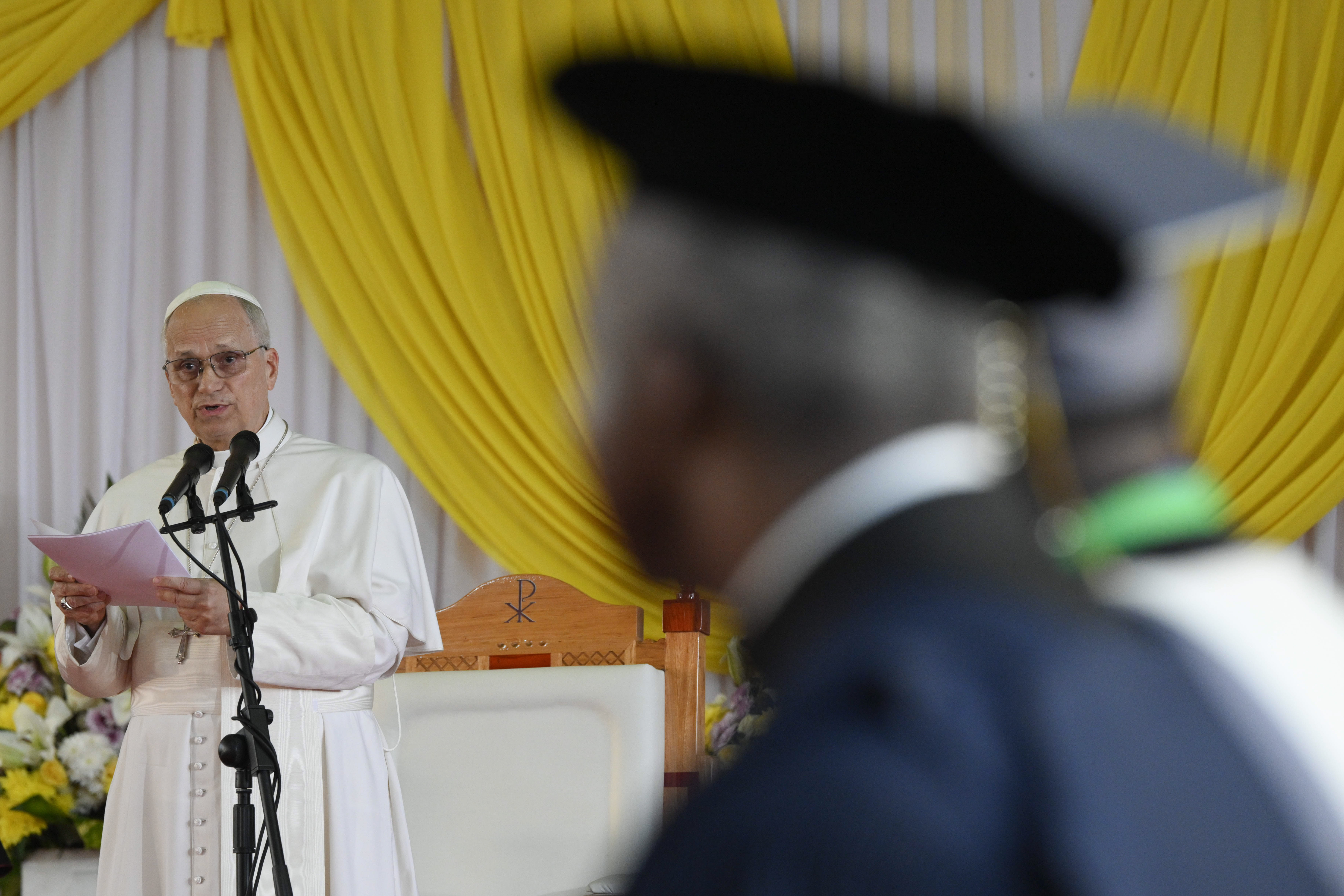
In a wide-ranging interview, the prefect of the Dicastery for Inter-religious Dialogue, Cardinal George Koovakad, spoke with The Pillar last week about the importance of Nostra aetate 60 years after its publication, and the role religions can play in defusing global tensions.
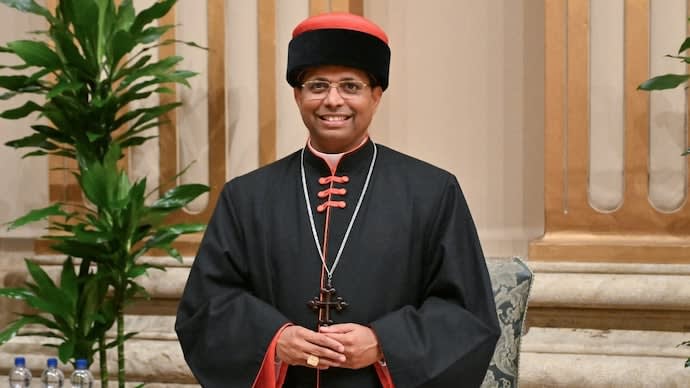
Cardinal George Koovakad also addressed the ongoing liturgical dispute within his own Syro-Malabar Church and the role of Eastern Catholics in Vatican administration.
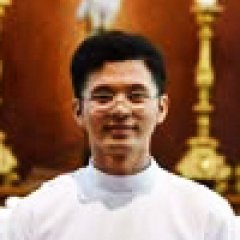
Koovakad is 52 years old. He was ordained in 2004 and joined the Holy See’s diplomatic service in 2006. In 2020 he joined the staff of the Secretariat of State and was responsible for organizing papal trips. He became a cardinal in 2024, in the last consistory held by Pope Francis.
In January 2025, Koovakad was appointed prefect of the Dicastery for Inter-religious Dialogue, and is also a member of the Dicastery for Eastern Churches. He participated in the Conclave that elected Pope Leo XIV in May.
The interview took place on the sidelines of a short visit to Portugal, and has been edited for length and clarity.
Nostra aetate — the Second Vatican Council declaration on non-Christian religions — turns 60 this year.
Is it still a good foundation for Catholic dialogue with other religions, or is it too dated?
That’s right, we are about to celebrate the 60th anniversary of Nostra aetate. This Second Vatican Council document was an important turning point with regard to the attitude of the Catholic Church towards other religions, to respect what is sacred and good in other religions, and to move forward together for peace and harmony in society. So that spirit of Nostra Aetate, that openness, is fundamental. It was a seed, but now it has become a tree!
It began with Pope Saint John XXIII, but then with Paul VI’s Ecclesiam suam, and then Pope John Paul II and the important meeting at Assisi, of which we will celebrate the 40th anniversary next year. Then Pope Benedict, of course, contributed again to the need of continuing this dialogue in charity. And Pope Francis, it goes without saying! We need only think about the Document on Human Fraternity for World Peace and Living Together, signed at Abu Dhabi in 2019.
And Pope Leo XIV is continuing in the same spirit that Nostra aetate brought. So really, Nostra aetate is very important, fundamental even, for inter-religious dialogue as far as the Church is concerned.
Pope Leo will take next month his first international trip to Turkey, which is a major player in the Muslim world. And then he is going to Lebanon, which is also, of course, a very important country in the Middle East, as a focal point for relations between Christians and different forms of Islam.
What are your expectations for this trip, from an inter-religious point of view?
Pope Leo is going as a pilgrim of peace. Since his first message, the first day when he addressed the people, he has been quoting the same message of Jesus: “Peace be with you”.
As we know, Pope Francis had the intention of going only to Turkey, because of the ecumenical importance of the 1700th anniversary of the Council of Nicaea. But now Pope Leo XIV is the new Holy Father and so it became his first state visit, and it has both an ecumenical and inter-religious aspect.
Lebanon was not in the original plan, so this is the desire of Pope Leo XIV and I am sure that it is to address the message of peace and the need of peace in the Middle East, especially, and in the whole world.
There’s Vatican dialogue with many different religions, but for obvious reasons, dialogue with Islam is prominent.
But Islam, especially Sunni Islam, has no central authority, so how do you choose who to dialogue with? Does it make sense to dialogue with just anyone, or are you selective in who you meet with?
As a dicastery, we are open to dialogue with any group of people, or religious groups. But regarding how we choose, it is a concerted activity, we coordinate together with the local churches, with the bishops’ conference, and also with apostolic nunciatures worldwide. We take all this into account, because some people or religious groups may not be very significant worldwide, but in a certain country, in a certain situation, they are important.
So we always listen to that advice and according to the suggestions we receive, we take our own steps forward. But very often now, especially due to Pope Francis’ pontificate, many groups are interested in reaching out to us, and we promote that.
There is much debate among Muslims about the true meaning of Islam, and the correct interpretation of the Quran, for example.
Does your approach to dialogue express an opinion on those issues?
Inter-religious dialogue means that, with respect, we try to foster good relationships. It is walking together, with respect. And the important thing is to bear witness of believing in God. We all believe in God.
When it is in regard to [other] religions, we do not enter into [their] doctrinal discussions, because each group believes that what they believe is the truth. So, we don’t want to enter into that sort of discussion.
There are things in common, perhaps more things in common than there are things that divide us, and it is important to explore these together.
And there are things which are universal: that religion is a relationship with God, and a religious person cannot provoke or condone violence, cannot kill in the name of God, cannot promote terrorism, or use religion for personal interests. So, there are common things that we can work on together, and make this world a better place.
You grew up in India, which is a very religiously diverse country.
How exposed were you to Hinduism and to Islam? Did that prepare you for this job?
Yes, I was born in India, in a multicultural and multi-religious setting. And from my childhood days, I had friends whose families were from other religions, especially Hinduism and Islam.
I often think that it is incredible how His Holiness Pope Francis made me cardinal! I never in my life expected it. But now I can say that it was really a providential decision that was made by His Holiness that now I have been given this responsibility for the Dicastery for Inter-religious Dialogue.
You have an insight into Hinduism that most clerics would not have.
Have you had the opportunity yet to dialogue with Hindu leaders?
I have had some experiences recently, but I would say that more than an official inter-religious dialogue I have had the experience of a dialogue of life, growing up without prejudice. It makes you believe in inter-religious dialogue, in forging relationships.
Nowadays, we see an increase in prejudice, labelling people as this or that. That is not correct, it is injustice. We have to really experience first-hand and understand the people, and the drive to do that is something that I got naturally from my life experience.
We’ve seen both Muslims and Christians in India complaining of a rise in discrimination in recent years.
As an Indian who is prefect of this dicastery, do you think you might have some role in dialogue with rising Indian Hindu nationalism?
With regard to that, we have to really distinguish between political issues and religious issues. When I became a cardinal the political authorities of India were extraordinarily appreciative of Pope Francis’ decision. It was surprising for me how well received it was.
So I don’t feel that there is such a contrast or contradiction in that sense. Often religions are not the cause of conflicts, they are manipulated for some interest, which can be political or personal.
The manipulation of religious sentiments — that is the problem!
But in that case, do you think that government manipulation of Hinduism in India is part of the problem at the moment?
I don’t think so. At least, I do not have any personal experience that would make me think that. Because you see, many things that we hear from the media are not true. In the past there were episodes of violence, some incidents which were interpreted by some people as manipulation of religious sentiments. But in the end, we learned that it was not so.
It can be ethnic, it can be other political interest, or even personal interest when it is near to an election. But that is common anywhere. I do not have any special instance, or personal experience, to prove that.
Pope Francis said several times that a “third world war” has begun, but in pieces.
The world does seem to be marching into broadening conflicts. Can religions play a role in ensuring peace, or in helping to promote peace worldwide?
Religions are part of the solution for this type of conflict, especially in places where the majority of people are believers. Religions can play a role; they can facilitate ways to foster relationships and open pathways for dialogue.
And religious leaders have a responsibility to calm the situation, to call for peace, because if they instigate hate speech or add fuel to the fire, that can make the situation more complex and serious.
The problem is manipulation of religious sentiments, so it is the responsibility of religious leaders always to invite people who are in all walks of life – politicians, other professionals – to contribute to peace. I think that is our first and foremost responsibility to society.
A focal point of conflict in recent years has been the war in Gaza.
We seem to have the prospect of peace.
What is your reaction to this peace deal, and do you have hope that it will be lasting?
I really appreciate those who worked for this. The Church’s policy was to always try, and pray, for a solution, and it is praiseworthy that the president of the United States could play a major role in this peace deal.
At the same time, this also is very fragile. All those involved have to make sure that there will be a lasting peace. And as we can see, this is not a religious problem, that is clear in the way it was solved. So, it is the responsibility of all to respect each other, especially because in the end it is the poor who pay the price. We have a responsibility to the poor, to the children, the women, and to the future generations to build a peaceful society.
Although you work in the Roman Curia, you are a Syro-Malabar bishop…
Yes, for sure, because I am a son of Syro-Malabar Church, and I continue to be a Syro-Malabar cardinal. But at the same time my mission is for the universal Church as a cabinet minister, so to speak, in the central government at the Vatican. But that does not affect my identity.
For example, when I celebrate sacraments in the Latin rite, if I ordain new deacons, if I go to celebrate marriage, I need permission from the Dicastery for the Eastern Churches, and I always inform them — so that means I still belong to the Syro-Malabar Church.
In the end, we are a Catholic Church and it just shows the beauty of that unity and diversity — not only of different rites!
During the recent conclave I was reflecting on how we had cardinals from different parts of the world, like Papua New Guinea, Mongolia, East Timor. These places are so distant! And then there is me, from a village of India, with the Syro-Malabar Church, which is the second biggest church after the Latin Church, that was just providential!
Do you have any role in the Holy Synod of the Syro-Malabar Church?
No, I am not a member of the Synod.
When you were named cardinal there was some discussion regarding you and Cardinal Mykola Bychok, who is from the Ukrainian Greek Catholic Church, that this might create some tension within your particular Churches sui iuris, because your respective major-archbishops are not cardinals.
Did you ever feel any tension or discomfort?
No, I never experienced any tension. In fact, the current major archbishop ordained me as archbishop and I always received from him fatherly affection and support.
Immediately after my creation as cardinal, the [Syro-Malabar bishops] very kindly invited me to address the synod, and to exchange some ideas. So there was a good relationship from the start, and it remains so.
The Pillar has covered extensively the liturgical disputes within the Syro-Malabar Church, which seem to have reached a point of resolution.
Being a Syro-Malabar cardinal, and being in Rome, did you play any role at all in mediating and coming up with this solution?
This is an ongoing process, but it is not finalized yet. As for myself, being responsible for the Dicastery for Inter-religious Dialogue, I thought I should concentrate on my responsibility and let the Dicastery for Eastern Churches work on this, together with the Holy Synod.
So whenever either of them asked me, I gave my contribution, but I never took my own initiative because I think that I have to respect the process.
But you were asked?
Yes, whenever I was asked to give my opinion, I was happy to, because as I believe regarding my dicastery, it is only through dialogue that we can find solutions, and as far as I see it, this is like a family issue where each side believes that their position is correct. In a conflict it is like that, and we have to find solutions together.
I think they are in that process, although it is not over yet, I wish that soon there will be harmony so that we can give witness to our faith.
In recent decades, there have been very few Eastern Catholics appointed to lead Vatican dicasteries and offices. Do you feel that Eastern Catholics are underrepresented in the Roman Curia?
If we think only in terms of prefects, or key roles, maybe we could think that, but when we think about different services in the Church, such as the diplomatic service, there are many.
Of course, our work in the diplomatic service is not very visible. If I think only about the Syro-Malabar Church, we currently have a few ambassadors, and maybe 10 secretaries or counsellors working worldwide.
It is a slow progress, and the universality of the Church did become more evident with Pope Francis, as we know.
But it is moving ahead, and not by design, but just very naturally.