













DDF head: No plans to change canon law on polygamous unions
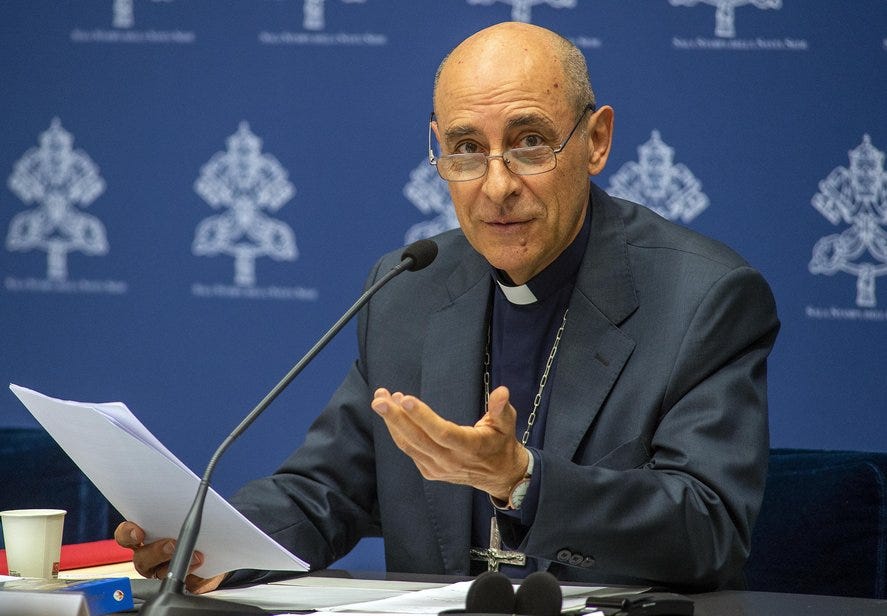
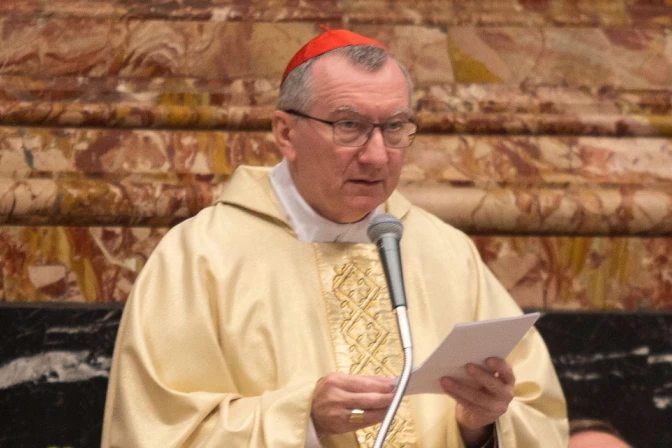
The Vatican’s chief doctrinal official said Tuesday that there are no plans to change canon law for addressing the situations of polygamous men entering the Catholic Church. And Cardinal Victor Fernandez told The Pillar that there remain unresolved questions about the pastoral challenges of polygamy in sub-Saharan Africa.
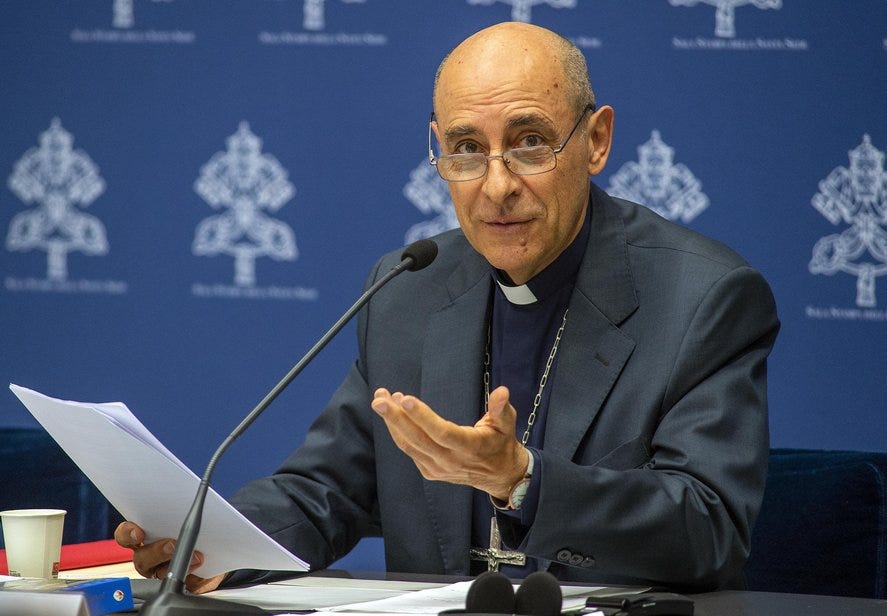
Speaking at a Nov. 25 press conference to present a new DDF document affirming the Church’s teaching on monogamy, Cardinal Víctor Fernández responded to questions from The Pillar by acknowledging concerns about the canonical praxis for regularizing polygamous situations.
But, the DDF prefect said, while the new text was in response to the pastoral challenges present in African societies, the doctrinal note did not set out to change canonical discipline.
The doctrinal note issued by the DDF on Tuesday, Una caro — “One Flesh,” in Latin — notes in a lengthy footnote that “studies on African cultures show that the different traditions attribute special importance to the first marriage” and “to the role that the first wife is called to play in relation to the other wives… The first wife, regularly married according to traditional customs, is often presented as the one given to the man by God, although the latter may adopt other women.”
“In the case of polygamy, the first wife is accorded a special place in performing sacred funeral rites or in raising children born to other women in the family,” it adds.
This footnote highlights a tension between social norms in Africa and canonical praxis, which allows a man to choose the woman with whom he will contract a valid union after being baptized.
While stating a preference for the first woman with whom he contracts marriage, canon law currently allows a polygamous man seeking baptism an effective free choice among his multiple “wives” in determining which union the Church will validate.
The bishops of Africa have long expressed concerns about that canonical discipline, and its potential for instances of public scandal and injustice as they work to address pastorally the reality of polygamy in African societies.
In an August document on the pastoral challenges of polygamy from the Symposium of Episcopal Conferences of Africa and Madagascar, the bishops called for “a necessary theological reevaluation” of the canonical praxis around polygamy. The bishops noted especially that, although canon law states a kind of preference for regularizing the first union into which a man enters, the main retains a choice among his “wives.”
“The possibility of choosing a wife left to the polygamous husband requesting baptism has been the occasion for many men to put their first wife ‘in the garage,’ preferring to marry a younger woman in Christian marriage for reasons that are certainly not always those of faith,” the bishops said.
“In pastoral reality, it is the first wives to whom the corruption of natural marriage has been imposed who have been most harmed” by the current canonical discipline, they said.
Asked by The Pillar about the footnote and current canon law on the subject, Fernández said that “the footnote is precisely a footnote because we didn’t want to develop this point in the text.”
“The text is about monogamy, not about polygamy,” the cardinal said. “But we thought that we needed to add this small note because the African bishops usually say that in the West we don’t make distinctions in these matters.”
Fernández explained that African bishops should be at the forefront of offering specific responses to the practice of polygamy, but that changes to canon law are not expected.
“Canon law will remain completely in force, we don’t deny it at all, it’s just that [the African bishops] have told us about very violent situations in small villages; we’ve had cases in which the man chose one woman, and left the rest on the street, in the desert, and the women even died of heatstroke, of hunger.”
“So, the idea is that this is done gradually, we must find a prudential solution that eventually leads to a monogamous union… But this can be better explained by the African bishops, but we added it to this note for this reason,” he added.
Polygamy is most common in sub-Saharan Africa, especially West and Central Africa.
In Burkina Faso, more than 1 in 3 people live in a polygamous household, including 24% of Christians. In Chad, 21% of Christians live in a polygamous home; in Mali, 14%.
In all, there are six African nations in which at least 10% of Christians live in a polygamous household, and another six in which at least 5% of Christians live in a polygamous household, according to Pew.
Cardinal Phillippe Ouédraogo of Burkina Faso said during the 2014 Synod on the Family that polygamy is of greater concern in parts of Africa than is divorce.
During that 2014 synod, Bishop Ignatius Kaigama of Jos, Nigeria explained that the “aim” of polygamy is often “to get offspring. To get children, that can be like a legacy.”
When a couple is infertile, “the tendency is to get a second wife. And a third wife. To get as many children as possible.”
Kaigama raised a unique pastoral question: The circumstance of Catholics who were in a polygamous union before converting to Christianity.
“Where we already have people who are in the polygamous setup, how do we help them? How do we bring them to conversion? How do we allow them to receive the sacraments? That is what we are asking,” he said.
Responding to a different question during the press conference, Fernández affirmed that the new doctrinal note on monogamy was a response to a request from the African bishops.
“Not only in the synod [on synodality], but also in their ad limina visits, the African bishops spoke about their difficulties with polygamy. They have said that they didn’t succeed in motivating young people to live in exclusive unions, and they had young men that did the confirmation classes with them, and a few years later, realized that these young men had four or five women.”
“So, some of [the bishops] suggested that we prepare a rich material that… with due reflection could help them, bishops and pastors, to motivate their people to be monogamous. So the document’s goal was not to speak against polygamy, but to encourage monogamy,” he added.
The African bishops presented their draft document “The Pastoral Challenges of Polygamy” during their plenary assembly in August of this year.
The 29-page text lays out the cultural and legal issues around African experiences of polygamy, as well as the Church’s teaching, “to critically assess pastoral practices, as well as the law and theology which support them.”
Aside from criticizing the challenges presented by current canon law on people in polygamous unions, the text offered a critical look at some of the more widespread pastoral practices, including informal toleration of polygamous situations in some places and the creation of a kind of “permanent catechumenate” status for those seemingly unable to extricate themselves from multiple unions.
While taking seriously the need for pastoral accompaniment, the text concluded with an affirmation that all evangelization and conversion required the “radical” proclamation of the Gospel and, eventually, an experience of “incarnation, death and resurrection,” both at the individual and societal level.
Fernández said that Una Caro was intended for the universal Church and not only for Africa, because polygamy also exists in the West, though often presenting itself as “polyamory” or some “non-public” forms of polygamy.
“When I studied in Rome, 40 years ago, people said as a joke that Romans had their wives, but most of them also had another lady, or another man. I didn’t know whether to laugh or cry. We talk about polygamy in Africa, but there are other forms of polygamy that are not public, that are not explicit, but are equally offensive against the dignity of women,” he said.
Fernández said that the African bishops had asked the dicastery and the synod on synodality to study the issue of polygamy.
“They already delivered a partial report, but sent it first to us, and we proposed some points for later reflection. So, we’re doing a work of dialogue, listening to them during the ad limina visits because we see, for example, in Equatorial Guinea, that there are many small villages in which everyone’s polygamous, so if you wish to be the bishop or father of those who have a monogamous marriage, you’ll end up alone, it’s a very difficult situation for them.”
Fernández added that the situation varies between countries, as polygamy is less prevalent in more urbanized countries. He stressed that the African bishops should lead the way in dealing with the matter.
“The problem of polygamy in Africa must be studied first by [the African bishops] because they understand the context and the concrete difficulties, but we’re here to create a space for dialogue with them,” he said.