
















Evangelization through tech detox? Replacing digital connectivity with human connection

Isaiah Ballard watched with glee as his iPhone splashed into the Missouri River and began to sink.
In December 2023, the then-freshman at Benedictine College in Atchison, Kan. had become so fed up with his screen addiction that he decided to chuck his iPhone into the river, at the invitation of a professor.

It was, perhaps, the most freeing thing Ballard had ever done.
“I got pretty addicted to mobile games and social media; especially during COVID when my phone was my primary way of communicating with people and entertainment,” Ballard told The Pillar.
“I was analyzing all the terrible things I did in my life on my phone, and I did not want any of that stuff, so now that phone is at the bottom of the Missouri River,” he said.
“It was so freeing and my life is so much better now because of it.”
Today, nearly two years after he ditched the smartphone, Ballard has a “dumb phone.” He can’t do much on it – and he says he’s much happier that way.
Tossing an iPhone into a river may be an unusual move. But Ballard is not alone in his desire to cut ties with a cellular device and the mindless scrolling that can come with it.
There are plenty of apps, devices, and even built-in phone features aimed at beating the screen addictions that are so pervasive in modern society. Many of them include timers that monitor phone use, and then issue warnings when a certain screen time limit is exceeded. Others disable the use of certain apps or features at specific times of day or after a use limit has been met.
But for Ballard, the help to maintain a low-tech lifestyle came through a program that takes a different approach, replacing digital connectedness with authentic human connection.
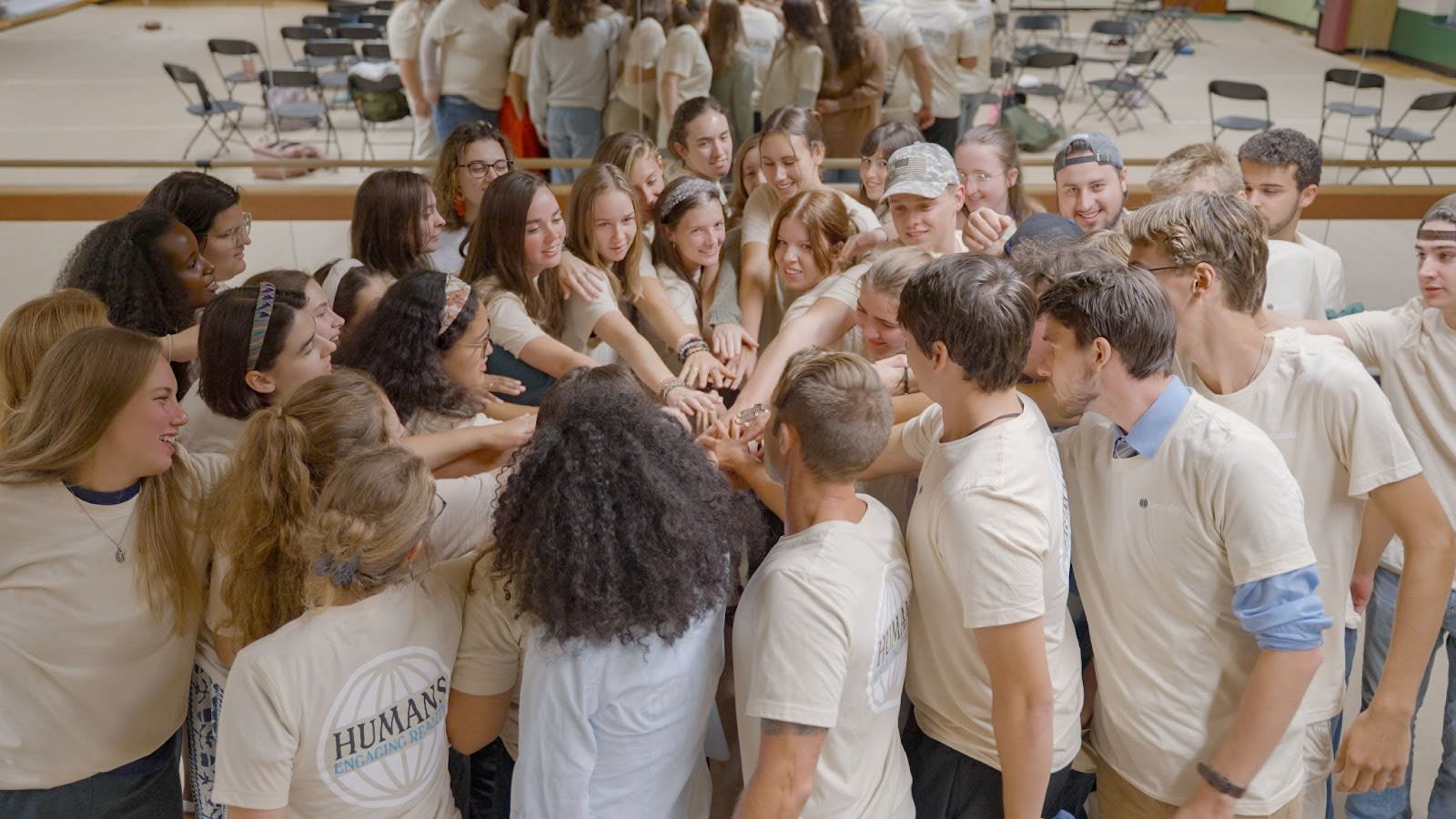
The program - called Humanality - emphasizes small groups that meet regularly, in-person, in order to foster accountability, education, and the creation of authentic relationships.
Humanality’s founder says this approach reflects a Catholic anthropology, and that while the program itself is not explicitly religious, it can pave the way for people to encounter the Gospel.
Challenging the Device
Andrew Laubacher, a former seminarian and worship leader, launched Humanality in 2023 to address the growing crisis of tech addiction.
“Humanality is essentially helping people use technology with intentionality and detox from digital addiction; that could be from screens, social media, gaming, pornography, whatever,” Laubacher told The Pillar.
“Our mission is to help people use technology as a tool and help get their time and lives back.”
In 2018, as Laubacher toured the country with his worship band, he saw the way technology dictated his life — endless hours doomscrolling, viewing pornography and worrying about his self-image.
He wanted to change that.
So he deleted all social media, dumped the smartphone, and switched to a flip phone. His friends, manager, and record label all thought he was crazy.
“As an artist, ditching your media is the worst thing you can do. My record label was like, this is a really bad idea. I just said, I have to do it because it’s just affecting my soul ultimately,” Laubacher said. “I deleted everything. I went to a flip phone and so many things in my life improved.”
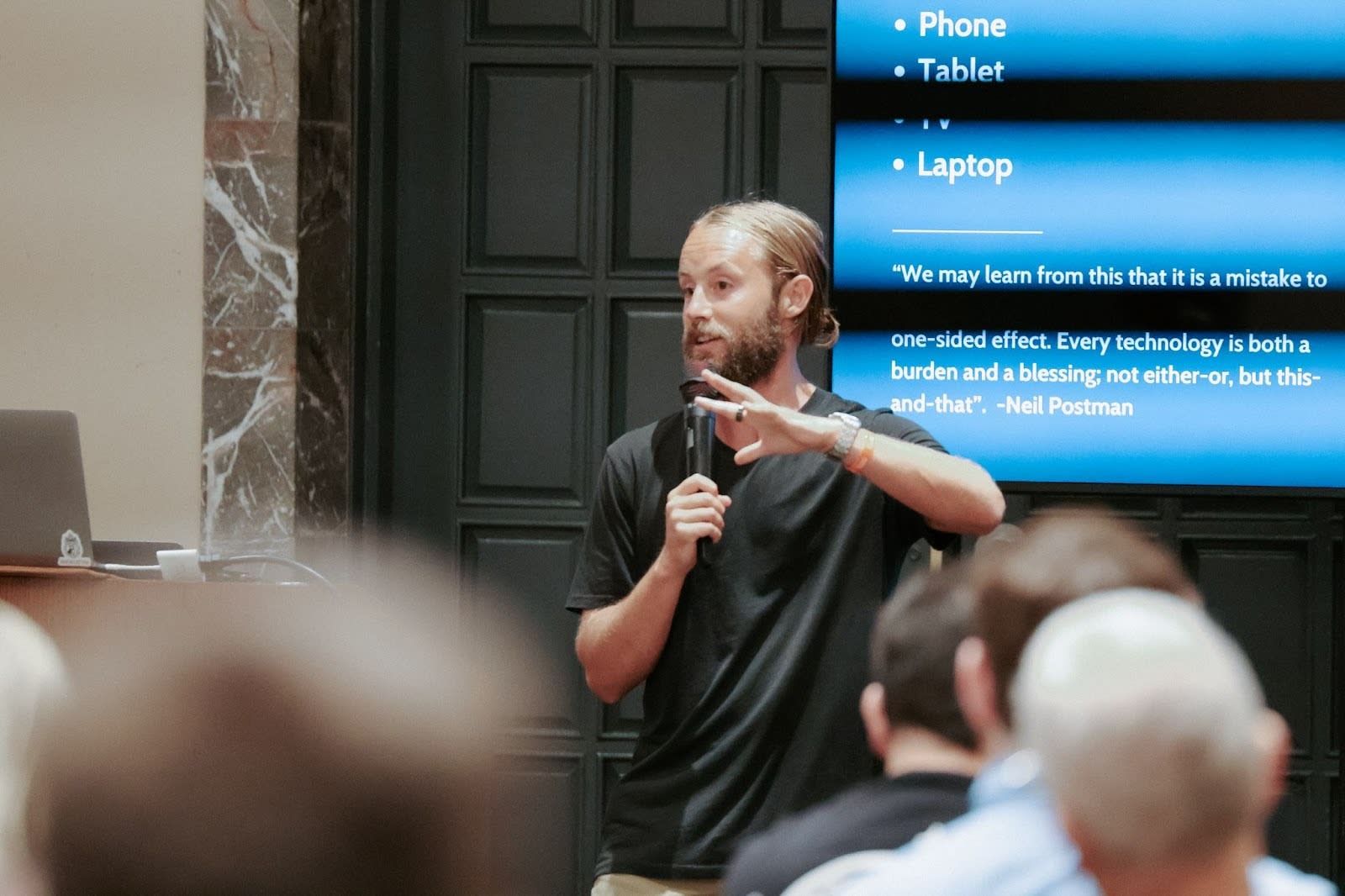
In 2022, a friend invited Laubacher to help lead a new initiative at Francsican University of Steubenville encouraging students to switch to a dumb phone.
Laubacher was all in.
“They paid 30 students scholarship money to give up their smartphone and take on a dumb phone,” Laubacher said. “All these students did that, and all of them started having all these amazing life changing experiences. It got a lot of press, got a lot of interest, and they started a whole organization.”
“And voila, Humanality was born.”
Laubacher assumed the role of executive director. But before diving in, he said, he wanted to better understand the impact technology was having on individuals and on society.
“I was looking at the loneliness epidemic, the mental health epidemic, the obesity epidemic. A lot of these things we are struggling with are deeply correlated to technology,” Laubacher said. “There’s multiple technologies that are impacting the way we live and behave.”
“We are not designed to be sedentary, screen-staring, meaning-devoid creatures.”
As he began researching time spent on screens, Laubacher found some startling statistics. For example, teenagers today average eight hours and 39 minutes online each day, he said. And in low income communities, that figure is closer to 10 hours each day.
“Right now, if you add up the time that Gen Z is going to be on a device, at the end of their life, with a 90-year lifespan, it’s about 27 years of their life that is going to be spent staring at a screen,” he said. “Our real mission is to help people get their time back.”
Laubacher sought to design an intentional program that would adjust individuals’ relationships with technology.
He wasn’t advocating for people to necessarily ditch smartphones altogether. But he wanted them to examine their habits, and what they would need to do to reclaim their time and freedom.
“Our phones impact the way we interact with one another, the lack of outdoors, the lack of movement, the amount of overstimulation and over-information, it’s affecting our lives in very serious ways,” Laubacher said.
His solution: Humanality villages — small groups that commit to practicing healthy technology practices, hold each other accountable, and gather weekly for educational opportunities, such as watching informative videos about tech use.
Humanality has produced a workbook, a video series, and a variety of articles examining the science and psychology behind the use of modern technology. It encourages participants to find a community — a village — to watch the videos with every week. A village may consist of friends or family members who are similarly committed to building healthy technology habits.
“We go into light science, we go into the reality that some kids are spending more time indoors than maximum security prisoners. We go into blue light science, how it’s affecting our circadian biology,” Laubacher said. “It is not homework, it is human work.”
“Then you take on these challenges every week which are like phone-free meals, or giving your phone a digital bedtime, or calling a friend. All are these healthy habits that we just struggle with on our own. We want them to become part of people’s life.”
It’s no coincidence that Humanality makes use of small groups, meeting in person, to help break technology addictions.
Research has shown that while social media and similar technology may give the impression of bringing people together, they actually create a relationship chasm. And rebuilding relationships may prove to be a key part of defeating that addiction.
The biggest problem with social media and other excessive technology use is disconnection, says Dr. Adriana Stacey, a psychiatrist who works with teenagers and young adults and has studied the psychological impact of social media.
“Humans were made to be in community. They were made to be in relationship with one another, to support each other, be what we call embodied,” Stacey told The Pillar.
“There is this fallacy that technology keeps us connected to each other, but it is the opposite. Technology makes us less connected to the people that we love and care about and those around us.”
Research shows that extreme exposure to technology reshapes the brain in an adverse way, decreasing an individual’s ability to relate to others. Over time, the brain develops neurological pathways between cells with use. During adolescence, the brain prunes pathways that are underutilized.
“What we are seeing is that the pathways for a lot of the emotional intelligence type things — face-to-face interaction, social skills — are being pruned away because kids aren’t using them because they are so engrossed in their technology,” Stacey said. “These pathways that are negatively affected by screens are also responsible for empathy, so we are seeing a reduction in empathy in people that overuse screens.”
Overdependence on technology also artificially stimulates an individual’s dopamine levels, which can lead to increased levels of anxiety and depression.
“The use of screens for entertainment does the same thing to the brain as cocaine, so they cause a huge rush of dopamine to be released from the brain,” Stacey said. “What’s the harm in that, right? Well, what goes up must come down.”
“The dopamine levels go down, but then the brain is depleted and no more can be released, and so that’s when depression and anxiety set in.”
“The next thing that happens is what we call craving, and so the brain wants only that particular stimulus because that’s what’s allowing this huge amount of dopamine to be released, so that’s why kids get addicted to screens so quickly.”
In battling screen addictions, the emphasis on community is key, Stacey said.
“You need a nest of people. You need a support group around you that’s doing the same thing,” she explained. “It is like when people try to quit drinking alcohol, or they try to stop smoking cigarettes, then they go around people that are quitting those same habits because it is so hard to do alone.”
“We generally ask kids, teenagers, college students to get a group of people that are going to do it together, and then they can really support each other, and we’ve had a lot of success with that model.”
Becoming human again
Nick Becker, a 31-year-old mechanical engineer in Fontana California, learned about Humanality last spring. He decided to try the program for Lent, and has not downloaded social media again since.
“Every Lent, I would give up social media and I always found it helpful, it was a good mental reset. But I would always go back after Easter,” Becker told The Pillar. “This year, I ended up extending it for three months and started to not use the screen and really began to embrace the Humanality program.”
“It has been liberating.”
Prior to starting Humanality, Becker found himself at the beck and call of his phone, willing to stop any conversation or drop whatever he was doing to check a notification.
He said his phone controlled him.
“I would constantly be checking the notifications and prioritize responding to them immediately. When I would scroll Instagram, I would do it as an escape, I was procrastinating or distracting myself, rather than dealing with the things that I needed to deal with,” Becker said.
“I do appreciate my smartphone. It is a helpful tool, but I did not have a good grasp on my relationship with it as a tool. It was something that rolled over me. It was a distraction that just killed time or allowed me to escape.”
By joining a Humanality village and watching the group’s educational videos, Becker says he learned how to have a proper relationship with his phone. And this in turn, he says, has positively impacted his daily routine, from friendships to his spiritual life.
“I’m using my phone as a tool, including in prayer rather than to distract from prayer,” Becker said. “I pray a lot more now, I put my phone to bed now as Humanality suggests. When I do that, I’m able to wake up and say morning prayer or go to bed and say a prayer rather than laying in bed while scrolling.”
But beyond prayer and friendships, Becker also believes Humanality has freed up his time and attention to focus on anything and everything in front of him - even the mundane or routine parts of his day.
“It has helped me to be present and just experiencing things, opening my eyes up to things that are going on around me or being present with other people and being able to dive deeper in those relationships because I am not constantly checking my phone,” Becker said.
For Ballard, Humanality has changed the way he thinks about technology and his relationships with others. After drowning his iPhone, he switched to a dumb phone that only has the ability to call and text.
Now, he has more time to pray, to socialize and to work. His friendships are richer, and he is more open with others. He attributes all of this to Humanailty and the village he has discovered.
“People are having a more open discourse about their problems like struggles with pornography, social media, or TV,” Ballard said. “People are coming to Humanality meetings to discuss these things and are looking for help in the right places.”

While many of his peers are still engrossed in their technology, worried about their online presence and appearance, Ballard is detached from the digital world, which he says allows him to live a more full college experience.
“Humanality will help colleges become more anxiety-free, students will be more productive, people will find a lot of freedom in realizing that they’re not the only ones that are fighting this,” Ballard said. “Campuses are full of students that are looking for help in forming human relationships. Humanality is a way to give them a concrete path to take.”
‘Exciting evangelization’
The experiences of Becker and Ballard demonstrate the ethos of Humanality’s mission — it wants to help people reconnect with others, with themselves, and with God.
While not an explicitly Catholic organization, Laubacher believes that Catholics should be the first in line to ditch technology.
“Time is this incredible finite resource we’ve been given by God and if we are wasting an average of five and a half hours a day on these platforms, we are wasting this great gift,” Laubacher said. “Most of these interactions aren’t beneficial, and if anything, they’re causing more polarization. There’s not more dialogue. There’s not more understanding or empathy. They are decreasing our cognitive abilities, our attention, our ability to relate to others.”
“Catholics should care, because this is affecting the human person.”
Many Catholics maintain an online presence in the name of “digital evangelization.” But Laubacher questions this practice. He thinks the cons of social media outweigh the pros, and he believes that evangelization is best done in-person.
“The idea that we need to evangelize through all of these platforms, and be on all of them at all times is just false. I think it is a net negative experience,” Laubacher said. “While you might see Father Mike Schmitz on one scroll, which might be helpful, your next one is like pornography, or women in booty shorts and a bikini.”
“The medium is the message, and the medium has just become so corrupted,” he said.
“The uncomfortable truth that no one really wants to talk about, that I’m fine talking about, is that evangelization needs to be prioritized in person.”
While Humanality started at Catholic colleges and has partnered with other Catholic institutions, Laubacher has attempted to brand content to make it appealing to a diverse, non-religious audience.
He has received requests from atheists, Jews, Muslims and various Protestants asking to partner with Humanality to help establish villages at their organizations, in order to help detox from tech.
Laubacher sees it as an opportunity to lay the groundwork for an encounter with the Gospel.
“Humanality’s ways are deeply rooted in Catholic anthropology, but they are accessible and applicable to everybody because if you’re human, you need proper sleep, you need proper relationships, you need nutrition, you need movement, and you probably need to help getting your time back,” he said.
“What I really love about this is that I connect with atheists who have nothing in common theologically, but they love what we are doing.”
“This is some of the most exciting evangelization that I have ever done.”