








Everything you’ve ever wanted to know about the Swiss Guards

Twenty-seven new Swiss Guards were sworn in on Oct. 4 before Pope Leo XIV.
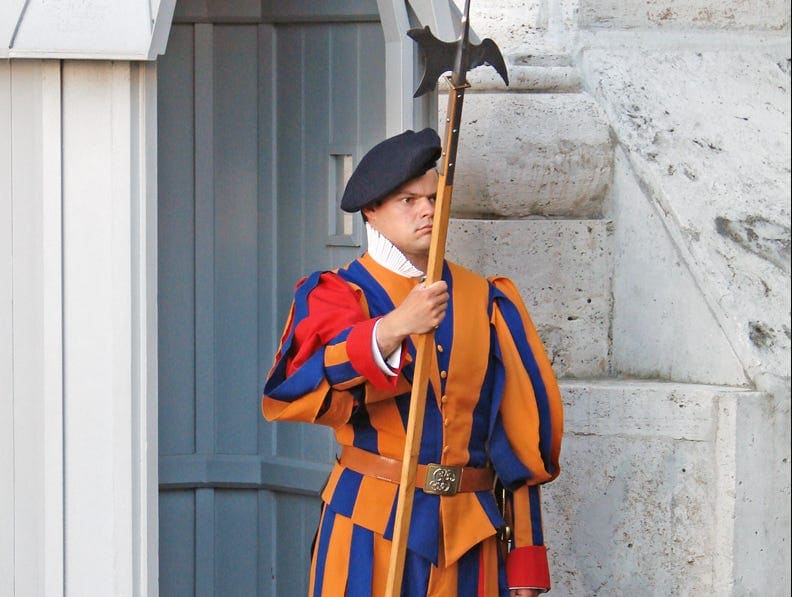
The Swiss Guard is one of the most recognizable military forces in the world, due to its Renaissance-inspired red, blue, and yellow uniforms.
While the colors may seem playful, the Swiss Guards are considered one of the most exclusive military forces in the world, with their numbers capped at just 135.
Tourists run to take pictures with members of the Swiss Guard on a daily basis, and they’re seen in just about every major papal event. Some guards even join the pope during his trips.
But why are Swiss Guards Swiss? And are they really trained to fight? And what is the history behind those uniforms?
The Pillar explains.
The news
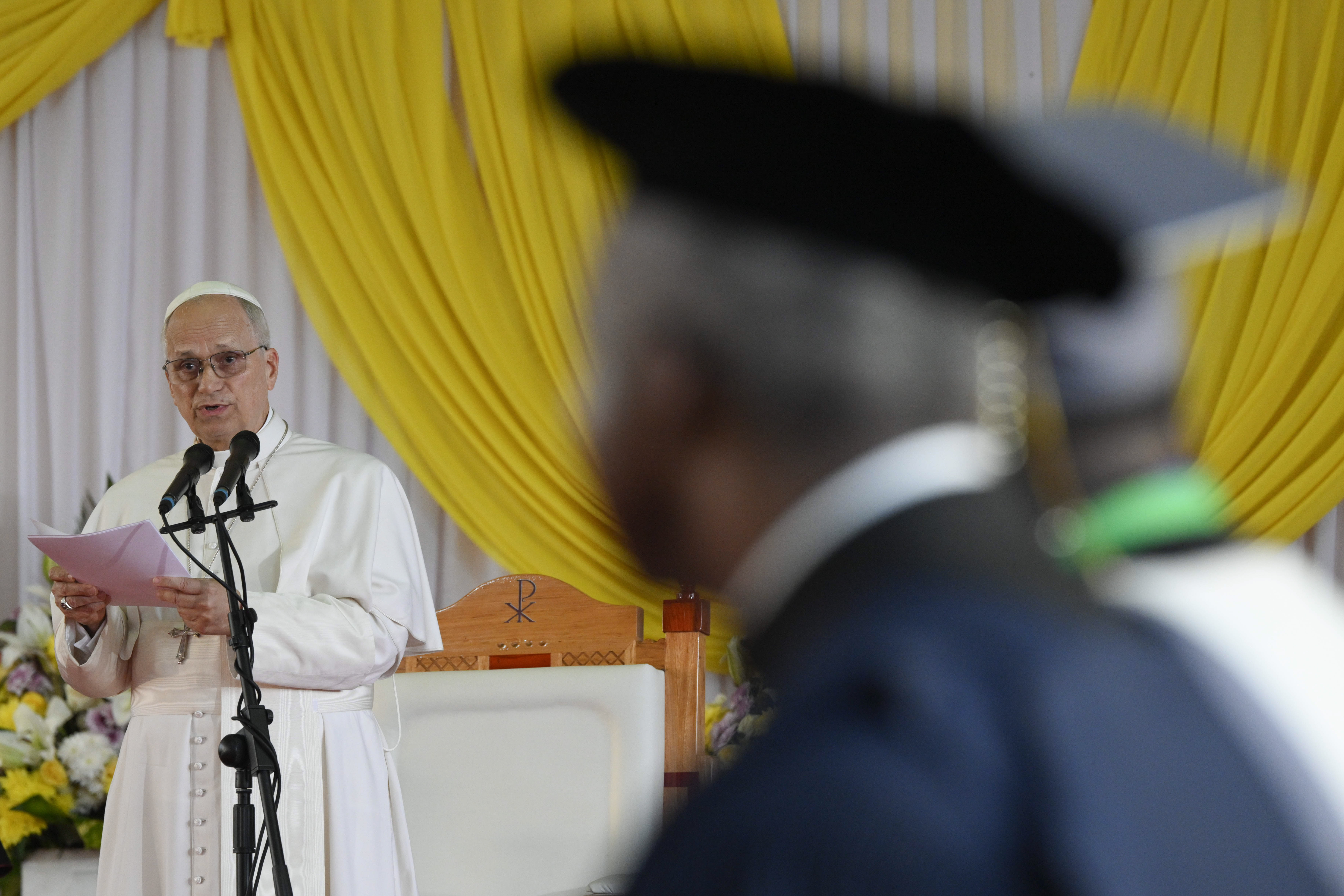
Twenty-four new Swiss Guards were sworn in at a Vatican ceremony on Oct. 4 before Pope Leo XIV, the first time a pope has participated in the yearly ceremony since Saint Paul VI in 1968.
The ceremony is usually conducted on May 6, the anniversary of the 1527 Sack of Rome in which 147 Swiss Guards died defending the pope. However, this year’s event was postponed due to the death of Pope Francis in April.
During the ceremony, after the Swiss and Vatican anthems were played, the new recruits swore to serve Pope Leo and his successors “faithfully, loyally, and honorably,” even by “sacrificing my life if necessary for their defense.”
Afterwards, the pope greeted those present and said, “To all of you who have made this oath: it is a very important witness in today’s world. It shows us the value of discipline, of sacrifice, of living the faith in a way that truly speaks to young people.”
Why the Swiss Guard? Why not the Italian or French Guard?
In the late Middle Ages, Swiss mercenaries were considered the most effective in Europe. They were often hired by major European powers such as Spain and France, and sometimes even fought against the papal forces in various wars.
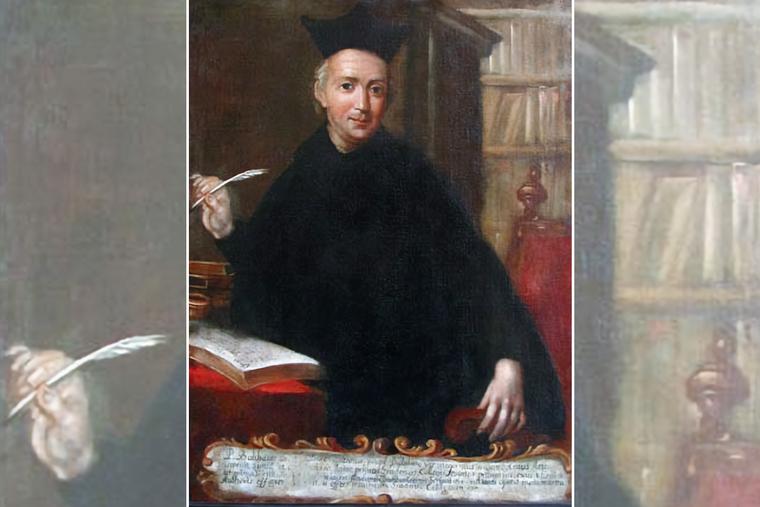
In 1505, Swiss Bishop Matthäus Schiner suggested that Pope Julius II hire Swiss mercenaries to protect Rome, and the pope took him up on his suggestion, hiring 150 Swiss mercenaries to serve him.
Pope Julius II was himself well acquainted with the Swiss military capacities, as he had briefly served as Bishop of Lausanne from 1472 to 1473.
Do the Swiss Guards actually fight?
If necessary to protect the pope, yes.
The most famous example is the 1527 Sack of Rome. Amid the Italian Wars of the 16th century, a mutinous segment of a Habsburg Army killed their own commander and sacked Rome on May 6, 1527.
The sack ended with thousands of civilians dead, and dozens of churches and monasteries destroyed in just a few days.
Among the casualties were 147 of the 189 Swiss guards, who died protecting Pope Clement VII and securing his passage through the Passeto di Borgo, an elevated corridor that connects the Vatican to the fortified Castel Sant’Angelo.
The Teutonic Cemetery, located just south of the Vatican, was built over the location where many Swiss Guards died defending the pope that day.
After the Italian Wars ended, the Swiss Guards stopped being a military combat unit, and became more of an honor guard.
However, there have been a few other times in which members of the Swiss Guard took part in active combat. Twelve Swiss Guards fought in the Battle of Lepanto in 1571.
While the Swiss Guards didn’t take part in active combat during World War II, Pope Pius XII asked them to receive submachine gun training and to improve the existing Vatican arsenal in case of a potential German attack against the Vatican.
How many Swiss Guards are there?
Currently, there are 135 Swiss Guards. However, that number has changed over the years.
The guard was disbanded and reinstated several times in the late 18th and 19th centuries due to the Napoleonic Wars and the Piedmontese invasion of Rome.
After the proclamation of the Kingdom of Italy in the mid-19th century, the Swiss Guard suffered a significant decline. However, Commander Jules Repond, who served between 1910 and 1921, reformed the guard, making numerous changes to its recruiting and operations. He reorganized the force so that it consisted of a commandant, five ranking officers, 15 minor officers, a chaplain and 110 halberdiers.
Repond’s reforms were not well received, and resulted in a week-long mutiny in July 1913 that ended with 15 members kicked out of the guard. However, they were effective at restoring the Swiss Guard into a professional body again.
The number of guards was fixed at 100 in 1979, and increased to 110 in 1998. In 2018, it was increased to its current number of 135, amid security concerns at the Vatican.
Do Swiss Guards have to be Swiss?
All Swiss guards are required to have Swiss citizenship. However, there are no requirements as to whether that citizenship must have been acquired by birth or by naturalization.
Therefore, some Swiss Guards have been born outside of Switzerland or have a non-Swiss ethnic origin.
For example, Dhani Bachmann, an Indian-born soldier adopted by a Swiss family as a child became the first non-ethnically European guard in 2002, and Sebastian Eviota became the first ethnically Filipino guard in 2025.
What are the other requirements to become a Swiss Guard?
Recruits must be unmarried, Catholic, Swiss men between the ages of 19 and 30. They must have a high school degree or a professional diploma, and must have completed the basic Swiss Armed Forces training, which is usually between 18 and 21 weeks long.
Moreover, they must be over 5’’8’ tall.
If Swiss Guards must be unmarried, does that mean they make a vow of celibacy?
While the guards must be unmarried when they enter the force, they don’t make a promise or vow of celibacy. They are allowed to marry after five years of service and as long as they are at least 25 years old. Married Swiss Guards commit to at least three more years of service.
In fact, Pope Francis simplified the process to marry as a guard. In 2018, he eliminated the requirement to be promoted to the rank of corporal to get married.
Pope Francis also encouraged Swiss Guards to marry while on service in January this year.
“I like the fact that the guards get married; I like the fact they have children, they have a family. This aspect has become a lot more relevant, inasmuch as the number of married guards with children has increased, and the wellbeing of the families is of fundamental importance for the Church and society,” he said.
Where do Swiss Guards live?
The Swiss Guards live in their barracks just beyond the Porta Sant’Anna, one of the main points of access of the Vatican.
There, low-ranking guards live in shared dormitories that accommodate up to ten guards, moving to double or triple rooms as they move up the ranks, or to private rooms once they marry.
In fact, married guards are allowed to reside outside the Vatican if no accommodation is available for them and their families within the Vatican.
In 2016, a foundation was established to fund the renovation of the barracks, which is set to start after the jubilee ends. The project is set to provide nearly all guards with small apartments and private bathrooms within the Vatican, replacing the shared dormitories.
Was the Swiss Guard uniform designed by Michelangelo?
Despite what Dan Brown would have you believe, no.
While this is one of the most common myths related to the Swiss Guard, the current uniforms were designed by Jules Repond, the 20th century commander that modernized the force.
It is believed that some time after the Swiss Guards first arrived in Rome, Pope Leo X, a member of the Medici family, gave them uniforms that displayed the colors of his family’s coat of arms — yellow, red and blue.
While the uniforms changed over time and some went into disuse, Repond meticulously recreated the uniform with Renaissance depictions and using the color scheme linked to the Medici family.
Repond allegedly studied Raphael’s The Mass at Bolsena, a fresco in the Apostolic Palace’s Raphael Rooms depicting a group of Swiss Guards in the lower right corner to draw inspiration from the colors.
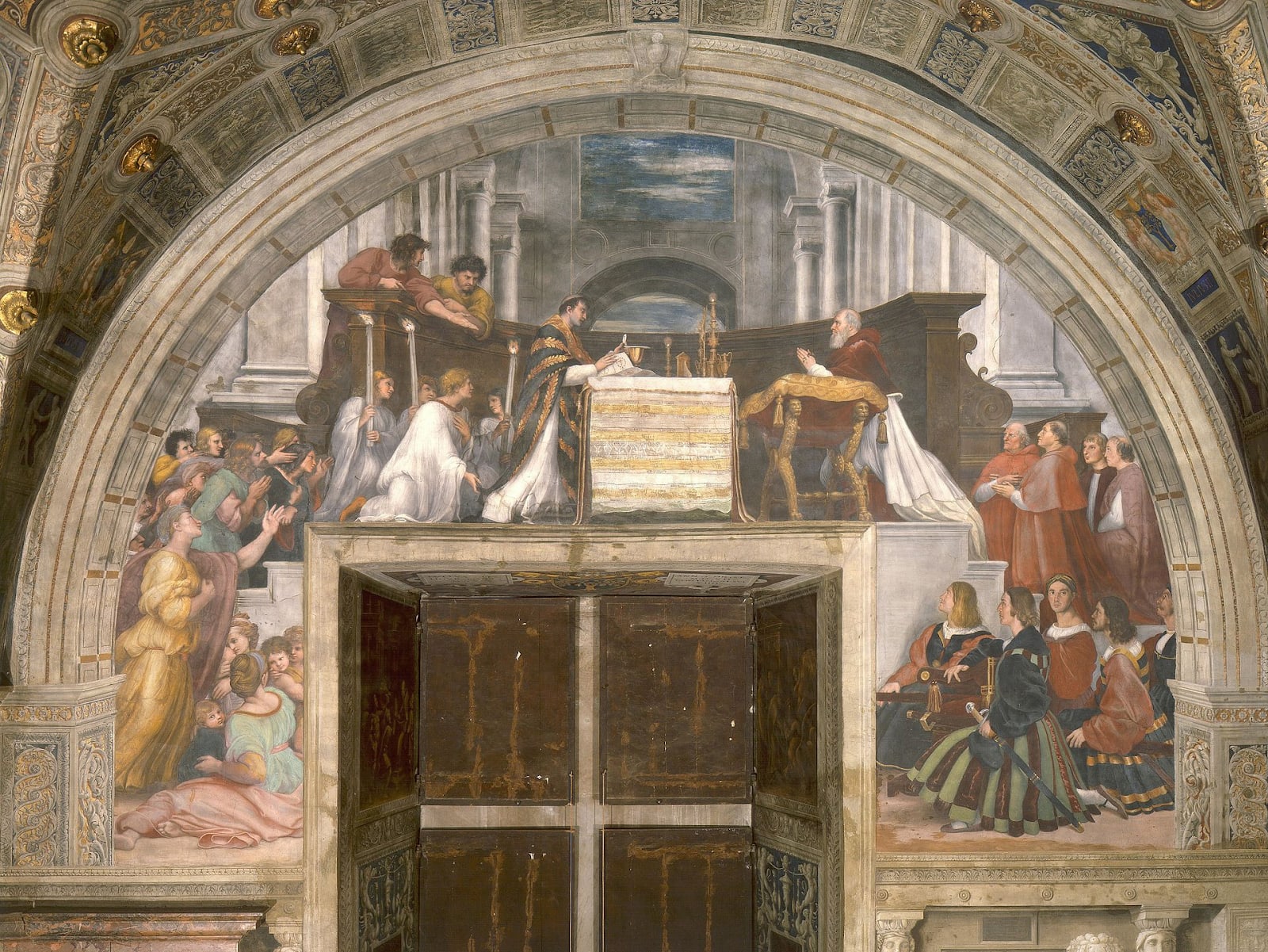
In fact, Repond’s studies were so extensive that they were published in 1917 as Le costume de la Garde suisse pontificale et la Renaissance italienne. (The uniform of the Swiss Guard and the Italian Renaissance).
I read that the Swiss Guards have a new uniform. Is that true?
It’s true, but their traditional uniform is not going anyway.
On October 2, the Swiss Guard revealed a new dark uniform meant to be used for receptions, embassy dinners, and other non-ceremonial occasions by senior ranks of the Swiss Guard.
But they are still using their traditional uniforms, with the iconic red, yellow, and blue, while on duty.
Can I buy a Swiss Guard uniform?
Not really. Only guards that serve for more than five years can keep their uniforms, and they sign a contract promising to be buried in their uniform or to give it back to an association of former Swiss Guards. This rule was reportedly instituted after children and grandchildren of former Swiss Guards were selling their uniforms online.
Uniforms of former Swiss Guards who decide not to be buried in them are usually destroyed by the Vatican.
Does the Swiss Guard have an anthem?
Not quite. At all Swiss Guards events both the Swiss and Vatican anthems are played.
However, many consider Sabaton’s The Last Stand, a power metal song narrating the guards’ stand in defense of the pope in 1527, something of an unofficial Swiss Guards anthem.