





‘God is faithful’: 20 years after Katrina, New Orleans Catholics rebuild

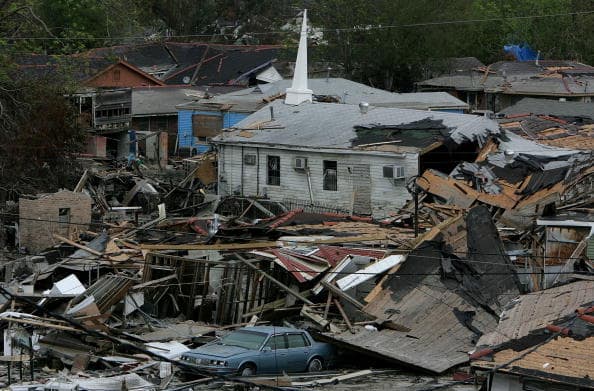
Twenty years ago this week, Louisiana was rocked by Hurricane Katrina, the 2005 storm that caused catastrophic damage along the Gulf Coast and led to levee breaches and widespread flooding in New Orleans.
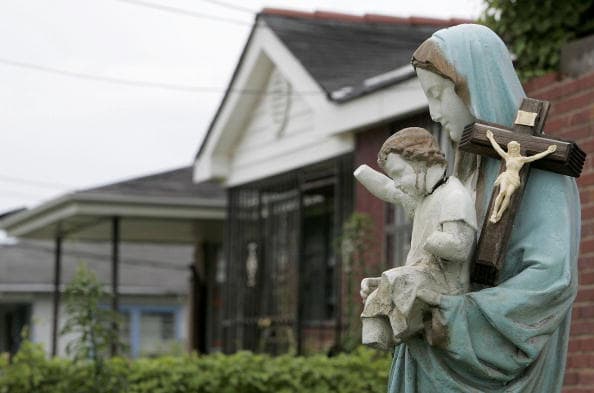
Hurricane Katrina formed in late August 2005, strengthened to a Category 5 hurricane over the Gulf of Mexico, then weakened to a Category 3 storm as it slammed into the coast of Louisiana and Mississippi.
The storm resulted in more than 1,300 deaths and $125 billion in damage, making it the costliest hurricane in U.S. history.
New Orleans was particularly hard-hit, due to the failure of the city’s levee system, which led to flooding over approximately 80% of the city, causing widespread devastation.
Like the rest of the city, the local Catholic Church was profoundly impacted by Katrina.
One church building was destroyed by a tornado that was spawned from the hurricane. Several others were completely washed away by the massive flooding.
The devastation was so pervasive and long-lasting that it became a major impetus for the 2008 restructuring of the archdiocese, said Sarah McDonald, communications director for the Archdiocese of New Orleans.
“Several parishes that were in severely damaged areas were merged with surrounding parishes, and new parishes were erected,” McDonald told The Pillar.
Some of the churches that had been destroyed in the storm were rebuilt, or were in the process of rebuilding. But others weren’t.
In some cases, there was no pressing need to rebuild, because the communities surrounding the churches were destroyed as well, McDonald said.
And some of those communities never re-formed.
In the aftermath of the hurricane, many of the people who had evacuated were slow to return to the city. Others never returned at all, choosing instead to relocate elsewhere and start fresh, after their homes and businesses were destroyed.
In the year 2000 New Orleans had a population of some 480,000 people. In July 2006, that number was only about 230,000; nearly a full year after the hurricane, more than half the population had not returned.
By 2020, New Orleans’ population was estimated at 380,000. People are returning to the area, but its population had not reached pre-hurricane levels.
In St. Bernard Civil Parish – civil parishes are the Louisiana equivalent of counties – there were 10 different Catholic parishes and missions present before Katrina, McDonald said. Afterward, those 10 churches were merged to one parish.
While hurricanes are a part of life in New Orleans, the experience of Katrina was unprecedented – not only for residents of New Orleans, but also for the relief agencies that worked to support them in the aftermath.
While Catholic Charities of New Orleans had some experience with responding to emergencies, this time was different, said Deacon Martin Gutierrez, vice president of mission and community engagement for the agency.
“This time, even those who work for Catholic Charities, those who responded normally to the needs of the clients, became clients themselves,” he told The Pillar. We were all impacted. We were expected to react and respond, but at the same time, we were all, most of us, dealing with tragedy at home as well.”
Gutierrez counts himself lucky. His house only had nine inches of water from the flooding. Some of his friends and colleagues had their houses entirely covered with water, or completely washed off their foundations.
Before Katrina, Catholic Charities of New Orleans had nearly 1,000 employees. After the hurricane, the agency was down to 300. It took two or three years for staffing numbers to return to normal levels.
Gutierrez had been leading the Archdiocese of New Orleans’ Hispanic outreach ministry before Katrina hit. He was in talks about moving over to Catholic Charities. When Katrina hit, his move was expedited.
With more than half the staff gone, the remaining employees were faced with overwhelming needs in the community, and a pervasive atmosphere of uncertainty – about jobs and schools and whether other residents would return.
Catholic Charities began by setting up resource centers to provide basic needs – food, water, and counseling.
“But we knew that the recovery was going to be long-term, and we knew that we were going to be there for the long haul,” Gutierrez said.
With help from volunteers across the country, Catholic Charities gutted, cleaned, or rebuilt more than 2,000 homes.
And for the next 10 years, much of the agency’s work centered around responding – directly or indirectly – to the hurricane’s aftermath.
Most of that work was done through case management, helping people navigate insurance claims and FEMA assistance, or helping them find new jobs after their careers had been derailed.
The need for counseling was significant after the trauma of the hurricane, Gutierrez added. Homelessness and a need for affordable housing became major issues as well.
“We got involved in issues of public safety,” he said. “Immigrants (were) being targeted because they were easy prey for those who wanted to take advantage of the fact that they carry their cash with them. They used to call them ‘walking ATMs.’ So we worked a lot with the local police departments to build that trust between the communities.”
Donations for all of these projects came from a variety of sources. Gutierrez said Catholic Charities saw funding from the USCCB, Catholic Charities USA, government grants, and private foundations.
“Foundations that normally would not look at this area of the country as an area that they would fund – they came in and they were responsive,” he said.
The process of responding to Katrina left its mark on Catholic Charities, Gutierrez said.
“Emergency or disaster preparedness and response was not something that we talked that much about before Katrina. And that is something that we do (now) on a regular basis.”
Each program developed by Catholic Charities must create and review emergency plans on a regular basis.
Additionally, the agency helps its clients develop their own emergency plans, to think about what they would do if they needed to evacuate, or to shelter in place.
“We have a couple of residential programs where we want to make sure that the structures, the buildings where we have our residents are as secure as possible,” Gutierrez added.
This focus has helped the agency as it responds to other emergencies – for example, in recovery efforts after Hurricane Ida in 2021, a project that Catholic Charities is only this week concluding, four years after the storm hit.
“I forget how many hurricanes we've had since Katrina that have impacted our area,” Gutierrez said. “Another disaster that we dealt with - and we responded and we did a lot of work - was the oil spill. We were not involved with cleaning up the Gulf Coast, but we were involved in providing assistance to families and business owners who were impacted hurricane by the oil spill. Many of them lost their way of making a living. So we needed to respond to that.”
Twenty years later, signs of Katrina are still visible. There are a number of vacant lots, particularly in the hardest-hit areas, where homes and businesses were never rebuilt.
But over time, new people have moved to the area. And while the population has not returned to its pre-hurricane levels, it has increased in recent years.
In St. Bernard Civil Parish, where 10 churches were merged down to just one after the hurricane, there are today three open churches, a sign of a growing population.
“The new communities that have been built out of that are really signs of hope and resilience in their neighborhoods,” McDonald said. “We’re a very resilient people.”
Gutierrez said he was concerned at first that the mass exodus of residents, followed by the slow-but-steady stream of newcomers, would change the culture and fabric of New Orleans.
“But I think what's happened for the most part is that the people who came - and they came in thousands - did not change New Orleans. I think New Orleans has changed them.”
“I have friends, former coworkers who came to work here one year, maybe volunteer one year, an internship, a fellowship. And that became two years and three years, four years. And here we are 10, 15 years later, and now they have become New Orleans,” he said.
“I got to know my city, New Orleans, better through the eyes of these people who came in from out of town. Because they were seeing New Orleans in a different way than I did. And they were discovering corners of our city that I had never really experienced before. So that was a wonderful thing that happened.”
In general, Gutierrez said, people are ready to move forward from the catastrophic events of 2005.
“Deep within ourselves, we carry still that trauma from those times during the hurricane and after the hurricane,” he acknowledged, adding that he knows some people who have chosen not to watch documentaries about the hurricane, or even to attend hurricane-related remembrance events.
“You always carry those things within you, and there are things that may trigger them to come back to the surface,” he said.
But overall, he said, “I think most people, at least the ones that I've talked to and that I'm aware of, have put Katrina in the past.
McDonald said people in New Orleans still think of time as being divided into “before the storm” and “after the storm.”
Still, she said, most people have settled into a new normal, in which life is not dictated by Katrina.
“There's now a whole generation of people that weren't alive for that,” she noted.
As the city recognizes the 20th anniversary of Hurricane Katrina, McDonald said people in general seem more interested in celebrating the accomplishments of the last two decades than in reflecting on the devastation that took place 20 years ago.
The morale is a positive one, she said.
“God is good, and God is faithful, and God will provide. He has done that for the city of New Orleans for 300 years, since we were formed.”