





‘I am just a priest’ — Fr. Mike Schmitz on Catholic influencer culture

For almost 20 years, Fr. Mike Schmitz has been a college chaplain at the University of Minnesota-Duluth, preaching, administering sacraments, and hanging out with students.
At some point, Schmitz’s students asked him to start recording his homilies, so they could stay connected to the university’s Newman Center after graduation or over spring break.
He said yes.
Eventually, the requests became bigger and bigger: Would he speak at this conference, would he MC that event?
Schmitz kept saying yes.
In 2015, the popular Catholic media company Ascension Press asked if he would be willing to record brief talks answering common Catholic questions.
Again, Schmitz said yes.
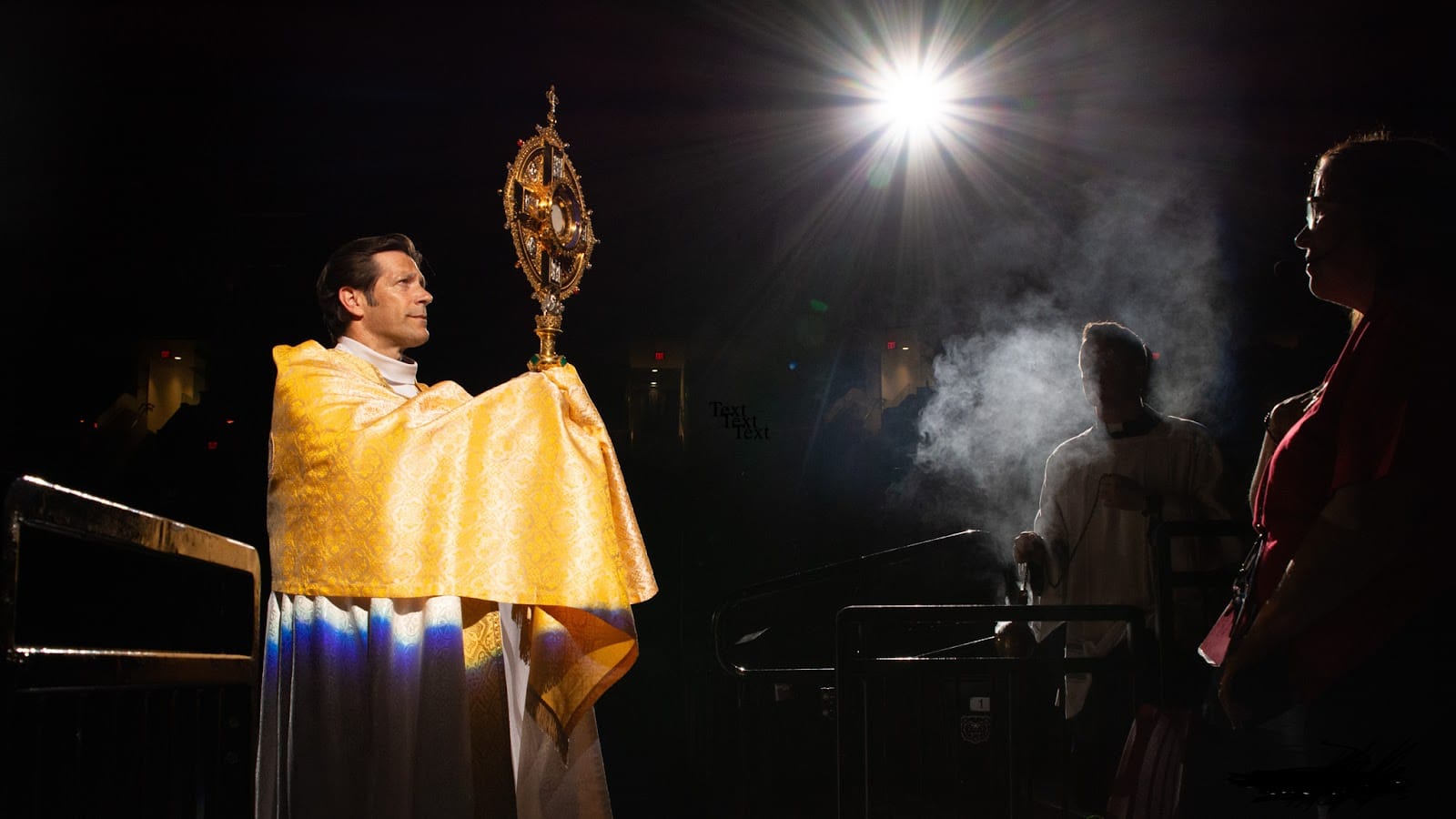
Quickly, his videos gained a following, and Father Mike Schmitz became a household name in the realm of digital evangelization.
His most-viewed video has 3.4 million views.
His “The Bible in a Year” podcast ranked #1 in the United States on Apple Podcasts after its launch. It remains the #2 podcast in the Religion and Spirituality category, four years after its release.
Today, when Father Mike attends a large conference, he is ushered around with a security detail. People swarm around, asking for a photo or an autograph. If there are “Catholic celebrities,” Schmitz is one of them.
But there are pitfalls to that kind of life. Priests in similar positions have had big falls. And Schmitz says he is well-aware of his fame, and the temptations that it can present.
He talked with The Pillar about the need for Catholics in the public eye to practice humility — and to stay focused on the Gospel, ahead of clicks and likes.
The following interview has been edited for length and clarity.
Father Mike, you have become one of the most well-known Catholic figures in the United States. What is that like for you?
I have never really liked the idea of pursuing fame … I've just been able to respond with a ‘yes’ when someone else has asked me to do something, like recording my homilies. That disposition has helped me have some freedom to know that I am only doing something because I was asked to do it.
When I am asked to stop doing videos — and it will happen at some point — I will have to be able to let it go, and letting it go is going to be a big challenge. But if I can’t let it go. then I should not have done it in the first place.
When I go out on campus today, nobody will want a selfie, no one's going to want a signature. They will just walk right by me. That is where life happens, and that helps me to really stay grounded in humility.
I know the truth. The truth is that I'm not that big of a deal. The truth is, I come back to this [Newman Center] and minister to students. We sometimes think that greatness is being known by a lot of people. It's not. Greatness is that the people you know, know that you care about them.
When I do have to be ushered around events [because of crowds], I feel super awkward. It's not my favorite thing. I'd rather go through a back way than have to race through everybody with the staff saying, “Sorry, he's too busy, you guys. He can't stop right now.”
Sometimes at conferences, I am really uncomfortable walking into a room of priests getting vested [for Mass], because it can be isolating. It can be kind of lonely, in the sense that many of them know my name or have watched my videos. But what I want others to know is that I'm just a priest. That is literally it.
Last summer I was asked to be a chaplain at a huge CrossFit event and it was awesome. I was able to walk around this event and I got to go to the expo and go to the vendors. I got to just hang out and walk around, and only a couple people stopped me, it was just great to be at one of these big events and just be a priest.
Ministering at CrossFit was fantastic because for the last couple of years, I have gone to a lot of Steubenville conferences, or SEEK, and there I have not been able to stop and minister since I am always being ushered around, which is pretty painful.
—
There are people who happen to be well-known in Catholic circles, at least for their teaching, for their ability to convey the faith — and that's a good thing. I think that's a great thing.
On the other hand, there is a type — and it is more rare — someone who is a “Catholic celebrity” who is more actively using media to promote themselves over the faith.
The question is this: Is someone using media to promote themselves, or is someone using media to promote the Lord and the faith?
As long as we are doing the former, where we are promoting the Lord, then we are doing well.
But there are challenges that come with being so well-known in Catholic circles.
How do you aim to keep people focused on Christ, rather than on you? Do you have any practices for maintaining humility?
The way I try to practice humility is by knowing what I have to bring to the Lord in confession. I know my brokenness. I am very aware of what people don't see. I know my own heart. I know how well I do not love when I should. I know how much the Lord needs to continue to provide me with graces.
I really try to make sure that very little of what I do in-person or online is performative.
I always tell myself: if this is not going to help someone, if it will only stroke my ego, then I don't want to be part of it.
People will ask, “what's your take on this or that major event?”
I have tried to be really discerning. If I don’t think I have the ability to add something of value, then I am not going to say anything. Part of the temptation for Catholic figures is they get caught up in the sense of having to comment on everything: “I have to make a statement about this. I have to just add to the noise.”
But I don't want to just add to the noise. If I'm adding light or heat to a place where there needs to be light and heat, then great — but I'm not just going to add to the noise.
In addition to your work with Ascension Press, you’re assigned full-time as the director of campus ministry at the University of Minnesota-Duluth.
How does it work to combine those two roles?
The fact that I have so much stuff out there, and if people have heard of me already means that trust is sometimes established with students before they even arrive so we do not have to start at zero.
College ministry has to be genuinely incarnational, and it's not going to happen without trust.
The second pro is that this online presence has helped us to secure funding for a new chapel and Newman Center. We operate right now out of a split level house. Our daily Mass chapel is a two-car garage. We have Sunday Mass in the ballroom on campus, and have never been able to get the funding necessary to build our own church.
But because of the online work we have done, people have supported us. And because of that, we have not only been able to reach a lot of people and hopefully offer them something of value like preaching the word of God to them, but people have supported us financially to build this through our campaign called Seeds of Faith.
The con is that there are times where we have visitors who came to Mass because they wanted to see me, and they talk to me after Mass which is great, but there are also students who are walking right by. I haven't had a chance to see them, making it a little bit hard at times to be attentive to students.
Ensuring that my students know that I love them is vastly more important than my online ministry.
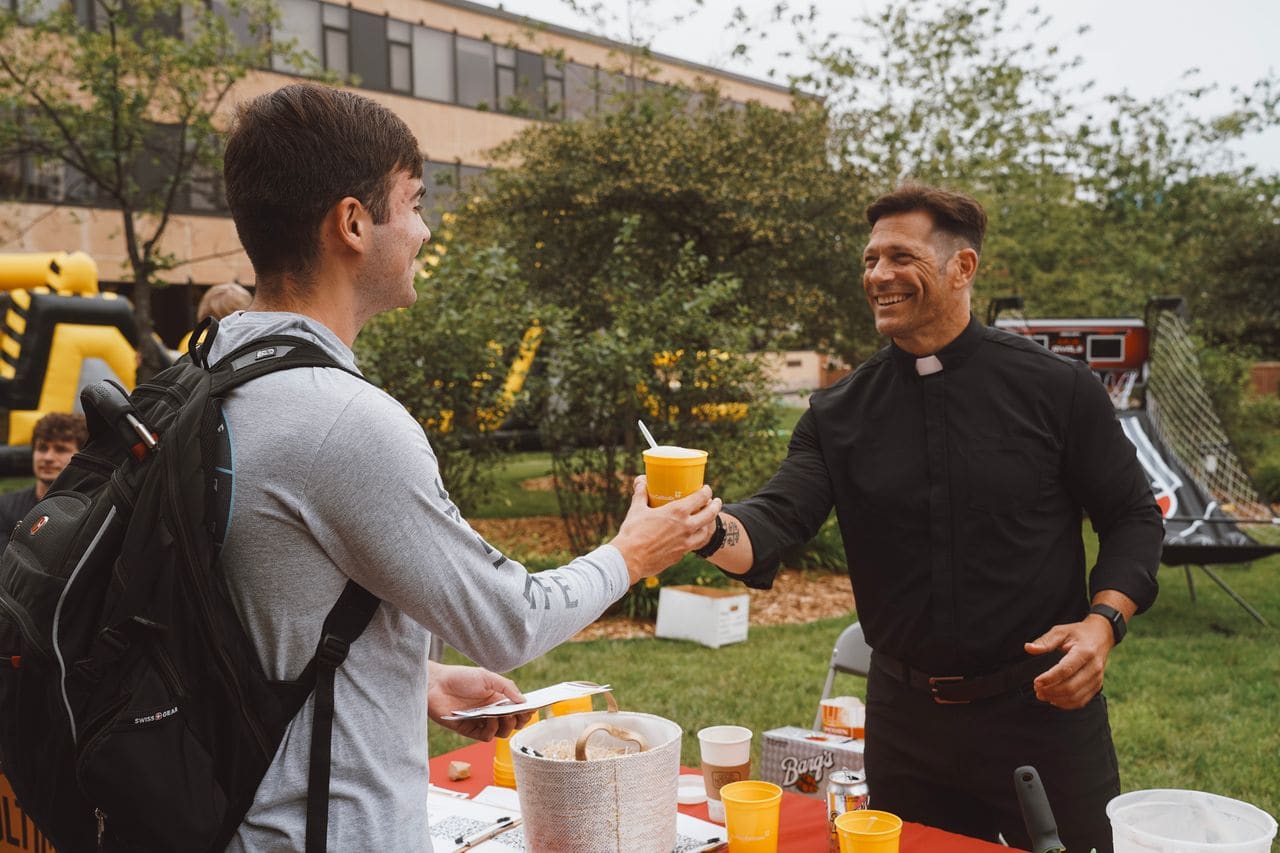
I talk to a lot of people who give talks or present at some of these big events and they say, “Yeah it’s cool, but when I come home, all my kids care about is: ‘Hey, are you going to come to the game tonight? Are you there for me?’’
That is 100% something that I get every time I come back home, here are our students and all they care about is: “Hey, we're glad you're doing this stuff. We're glad you're out there, but do you still love us?”
Do you think it can be dangerous for Catholics to buy into Catholic celebrity culture?
It all depends on what you mean by “Catholic celebrity culture.”
Think about Bishop Robert Barron, I would say that he has influenced a lot of people coming to know the Lord and the Church. He is not so much a celebrity as he is someone who has actually helped people get closer to the faith. Think about Matt Fradd, Lila Rose, Trent Horn. I see them all less as celebrities and rather as people who have really helped me understand something.
As long as that's the case and these people are adding light and something valuable, that is a great thing and people can look to them as teachers and resources and turn to for help.
What do people close to you think about how well-known you’ve become?
Your students on campus, and your family?
Some students will show up here with this “Wow, you're here and you're my priest” mentality.
But they quickly realize what everyone else realizes, that I am just Father Mike and I am just their priest.
And soon they realize that I am just a normal priest. They don't care how many views the last video got, or how many people are listening to a podcast. What they care about is whether I'm here for them.
As for my family, years ago, I remember thinking that I don’t want any of my nieces and nephews to ever say: “My uncle is Father Mike Schmitz, but he never really made a significant impact on my spiritual life.”
That has really rerouted some of the ways that I try to be a family member to my siblings, to my parents, to my nieces and nephews. I don’t want to help a lot of other people, and not be able to be there for my own nieces and nephews.
My parents went through “The Bible in the Year” and “The Catechism in the Year” podcast.
My older brother…mentioned once “I get to hear your voice every day, but I don't get to talk back to you until we get to talk on Sunday afternoon. So I really miss you.”
I think it is incredible to be able to share [this work] with my family and friends because sometimes the hardest people to share the Gospel with are your family members.
What does your bishop think of your online ministry?
At one point, when I was recording “The Catechism in the Year,” we were together for a youth camp, and he said, “Hey, I'm listening to the Catechism with you.”
I immediately thought, “Oh no, my bishop's listening to this, hopefully I am saying everything right.”
Then he asked, “How do you know all that stuff?”
I said, “Well, Bishop, you know that there are guys in our diocese who are way smarter than me, who are really intelligent.”
And he said something I was so moved by: “Yeah, but you have the ability to help us understand it. There are other people who are really smart but you have the ability to help us understand it, and that’s a gift.”
My bishop is very protective in the sense that he does not want my fame to destroy my heart or my faith or my soul. But he is also very encouraging about this whole thing.
What advice do you have for young people who want to be online evangelists?
People have asked me, “How do I get to do what you do? How do I get on beyond this stage here? How do I get to give talks and whatnot?”
Right now, anyone can just do it. You just grab a camera, grab a microphone, and you can start, which is wonderful.
My hope is that when it comes to the phrase “Catholic celebrity,” every person who might be seen as some kind of Catholic celebrity has the exact same motivation — bringing others to Jesus Christ. That this is just for the Lord.