






‘My stomach dropped’ - After Minneapolis shooting, Catholic school leaders bolster security

Paul Escala had just dropped his kids off for their first day at the local Catholic school when he got a phone call.
“There has been a shooting at a Catholic school in Minneapolis,” a colleague told Escala.
Escala is the superintendent of schools for the Archdiocese of Los Angeles, the largest diocese by population in the country. So he started calling people.
Within an hour, the Archdiocese of Los Angeles had released a statement, and had begun compiling guidance to its 250 schools about the situation. It wasn’t much. But at 2,000 miles away from Minneapolis, getting out guidance felt to Escala like something he could do, at least, to quell a tide of fear gripping Catholic school parents across the country.
And that was only the beginning.
“I had to get to work quickly on understanding what exactly was going on, trying to get the facts, while also connecting with a variety of our other ministries and with law enforcement just to make sure that we could confirm that this wasn’t a national threat,” Escala told The Pillar.
“Then we had to immediately get in touch with all of our schools. By that afternoon, we had put together a letter outlining all of the necessary resources to respond to a crisis like this, from mental and emotional health to safety protocols that schools needed to take immediately,” Escala continued.
When news broke Aug. 27 that a man had shot through the windows of Annunciation Catholic Church in Minneapolis, Minnesota, killing two and injuring 18 others, pastors, principals, and superintendents across the country jumped into action, to respond to concerns about the safety of their Catholic schools.
The shooting appears to be the first mass shooting at a Catholic school in the United States, shocking administrators and pastors.
But Wendell Hissrich, director of security for the Diocese of Pittsburgh, said he had long expected that the country’s spate of mass shootings would eventually impact a Catholic school directly.
“We haven’t seen a tragedy occur in a Catholic school until Annunciation but I think we all knew sooner or later it was going to happen,” Hissrich told The Pillar.
Police identified the Minneapolis gunman as 23-year-old Robin Westman, who identified as transgender. Local reports, citing law enforcement sources, indicated that the shooter’s mother had previously worked at the school before retiring in 2021.
Reactions varied the morning of Aug. 27.
Publicly, bishops and dioceses issued statements offering prayers and condolences for those affected. Internally, administrators scrambled to assess the situation — to gauge local security needs, and to understand whether the shooting was an isolated incident, or whether Catholic schools faced a national threat.
In the days that followed, diocesan and school officials aimed to strengthen safety protocols, and to convey their plans to anxious families.
One long day
In Pittsburgh, Hissrich — a former FBI unit chief and city director of public safety — started soon after the shooting talking with contacts at the FBI and state police agencies.
But before that, he dispatched diocesan police officers to check in at each of the 45 Catholic schools in the diocese.
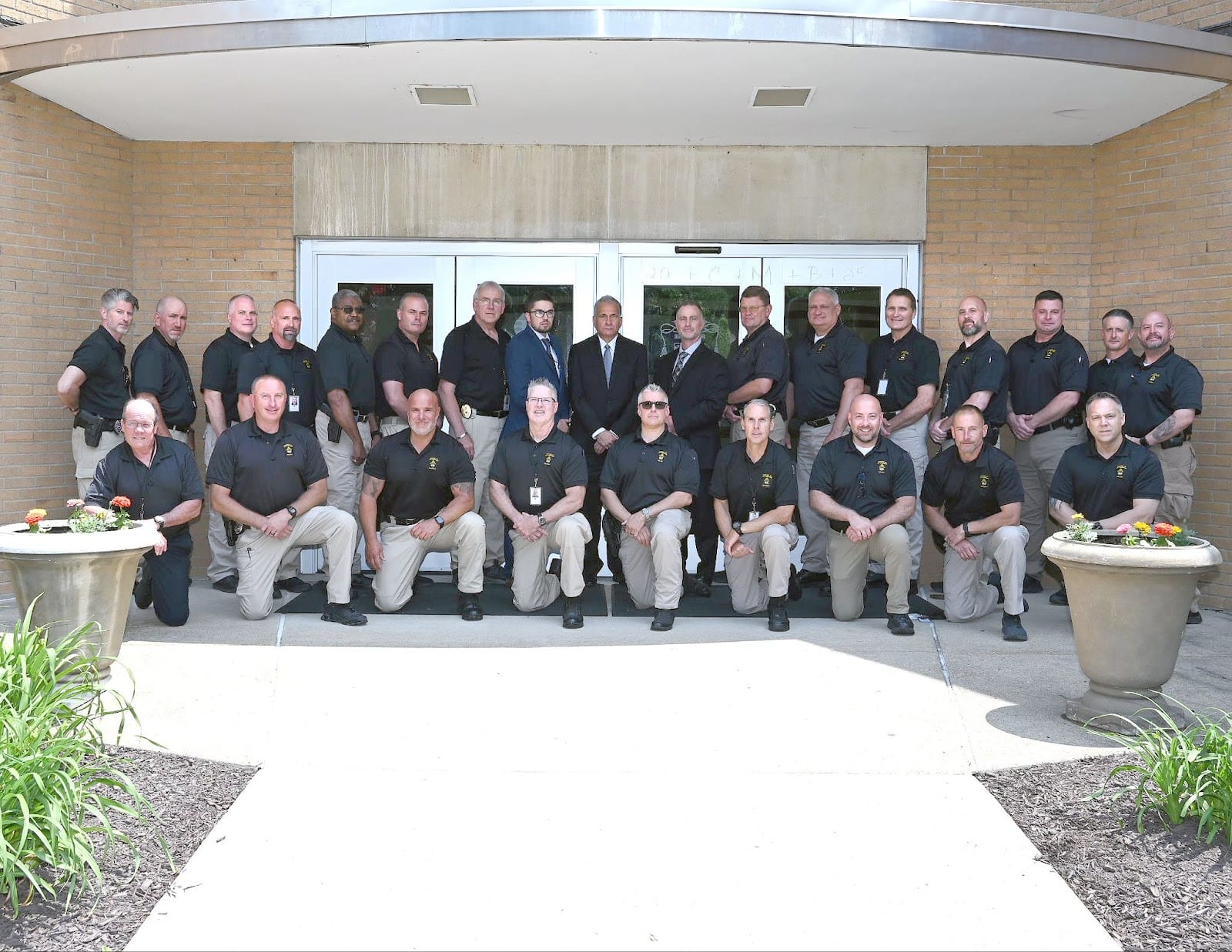
In 2023, the Diocese of Pittsburgh began forming a private police department, making use of a Pennsylvania statute allowing non-profit organizations like hospitals and colleges to form private police forces, with law enforcement authority.
Hissrich was hired to lead the group. He has since hired 21 full-time police officers, six part-time, three supervisors and an intelligence analyst.
“We have jurisdiction not only in the schools, but anything that’s under the bishop's purview, which includes the churches and anything else that the diocese would own property-wise,” Hissrich told The Pillar.
Pittsburgh is one of two Catholic dioceses to establish its own police force, the other being the nearby Diocese of Greensburg, Pennsylvania.
Hissrich sees the police force as a major asset in preventing future tragedies from occurring.
“We will never know what we prevent by having visibility in the schools here in the Diocese of Pittsburgh,” Hissrich said. “When we first announced this, people were concerned that we are putting officers with weapons in a Catholic school — what’s the image going to be? But now, the complaint we’re getting from parents is: Why can’t we have more officers in schools.”
On the morning of the shooting, Hissrich called in all his officers, dispatching them to schools across the diocese. He then began coordinating with contacts at the FBI and other law enforcement agencies to try and understand the situation.
“With all the hoaxes that were going on at the universities, we wanted to confirm whether or not this was an actual event. Then, we wanted to understand whether this was just a lone event or is there a possibility of a multi-city event?” Hissrich said. “Within an hour, we had put all of our officers out in schools, school operated as usual.”
“We increased the vigilance of not only the officers, but the administrators and teachers, telling them that if they see anything suspicious, please report that.”
Communicate, communicate, communicate
At the Archdiocese of Minneapolis-St. Paul's Office for Ministerial Standards and Safe Environment, Paul Iovino, the office’s director, has since the shooting fielded questions non-stop about best safety procedures.
“We have put out just some broad information about going back and reviewing those security plans that everybody has in place, sharing them with the appropriate people on your staff and making sure that they, again, know what those security plans are,” Iovino said. “We are stressing that they need to lean on it and be intentional about those relationships with local law enforcement.”
The office has stressed the importance of communication with local law enforcement.
“They are the best partners in these situations right now. They are the subject matter experts. They are the ones that should know the layout of your places of worship, your schools. They are the ones that can provide those extra patrols and that extra security.”
The archdiocese also had its own resources to fall back on. In January 2024, the office launched an information group for security managers, bringing together parish and school leaders together to discuss best security practices.
“We wanted the 185 parishes and 91 schools to get out of those silos — which we’re not intentionally in, but which have just naturally formed. [To] bring them together to hear common themes, and so they can see the need for best security practices, all while getting the right people in a room on a regular basis for these conversations,” Iovino said.
From a pastoral perspective, the Archdiocese of Minneapolis-St. Paul says it has been at work ensuring that local Catholics know that they are not alone.
“Archbishop Hebda has been present in all sorts of ways, in person at different events. And he’s been on and we have tried to get him on every radio, TV station, publication, just so people know that he's here, that the shepherd is here, that he hears them, and that the Church is still here,” Tom Halden, archdiocesan director of communications, told The Pillar.
“Our emphasis is on going right to the parishes and helping them to communicate because that's where people experience the Church, at the parish level.”
William Klements, school superintendent in the Diocese of Providence Rhode Island, issued directives Aug. 27 to the diocese’s 35 Catholic schools, advising them to be vigilant, and to communicate with local law enforcement about enhanced safety precautions.
“My kids are in Catholic schools, my stomach dropped when I heard about it,” Klements told The Pillar.
“We were communicating with our principals. We had principals reaching out, looking for guidance. We had written statements that were provided to them within a few hours before the end of the day, advising them of best practices, how to communicate with their local law enforcement, what to say to parents, and issuing them some school-specific talking points.”
“Since then, we have been in constant communication with our schools and our principals, keeping them up to date.”
But in the immediate aftermath of the Minneapolis shooting, Klements knew that administrators and teachers should pause, and pray for those impacted by the shooting as a school community.
“I had a conversation with Bishop Bruce Lewandowski and decided that we needed to come together as a diocese in prayer to address this tragedy,” Klements said. “We prayed a rosary in the afternoon in all of our schools and invited all to participate with the intention of praying for all of those impacted to really show the power of prayer.”
The next day, Klements began addressing the new security approaches with his principals, advising them to heighten vigilance and consider new measures that could be enacted.
“When it comes to the Mass, the pastors should be having a say in what is taking place in their churches. We don't have the desire to micromanage that,” Klements said. “Having said that, we are absolutely communicating best practices to them, encouraging them to be in touch with local law enforcement entities, with the fire department as well.”
“It has just been a whirlwind.”
Safety policy at Catholic schools presents different challenges than in public schools, said Klements, who worked as a public school teacher and administrator for 20 years,
“The biggest challenge has to do with public funding,” Klements said. “[Public] schools are drawing from the same pot whether it's town taxes or whether you set up an agreement with a local agency who is going to assign one of their officers to a school. We don’t have that funding as a Catholic school.”
“Additionally, most towns have a whole bunch of public schools, yet only one Catholic school.
If a town has one pre-K to eighth grade [Catholic] school with 150 kids, based on its size, it doesn't warrant a full-time officer,” Klements added.
The Catholic identity of Catholic schools might also presents a unique safety challenge.
“We know that there are individuals who have strong feelings about the Church,” Escala said. “When you have churches and schools all on the same property, this becomes an added layer of risk that we all have to be mindful of.”
Klements said his diocese has left to pastors and principals the work of coordinating parish-specific safety plans and procedures.
“Some are having Masses where the parents are welcome. Some are having Masses where they are not. Some are going through whether or not even to lock the church doors,” Klements said.
Reportedly along with several other U.S. dioceses, the Diocese of Columbus, Ohio advised pastors after the Minneapolis shooting that only students and teachers should be allowed to attend school Masses.
“At an Office of Catholic Schools meeting today, principals were advised that going forward we should be locking the church doors at all school Masses, and not admitting anyone to the Mass other than the faculty, aides and school children,” said an Aug. 27 letter from a Columbus Catholic school, which was obtained by The Pillar.
“School Parents and other parishioners will no longer be able to attend the school Mass. We realize that this will cause some heartache and disappointment but we believe that this is necessary as part of locking the church down when the school is attending Mass. We cannot try to apply a selective process where some are allowed to attend and others cannot. That would be unjust on those denied admittance.”
Some parents expressed disappointment with that policy, even while they said they understood the challenges of safety policy.
"I understand the desire to keep the children safe, and I sympathize with the grave responsibilities of the pastor and principal, but I don’t agree with it,” one Ohio Catholic school parent told The Pillar.
The parent cited the limitations of security measures, in the face of a person intent on doing violence, emphasizing to The Pillar “Our Lord's command to be not afraid.”
And while stressing the importance of parents worshipping with their children in the wake of the Minneapolis tragedy, the parent — who requested anonymity for family privacy — said that “ultimately, this measure won't stop a person intent on doing such an evil act."
The Diocese of Columbus did not respond to The Pillar’s request for comment.
New procedures
In the weeks since the shooting, administrators have discussed how they can best prepare for the worst-case scenarios, noting that Annunciation School had robust safety procedures in place, but that few would have anticipated gunfire from outside a church, as happened in the Minneapolis shooting.
“Typically, schools are training for active shooters within the campus, walking through hallways and corridors, not necessarily outside in a public street or sidewalk and shooting into a church. So this was a new element,” said Escala, superintendent in Los Angeles.
“We [now] need people to start thinking about situations they may not have been thinking about initially.”
“We had to ask people to think about their soft target spaces, like main doors to churches — to close those, to make sure you have exits cleared, to make sure that everyone knows the evacuation procedures,” he added.
But Escala said that preparation should be balanced with a school’s commitment to its Catholic identity.
“We shared with folks that this is not a time to be afraid, that we have to celebrate liturgy,” Escala said. “We want everyone to maintain [fidelity] to our beliefs, our faith, that prayer should proceed.”
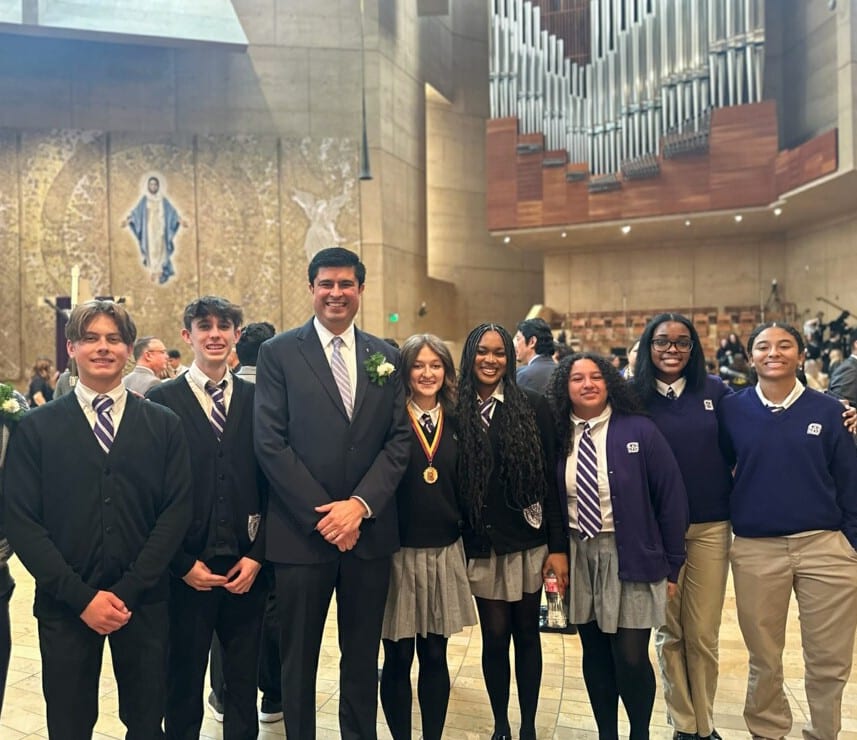
“We have to be careful, yes, but we also can't operate in fear. Canceling Masses … is not an option because our liturgies are centering. That's where our faith is and that's what our schools are centered around.”
The Diocese of Providence has encouraged schools to tap into their parent base, asking parents with law enforcement or military backgrounds to attend school Masses and help coordinate safety plans.
“We are reaching out to connections. I have had principals set up parent volunteers to just come in and be an extra set of eyes walking around,” Klements said.
“We have multiple chiefs of police and officers whose children attend our schools so we're leaning on those connections there to just make sure that we have either active or former military police walking around our schools and advising us on best procedures.”
Hissrich is planning in Pittsburgh to adjust safety training sessions, not just for the diocesan police force but for teachers and administrators as well.
“We've concentrated so much on ‘active shooter violence’ within the schools, but now we are going to have to look at incidents that could happen within the churches and other spaces,” Hissrich said. “The important thing is the training — [so that] not only the officers, but the administrators, the teachers and the students know what to do.”
On a day-to-day basis, Hissrich and his officers are not dealing with emergency situations, he said, but are aiming to support administrators in cultivating a safe environment.
“Our officers sit down with the students at lunchtime. They are there in the morning when they arrive. They are outside when they leave at night,” Hissrich said. “We have already had students come to our officers and say, ‘you'd better look at this student because he has some type of problem,’ which our officers can then either address or inform teachers and other staff members.”
As for Minneapolis, diocesan leaders are meeting with security firms to discuss ways they can bolster security, and are preparing to share those findings at the next security managers meeting in October.
“We've got a [security managers] meeting in October, which was our next scheduled meeting, so we'll of course be addressing the tragedy at Annunciation," Iovino said.
“We are meeting with 3M, the science company who's in our backyard here, and we're going to actually visit 3M — where they actually manufacture their security window film — and discuss measures with them.”
“We are being proactive, as we always have been.”
Still, proper training and safety measures can only do so much. Tragedy is always a possibility. And it is a reminder, Escala said, of a different call to help.
To that end, he said, school and diocesan administrators are also reviewing formation and mental health resources at schools.
“Prevention starts in school, in church, in parish life,” Escala said.
We need “to open our hearts and to open our ears and to begin the process of healing people who are hurt, who are harmed, either through their experiences in church, in school, or in life.”
“The individual who did this clearly had their own personal motivation. Anyone who would do this is certainly in desperate, desperate need of help.”
Going forward, superintendents and officials are emphasizing the need for regular communication with the parishes, as Catholics look for guidance and comfort.
“I'm talking to the parishes and the schools who are in turn speaking to their congregations,” Iovino said in Minneapolis. “We were at Mass this past weekend, my wife and I, and the pews were full.”
“It warmed my heart to see how this community is coming together in prayer seeking that healing for Annunciation and our entire community.”