






Paprocki: On Durbin award, ‘I had to say something’

The Archdiocese of Chicago announced recently its plans to honor Senator Dick Durbin with a “lifetime achievement award” from the archdiocesan office of human dignity and solidarity.
Durbin, who is Catholic, is scheduled to receive the award “for his work with immigrants” at a Nov. 3 fundraiser in the Chicago archdiocese.
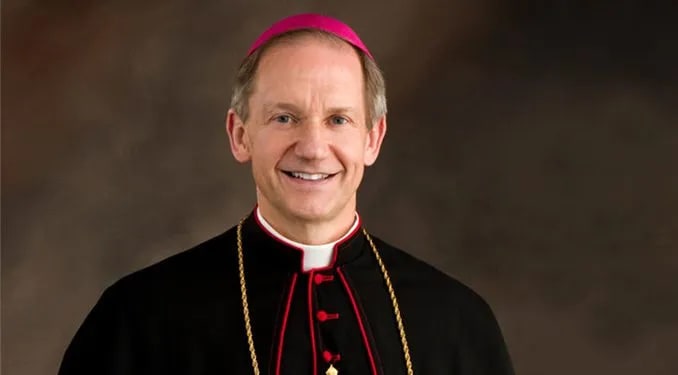
But late last week, Bishop Thomas Paprocki of Springfield, Illinois expressed “shock” over the decision, explaining that Durbin is prohibited from receiving the Eucharist in the Springfield diocese, where he resides, because of his advocacy for legal protection for abortion.
Paprocki talked with The Pillar Sept. 22 about the award, and his decision to speak out.
This interview has been edited for length and clarity.
Bishop Paprocki, it is not common for a diocesan bishop to comment on decisions made in another diocese.
Why did you feel it important to say something about this award?
The main issue for me is the fact that Senator Durbin has his home here in Springfield, and in that regard, I'm still his bishop.
I know that he has a residence also in Chicago, and since he was told back in 2004 not to go to communion here in Springfield, he has started, for some time now, apparently going to Mass in Chicago.
But the fact is that he still has a domicile here, and that still gives me jurisdiction over him.
If he lived somewhere else — in another diocese — and I didn't have a direct connection I might not have said anything publicly about this. But in this case, because my predecessor was so strong in dealing with this matter and I've continued that here, I felt that I had to say something.
I think some people reading your comments might conclude that this is a partisan issue, that your intervention came because Sen. Durbin is a Democrat. Is this about a partisan position?
No, it’s not.
I would have done the same thing if Senator Durbin were a Republican.
For me, it's a pro-life matter, an abortion issue.
We have a politician here, who is a Catholic politician, and who has very publicly promoted a [policy of] abortion license, and has opposed any attempt to restrict abortion rights, and so that's what it comes down to.
I think it's also a question of the consistent ethic of life promoted by Cardinal Joseph Bernardin, the late archbishop of Chicago, who I worked very closely with over the years … I served as his chancellor until he died.
So I think his emphasis on the “consistent ethic” was precisely what the phrase implies — we have to be consistent, and that you can't say, ‘well, I'm pro-life on 9 out of 10 issues, I just disagree with the Church on the abortion issue, but I'm still pro-life, I'm still consistent.’
I think Cardinal Bernardin’s answer to that would have been: ‘No, you can’t say that you’re pro-life if you’re not consistent across the board.’
Cardinal Berndardin didn't like it when people would use the consistent ethic to try to argue that you can downplay the abortion issue as long as you're promoting other social justice issues.
And I know that from his own words.
In 1998, he told the National Catholic Register: ‘I know that some people on the left, if I may use that label, have used the consistent ethic to give the impression that the abortion issue is not all that important anymore, that you should just be against abortion in a general way but there are more important issues, so don’t hold anybody’s feet to the fire just on abortion. That’s a misuse of the consistent ethic, and I deplore it.’
I think in this case, Cardinal Bernardin would deplore any attempt to say: ‘Well, we're just using a consistent ethic of life to honor Senator Durbin, even though he happens to be pro-abortion.’
I would say that's comparable to saying that someone is a good Catholic who follows 9 out of the 10 Commandments except for the one that says ‘Thou shalt not kill.’
Do you anticipate any reconsideration from the Chicago archdiocese?
Well, I’m hoping and praying for some reconsideration. I mean, I think that it would be important.
I've heard from a number of pro-life people who are very upset that the Archdiocese of Chicago is doing this.
And I think it would be important for people to speak out about this so that I’m not the only one speaking on it. If there is a general outcry from the Catholic community, saying that this really shouldn't be done and that the honor should be revoked, I would hope that the Archdiocese of Chicago and Cardinal Cupich would reconsider.
Archbishop Salvatore Cordileone has already expressed some solidarity with your position. Do you anticipate other bishops might say something?
Yes, I do. And this is even something that I hope the USCCB would weigh in upon, because it is contrary to the statement the USCCB issued back in 2004 on Catholics and political life.
That statement is very clear as well, it says that the Catholic community and Catholic institutions should not honor those who act in defiance of our fundamental moral principles. They should not be given awards, honors, or platforms which would suggest support for their actions. So when you have an archdiocese basically acting contrary to this guidance from the USCCB, I don't know what the consequences are of that.
I would hope at least for some kind of a statement from the USCCB that this is contrary to our statement on Catholics and political life.
Would you feel compelled to speak out in the same way in a similar situation, if the person advocated for other things contrary to the faith — the unfettered use of the death penalty, for example…
Yes.
And again, this [Durbin] situation is connected to my own diocese.
But if there was a case in another diocese, and that bishop were to speak concern about the policies of the national bishops’ conference being flouted here, yes, I would've said something in support of that as well.
And I appreciate the Archdiocese of San Francisco and Archbishop Cordileone and their words of support, and I do anticipate that more [bishops] will be supportive as well.
There has been a great deal of emphasis placed at the USCCB in the past few years on unity, and the appearance of unity among bishops. And it seems that Pope Leo really wants to emphasize episcopal unity.
Have you violated that unity by speaking about a brother bishop the way that you have?
Well, I think the question is: Who initiated that? Who is violating the unity here?
I don’t think I'm violating unity by pointing out a violation of our USCCB statement and policy. It’s the violation of the USCCB statement that is acting contrary to our unity.
I think what we have to do is speak the truth, and when we see something that is wrong taking place, I don’t think that we should be silent or say, ‘Well, I don't want to say anything because that will violate unity.’
What’s violating unity is not speaking out, it’s that something has been done contrary to Church teaching.
I’m reminded that French bishops spoke out this summer, when the archbishop of Toulouse made a controversial appointment to the office of chancellor…
Yes.
Unity does not mean that you stay silent because you don't want to ruffle anybody's feathers. It certainly is desirable that we all speak with one voice and that we work together as Christ entrusted his mission to us. But when someone steps outside of what the Church teaches, well I think we have to call that out.