














Scott Adams and the legitimacy of imperfect confession

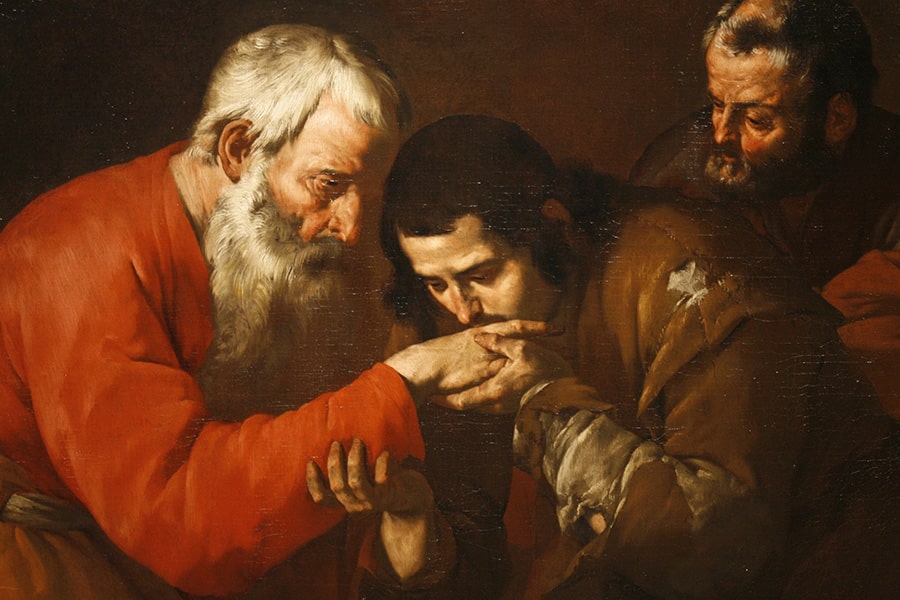
“What happens next is between me and Jesus.” – Scott Adams, Jan. 4, 2026
Only days after announcing a planned-upon, heavily hedged conversion to Christianity, Scott Adams, creator of the “Dilbert” comic strip, author, political commentator and professed agnostic died of metastatic prostate cancer at the age of 68.
What happens next is, indeed, between him and Jesus, and far beyond our knowing. That hasn’t stopped the post-addicted denizens of social media from ruling (some with embarrassing certainty) on the state of Adams’ soul and whether he has been admitted into the beatific vision or stands outside the pearly gates, guilty of making an imperfect confession of Christ.
Certainly, Adams’ announced conversion plan was not a typically pious one. “I’ve not been a believer, but … I have great respect for people who care enough that they want me to convert … it’s coming so you don’t need to talk me into it.”
Respect aside, Adams admitted that complaints from Christians about his approach to Christ had almost talked him out of it, and made it clear that he would judge the ripest moment for his move. “I still have time, but my understanding is, you’re never too late.” He added, “If it turns out that there’s nothing there, I’ve lost nothing … If it turns out there is something there and the Christian model is the closest to it, I win.”
Only upon the announcement of his death, in his own written remarks, did Adams give his Christian followers the words they wanted to hear, delivered respectfully but with honest dollops of hope and hedging: “I’m not a believer, but I have to admit the risk-reward calculation for doing so looks so attractive to me, so here I go: I accept Jesus Christ as my Lord and Savior and look forward to spending an eternity with him. The part about me not being a believer should be quickly resolved if I wake up in Heaven. I won’t need any more convincing than that. I hope I still qualify for entry.”
Given that his “Dilbert” cartoon spoofed corporate life, it seems fitting Adams approached the idea of religious conversion as a dryly analytical risk-return computation. To some his thinking recalled “Pascal’s wager,” in which 17th-century mathematician Blaise Pascal reasoned that a 50 percent probability of God’s existence represented a bet worth making.
The question for many — offered in Dilbert-speak — is: Can such a calculated conversion, so full of risk management, “close the deal” and bring a heavenly reward? Some consider his action insufficient, lacking a true encounter with Christ. Others argue that simply saying the words is enough to provide an opening for divine mercy.
Two books can help us with these questions. In the Gospel according to Luke we read of a prodigal son who demands his inheritance and, after wasting it, reasons that a return to his father will fill his belly and serve his needs: “I will get up and go to my father, and will tell him, ‘Father, I have sinned against heaven, and in your sight. I am no longer worthy to be called your son. Make me like one of your hired servants.'”
Even if they were not heartfelt, the self-interested son’s words met the formula of apology. We may consider it an inadequate confession, and yet Luke tells us, “While he was still a long way off, his father caught sight of him and was filled with compassion. He ran to his son, embraced him and kissed him” (Lk 15:20).
A deathbed conversion, almost by definition, suggests a soul that is “still a long way off” — we are all of us, always, a long way off — and yet the Father, who has been waiting and watching, comes running, accepting our confessions even when they are weakly made, or looking for a win.
Rumer Godden’s classic novel “In This House of Brede” gives us another thought to chew on, as an abbess counsels, “Most of us die in our sins, but no one knows what happens in those last few moments. God is infinitely merciful …”
It is certainly a mercy worth betting on. RIP, Scott Adams.
Read More Commentary