





Spanish priest denies conviction reports in hate crime trial

A priest in Spain has denied media reports claiming that he was convicted in a hate crimes trial which stems from comments made during a 2017 streaming broadcast on radical Islam.
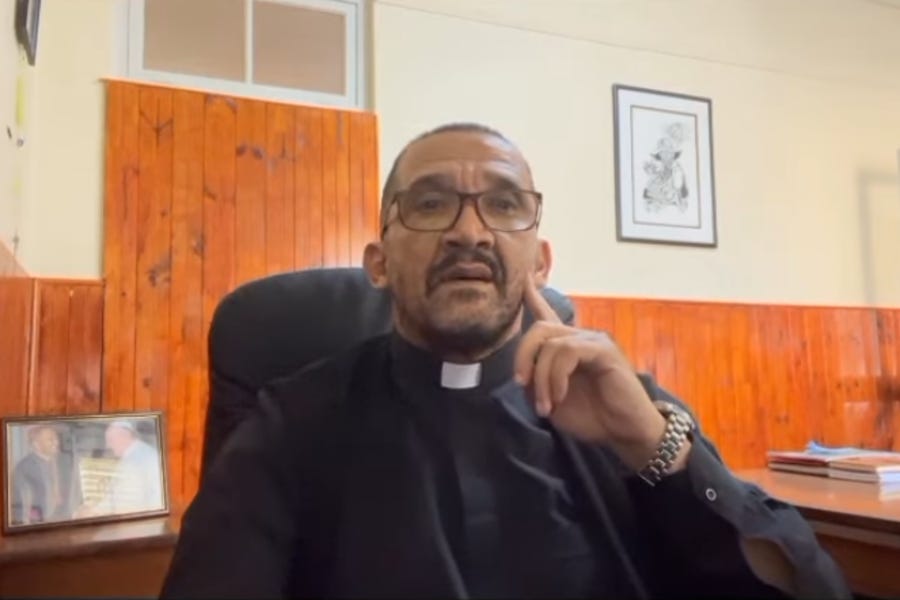
“We’re still awaiting a court ruling. It will take at least a month or two,” Fr. Custodio Ballester of the Archdiocese of Barcelona told The Pillar October 16.
“If we’re convicted, we will appeal to the [Spanish] supreme court, of course. But they haven’t done that yet.”
Ballester faces the possibility of three years in prison and a €3,000 fine if he is found guilty on hate crimes charges.
But he denied claims, published in several English-language publications, that he was found guilty earlier this month.
The charges against Ballester stem from a 2017 broadcast about radical Islam in Catalonia, on a show called La Ratonera (The Mouse Trap), produced by Alerta Digital.
Another priest who participated in the broadcast, Fr. Jesús Calvo of the Diocese of León, was also charged with a hate crime, as was the host of the broadcast, journalist Armado Robles.
During the broadcast, Ballester called jihadism a “predatory stain” and said that “radical jihadism and violent Islam want to destroy Europe and the Western civilization.” Calvo said that jihadists were arriving in Spain as “invading refugees… making coexistence complicated.”
Ballester told The Pillar that his comments were made in the context of a discussion on radical Islam, not against Muslims in general, and were subsequently taken out of context by the prosecutor.
“I don’t have a single Islamophobic bone in me,” he said.
He noted that he wrote a column praising Turkish President Recep Tayyip Erdogan and Iranian Ayatollah Ali Khamenei, both Muslims, when they spoke out against a controversial Last Supper parody included in the opening ceremony of the 2024 Olympics.
“When I see there’s something admirable in Islam, I have no problem in admitting it,” Ballester said.
The provincial prosecutor’s office of Malaga opened an investigation and pressed charges against Ballester, Calvo and Robles in 2020, after a legal complaint from the group Muslims Against Islamophobia.
The group has received funding from the Catalan regional government, according to Spanish media.
The group was widely criticized in 2021 over a statement praising the Taliban’s return to power in Afghanistan.
Ballester said prosecutors are seeking the maximum sentence for the defendants: four years for the program’s host, and three years each for Ballester and Calvo, along with an eight-year disqualification from teaching and €3,000 fines.
The defendants appeared before a three-judge panel on Oct. 1. Ballester described the hearing as “a philosophical and even linguistic interrogation.”
“I was being interrogated on whether I was talking about the whole or a part [of Islam], and they conducted a morphological and semantic analysis of my phrases, to the point in which I had to tell the prosecutor that I couldn’t put an adjective to every single noun I said to make clear I was talking about radical Islam, because no one speaks like that,” Ballester said.
“It’s obvious I wasn’t talking about all the Muslims in the world, but extremists,” he added.
Ballester holds that his remarks were intended as an analysis, not to call for violence.
“My attorney says that if there’s no politics involved, they will absolve us. We haven’t called to burn anyone or promoted violence against anyone. We’ve just conducted a geopolitical and religious analysis of a situation,” he told The Pillar.
Still, Ballester knows he may spend time in prison over the ordeal. He said he is thankful to be facing “only three years of prison.”
“In Afghanistan, I would’ve gotten the death penalty,” he commented.
“There’s the chance that I’m declared guilty but without a prison sentence,” he said. “But if I have to go to prison, my own bishop told me that I can do a lot of good in prison. As long as I’m allowed to celebrate Mass, the problem is solved.”
The priest is concerned, though, that a conviction in his case could set a worrying precedent for Catholics in Spain and in Europe more broadly.
“This hate crime has been introduced in such a way that you can go to prison for what you say and think, this is George Orwell’s thought police, this is what prosecutors have been turned into,” he said.
Ballester also pointed to a 2023 killing of a church sacristan by a radical jihadist, in which the prosecutor originally declined to pursue hatred as an aggravating factor. He suggested that the incident reveals a bias against Christians in the way that laws are applied.
“The trial started a week after mine, and a legal organization called Abogados Cristianos had to file a formal accusation to introduce the aggravating factor of hate crime, because the prosecutor only wanted to accuse this man of homicide,” he said.
Neither the Spanish bishops’ conference nor the priests’ respective bishops have publicly defended them. Spanish bishops’ spokesman Bishop César García Magán said Oct. 3 that the case “is the direct responsibility of the local bishop” and that the conference “can’t comment on every priest with public activities.”
“Freedom of speech within the law is a fundamental right for all… Judges must determine if that exercise of freedom of speech has surpassed the limits established by the law,” García Magán added.
Ballester has differed from his bishop, Cardinal Juan José Omella of Barcelona, on the topic of Islam in the past.
In 2016, Ballester wrote an article entitled “The impossibility of dialogue with Islam,” in response to an earlier article by Omella, “The necessity of dialogue with Islam.”
“Let’s not fool ourselves,” Ballester wrote in the piece. “Islam today and always—with one hand promotes works of charity, while arming the other to annihilate those who refuse to recognize Allah and Mohammed as the last and definitive prophet of God.”
The article was also incorporated into the case against Ballester.
While Omella has faced criticism for his public silence on the hate crime trial, Ballester says he has felt his bishop’s support.
“He has called me before and after the trial to ask me how I was feeling, what my lawyer told me. He himself said that if there are no politics involved, I should be absolved. He told me that everyone knows this is just politics.”
“So I’ve felt accompanied by my bishop, even if he hasn’t said anything publicly. He has called me, he has supported me. To me that’s enough, and I’m thankful to him,” Ballester said.
He said he has also received support from many priests and laypeople.
“Above all, I’ve felt the support of the people of God. There are a lot of Catholic YouTubers and even some non-believers who have written to me or talked about my case, I guess because they also see this could happen to them,” he said.
“There are also many priest friends who have called me, and some that I hadn’t even spoken to in years. One told me a few days ago that he was celebrating three Masses that day, and that he’d offer all three of them for me. This gives me strength.”