






Vatican probes abuse claim against Spanish bishop

The Vatican has opened an investigation into alleged sexual abuse of a minor against Bishop Rafael Zornoza of Cádiz, the first probe of its kind against a serving Spanish bishop.
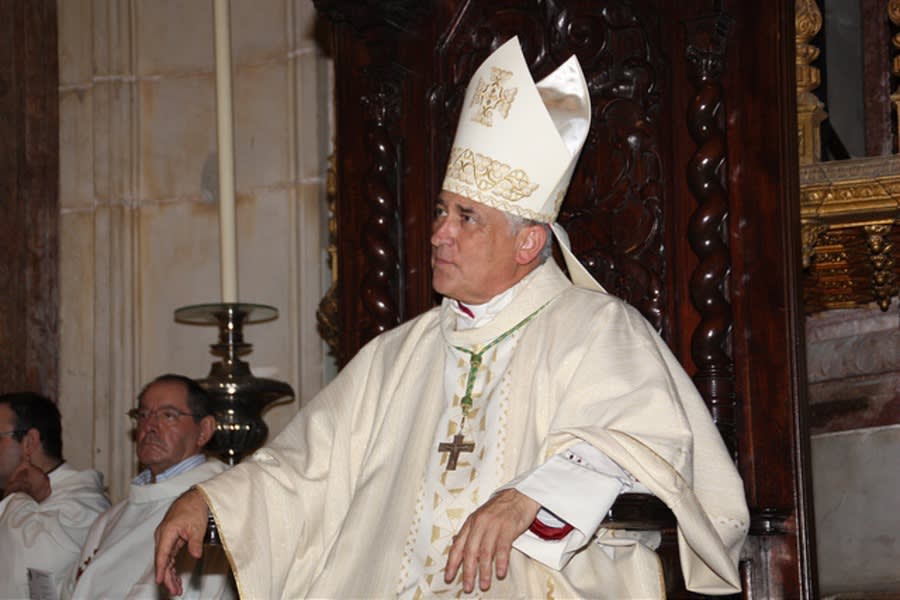
According to Spanish media, Zornoza, 76, is accused of abusing a minor when he served as rector of the seminary of the Diocese of Getafe, south of Madrid, between 1994 and 2001. The alleged victim sent a complaint to the Dicastery for the Doctrine of the Faith in the summer. Zornoza denies the allegations.
Zornoza was ordained a priest in 1975 in the Archdiocese of Madrid. When the Diocese of Getafe was created from the territory of the Archdiocese of Madrid, Zornoza was incardinated in the new diocese and served as the first bishop’s secretary. He then became rector of the seminary in 1994. He was named auxiliary bishop of Getafe in 2005 and appointed Bishop of Cádiz, southern Spain, in 2011.
According to the Spanish newspaper El País, the alleged victim accused Zornoza of abusing him when he was between 14 and 21 years old.
“From 14 to 18 years old, I went almost every weekend to the seminary… During this time, he abused me. He went to my bedroom during the evening and I suffered his abuse. He got on my bed, caressed me, and kissed me. In the mornings, I woke up in the same way. At this time, I didn’t tell him anything, paralysis controlled me,” the letter quoted by El País said.
The alleged abuse continued after the complainant entered the seminary when he turned 18.
The alleged victim added: “I acknowledged my homosexuality to him. [Zornoza] allowed me to enter seminary and took me to a conversion therapy to heal my homosexuality.”
El País did not publish the full letter but it reported that the alleged victim said Zornoza got into his bed almost every evening and morning to kiss him and touch him intimately during the two years he was a seminarian.
“I told [Zornoza] many times that what we were doing wasn’t fine. He always told me it was an intimate friendship [and that] I misunderstood his friendship,” the letter said.
The letter mentioned potential crimes of solicitation and absolution of an accomplice in a sin against the sixth commandment, which are excommunicable offenses and reserved to the DDF.
“Another example of his capacity for manipulation and control over me was the confessions… He made me see that I was not capable of loving or understanding friendship. After confessing my homosexual acts, I went to bed, and a few minutes later, he got into my bed and caressed me,” the alleged victim wrote.
“He convinced me of going to the seminary and said that ‘my wound’ (that’s how he called my homosexuality) didn’t allow me to see things [clearly] or to trust in him. He also convinced me to go to a psychiatrist twice a week to heal my wound, my homosexuality. He didn’t allow me to share my homosexuality or that I was going to therapy with anyone, neither my parents, nor my family, nor my friends.”
The letter also said the alleged victim only became aware he had been abused years later, after going to therapy.
“When I was 32 years old, I sent him an email saying he had abused me. I never received a response, and he never got in touch with me ever since,” the letter said.
According to the letter, the alleged victim met with Zornoza in person this year.
“I told him he had abused me from 14 to 21 years old. He told me that was never his intention, although he acknowledged the manipulation and abuses,” the letter said.
In most situations where a bishop is investigated under the norms of Pope Francis’ 2019 document Vos estis lux mundi, the probe is conducted by the bishop’s metropolitan, in this case Archbishop José Ángel Saiz of Seville. But the Vatican decided instead to ask the Spanish Rota to conduct the investigation.
The Spanish Rota was created through a canonical privilege granted to Spain in the late Middle Ages, establishing it as an ordinary appellate court for various canonical cases in the country.
While it’s not within its official functions, the Spanish Rota is ordinarily asked by the Vatican and the Spanish bishops to conduct investigations on their behalf.
For example, when Cardinal José Cobo of Madrid intervened in 2024 in the Sisters of Merciful Love, a public association of the faithful attempting to become a religious congregation, he asked the Spanish Rota to investigate allegations of sexual abuse and abuse of conscience within the association.
“The rota is the only institution that can conduct an investigation at this level, considering it’s the first of its kind in Spain, due to its means and its experience,” a source close to the Spanish bishops’ conference told The Pillar.
“Everyone will respect a decision made by the rota, it’s the most impartial possibility,” another source added.
The Spanish bishops’ conference told El País that it “trusted justice [would be served] and respected the job of the rota.”
Bishop Zornoza said in his denial of the accusations that “they have to do with facts that occurred over 30 years ago, are very grave and also false.”
“The case was brought to the rota of the apostolic nunciature in Spain last week. There is trust in justice and we will collaborate with it in every way possible. At the same time, it is necessary to remember the respect for the presumption of innocence,” the denial said.
While no canonical precept or precautionary measure was announced against the bishop, he said he had decided to suspend his agenda temporarily.
Spanish media reported that Zornoza is suffering from an aggressive form of prostate cancer, and he confirmed the reports in his statement.
Sources close to the bishop have questioned the allegations.
One source told The Pillar: “According to the news, this was a case of ongoing abuse. At that time, Bishop Rafael was popular among young people and had thousands of young men and women in camps, retreats, and activities at the seminary and in other places, so it would be very weird if no one else ever saw anything odd or that no one else suffered any kind of abuse.”
The source added: “He was the rector of a very large seminary, so it would be unlikely that he only abused this alleged victim but no one else, or that no one else saw anything, considering how frequent the alleged abuses seem to have been.”
But a source close to the Spanish Rota told The Pillar that “if the rota took the case, it’s because they believe the allegations have a degree of credibility and at least deserve to be investigated.”
Meanwhile, Spanish media Religión Digital quoted sources in the Diocese of Getafe as saying that they received the news “with pain but without surprise… We’re surprised it took so long for something to come out.”
Archbishop Luis Argüello of Valladolid, the president of the Spanish bishops’ conference, said Nov. 11 that the conference “wanted the truth to be known” and asked for the principle of the presumption of innocence to be respected.
“The Church wants to be close to the pain produced by the signs of the credibility of the complaint and the pain of the presumption of innocence that could be attacked,” he said.
At a separate press conference Nov. 11, Cardinal Cobo said that “the investigation is in good hands” and the Vatican had decided to investigate the allegations because they “seem credible.”
He added that the investigation would be “exhaustive and efficient.”