





Will the new Archbishop of Canterbury impact Anglican-Catholic ties?
With its 85 million members in 165 countries, the Anglican Communion is the third-largest Christian communion after Catholicism and Eastern Orthodoxy. The appointment of its new spiritual leader is therefore a big deal.
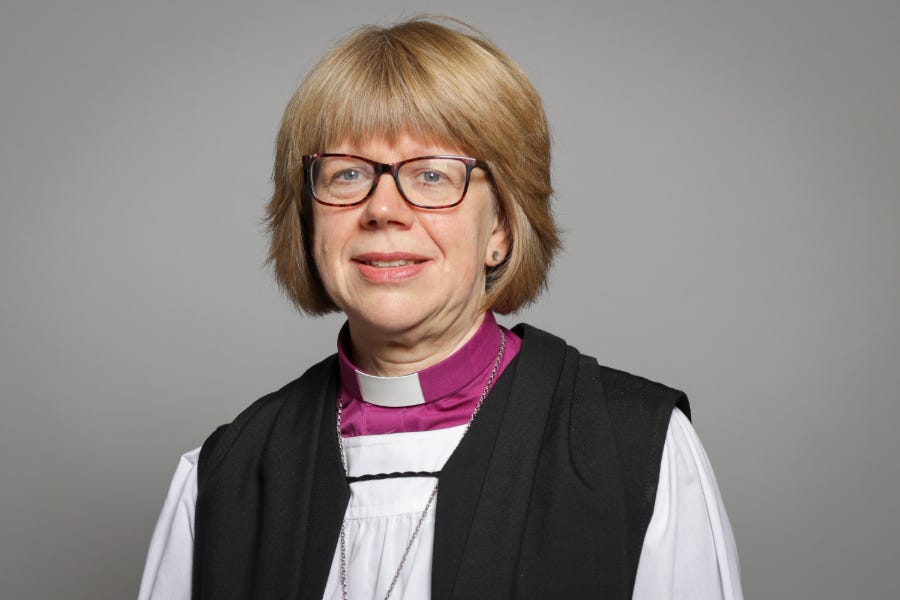
The U.K. government said Oct. 3 that King Charles III, the Supreme Governor of the Church of England, had approved the nomination of Bishop Sarah Mullally as the next Archbishop of Canterbury, leader of the Anglican Diocese of Canterbury and ex officio the spiritual figurehead of the loose-knit Anglican Communion.
“The 106th Archbishop of Canterbury since St. Augustine arrived in Kent from Rome in 597, Bishop Sarah will be the first woman to hold the office,” said the press release making the announcement — referring to the Anglican claim of an unbroken succession of archbishops of Canterbury, despite the Church of England’s establishment as a separate entity from the Catholic Church during the Reformation.
Who is the Archbishop of Canterbury-designate? And what does her appointment mean for Anglican-Catholic relations?
Is there an actual Diocese of Canterbury?
Yes, the Anglican Diocese of Canterbury is centered on the cathedral in the city which is the site of the martyrdom of St. Thomas Becket.
Although the diocese traces its origins back to the arrival of the first Catholic missionaries in Kent, led by St. Augustine in 597, the diocese formally broke with Rome in 1534, with the passage of the Act of Supremacy — the law establishing the king as head of the Church of England.
The modern Archbishops of Canterbury remain head of the historic territory, though in practice they spend most of their time leading the Church of England and acting as global representative of the Anglican Communion, spending most of their time at the archbishop’s residence at Lambeth Palace in London. In the archbishop’s place, the senior suffragan bishop of the archdiocese, the Bishop of Dover, customarily leads the diocese day-to-day.
Does the Church recognize Anglican bishops as validly consecrated?
In the 1896 bull Apostolicae Curae, Pope Leo XIII declared ordinations in the Anglican communion to be “absolutely null and totally void,” even though, from a purely historical perspective, a line could be traced from the Catholic Church prior to the Reformation.
Leo concluded that changes to the rite of ordination introduced in the early years of the Church of England nullified the intention to confer sacramental ordination according to the understanding of the Catholic Church.
Of course, the Church also teaches that the conferral of priestly or episcopal ordination is reserved to men alone, so even if an otherwise valid ordination were attempted on a woman, it would be by its nature invalid.
Who is Sarah Mullally?
Sarah Mullally is the 63-year-old Anglican Bishop of London, who previously served as the chief nursing officer for England.
She was among the favorites to succeed Archbishop Justin Welby, who resigned as Archbishop of Canterbury in November 2024, following intense criticism of his handling of an abuse case.
She was born Sarah Elisabeth Bowser in Woking, Surrey, on March 26, 1962. She became a Christian at the age of 16 and embarked on a long and distinguished career in Britain’s National Health Service, describing nursing as “an opportunity to reflect the love of God.”
In 1987, she married Eamonn Mullally, a London tourist guide with Irish roots, and together they raised two children.
The Church of England, the country’s established church (state church) and the mother church of the Anglican Communion, approved the ordination of women priests in 1992 and women bishops in 2014.
Sarah Mullally was ordained as an Anglican priest in 2001 and became a bishop in 2015. Her national profile grew considerably in 2018 when she was named the Bishop of London, the third most-prominent role in the Church of England behind the Archbishop of Canterbury and the Archbishop of York. The appointment also gave her a seat in the House of Lords, the upper house of Britain’s Parliament, and meant she played a prominent role at King Charles’ 2023 coronation.
Mullally is portrayed by the British media as a theological liberal. But she has described herself as being “very respectful of those who, for theological reasons, cannot accept my role as a priest or a bishop” — a reference to those Anglican groups and individuals who remain members of the Church of England but operate under special pastoral and structural arrangements without acknowledging women clergy.
Perhaps most controversially for Catholics, Mullally described herself as “pro-choice” in a 2012 blog post.
“I would suspect that I would describe my approach to this issue as pro-choice rather than pro-life although if it were a continuum I would be somewhere along it moving towards pro-life when it relates to my choice and then enabling choice when it related to others,” she wrote.
Mullally will legally become the Archbishop of Canterbury at a Jan. 28, 2026, ceremony at St Paul’s Cathedral in London. She will be installed at Canterbury Cathedral in Kent in March 2026.
What’s the ecumenical impact?
The first Catholic reaction to Mullally’s nomination came from Cardinal Vincent Nichols, the president of the Bishops’ Conference of England and Wales.
He welcomed the appointment but did not note that Mullally will be the first woman to hold the post or highlight any potential ecumenical implications.
“She will bring many personal gifts and experience to her new role,” he said. “The challenges and opportunities facing the new Archbishop are many and significant. On behalf of our Catholic community, I assure her of our prayers.”
Nichols is unlikely to work alongside Mullally as he turns 80 in November and is expected to step down as the Archbishop of Westminster, England’s most prominent Catholic leader.
Cardinal Kurt Koch, president of the Dicastery for Promoting Christian Unity, took a similarly discreet approach to Nichols in a letter congratulating Mullally on her appointment.
“I pray that the Lord will bless you with the gifts you need for the very demanding ministry to which you have now been called, equipping you to be an instrument of communion and unity for the faithful among whom you will serve,” he said.
The Vatican does not seem greatly concerned by the nomination of the first female Anglican Archbishop of Canterbury, though it may have concerns about Mullally’s ethical positions.
The Catholic Church made clear in 1992 that it considered the ordination of women to be a grave setback for efforts to promote Anglican-Catholic unity. It recognized at the time that the step would inevitably lead to Anglican female bishops, so it will not be surprised that a woman is poised to lead the Anglican Communion.
The Vatican already has well-established protocols for receiving women bishops from Protestant communions. Earlier this week, for example, the Dicastery for Promoting Christian Unity hosted the German Lutheran Bishop Kristina Kühnbaum-Schmidt.
Catholic leaders around the world are also used to engaging with Protestant women bishops. For example, Stockholm’s Cardinal Anders Arborelius has a strong ecumenical relationship with the Lutheran Church of Sweden’s Bishop Karin Johannesson.
But Vatican officials may need to think through how to choreograph major ecumenical prayer events when the leaders of the three largest Christian communions — Pope Leo XIV, Ecumenical Patriarch Bartholomew I, and Archbishop-designate Sarah Mullally — are present.
Recent trends in the ecumenical world also suggest Mullally’s appointment will have limited impact on Anglican-Catholic relations. In recent decades, the ecumenical movement has shifted its focus from groundbreaking joint statements toward what Pope Francis called the “ecumenism of life,” which stresses everyday coexistence and cooperation.
This change of emphasis has allowed Church leaders to put theological disagreements on the back burner, although dialogue between Anglican and Catholic theologians continues through bodies such as ARCIC and IARCCUM.
Fr. James Bradley, an assistant professor of canon law at The Catholic University of America and a member of the Personal Ordinariate of Our Lady of Walsingham, told The Pillar via email: “The Oxford Movement in the 19th century challenged the Church of England as much about her origins as her identity today. Its protagonists sought to call her back to the Catholic elements still present in the Anglican tradition, which Vatican II would later acknowledge and hold in high regard.”
“The developments around the ordination of women in the Church of England are both a catalyst and a fruit of the determination made over the past 50 years or so that the Church of England should look not principally to her origins in the Church of the first millennium, but to the events of the 16th century.”
“This means that the common ground of doctrine that was so evident between Anglicans and Catholics in the postconciliar era is today drastically reduced. This new appointment is, in its way, simply a recognition of that reality, which has existed for close to 20 years.”
Bradley said Mullally’s appointment would not diminish Rome’s commitment to ecumenism.
“There is an unwavering dedication to ecumenical dialogue in the Catholic Church, and we should not expect this to be affected by the appointment,” he said.
“Ecumenical relations will certainly continue, and with a new pope and a new Archbishop of Canterbury — as was the case with Pope Francis and Justin Welby — there is a new opportunity for building personal relationships of trust and mutual respect.”
“But the immediate goal of dialogue has really already changed from one of corporate reconciliation, to one of simple coordination and cooperation.”
Fr. Ed Tomlinson, another priest of the Personal Ordinariate of Our Lady of Walsingham, said Mullally’s appointment could have a profound effect in some quarters of the Anglican Communion.
“For those who care about fidelity to Scripture and to the historic faith in all ages this appointment will almost certainly present a challenge and for some a catastrophe,” he told The Pillar via email.
“The appointment moves the Church of England closer to the modernist spirit of the Episcopal Church in America and away from the Anglican presence in Africa and Asia, which will bring tensions to the unity of the global Anglican Church. Expect Evanglicals to lead a disgruntled opposition in this respect.”
“It also moves the Church of England even further away from the faith and praxis of both Roman Catholics and the Eastern Orthodox, which will have major implications for ecumenical dialogue.”
He added: “This will almost certainly lead to a polite gesture ecumenism only, whereby doctrine is never seriously discussed due to irreconcilable differences and friendships are simply celebrated for an easy photo opportunity. This will stand in contrast to the meaningful work of unity as proposed by Pope Benedict XVI via his erection of the ordinariates.”
A minority of members of the Church of England continue to stress Anglicanism’s Catholic elements. In 2010, before the approval of women bishops, roughly 1,000 out of 13,000 parishes rejected women priests. Will the prospect of a female Archbishop of Canterbury prompt some of these Anglicans to cross the Tiber?
“The ordinariates represent an alternative path forward,” said Bradley. “One that remains intent on pursuing concrete unity, and finding an honored place for the Anglican tradition in the Catholic Church; of being Christians with each other, not just Christians to each other.”
“Anglicans still committed to reconciliation with the Catholic Church have had this proposal before them since 2009. But the history of Anglicanism — particularly of Anglo-Catholicism — is one of lines being drawn in the sand. Perhaps this will be a line that some cannot cross, whilst others will accommodate themselves once more to the new reality.”
“Whatever happens in that regard, we can do no better than echo the sentiments and hopes of St. John Henry Newman: ‘I give my best prayers, such as they are, that some means of drawing to us so many good people, who are now shivering at the gates, may be discovered.’”