















3 Principles for Interpreting Scripture


Recently I had a conversation with an older gentleman who has had a serious spirituality of the Word for over 50 years. He’d heard a talk I gave on the three spiritual senses of Scripture and had some time to practice them in his own prayer. He marveled over the riches they brought out of the text and wondered why he was hearing about it only now, after half a century. That is a good question. The Catechism of the Catholic Church has a rich section on spiritual exegesis precisely so it does not remain hidden any longer (see CCC 108-18).
The 3 Principles
The Catechism, following Dei Verbum, lays out three principles for reading the Scriptures “in the same Spirit by whom they were written” (CCC 111-14). Because these three principles immediately precede the account of the three spiritual senses (CCC 115-18), we ought to let them govern our use of the spiritual senses and act as a guard against whimsical or arbitrary interpretations, thereby keeping us within the richness of the Word.
The three principles help us open layers of meaning contained in Scripture as we aim to reveal the core truth of a given passage, which is the mystery of Jesus and our participation in it. There is not just one meaning of a passage but a symphony of interpretations as the mystery of Jesus in our lives breaks open. St. Bonaventure compared interpretation and insights drawn from the Word to a seed expanding into a whole forest and then producing even more seeds.
According to the three principles (CCC 111-14), first, we are to read the passage in light of the whole canon of Scripture. When reading its verses, we are to ask ourselves what other passages come to mind. For example, the rabbis spoke of “stringing pearls” as a given theme in the Bible, which leads us to other passages, which we then weave together to enrich our understanding. We do this at every Mass, as the Lectionary pairs an Old and New Testament reading that corresponds to each day’s Gospel.
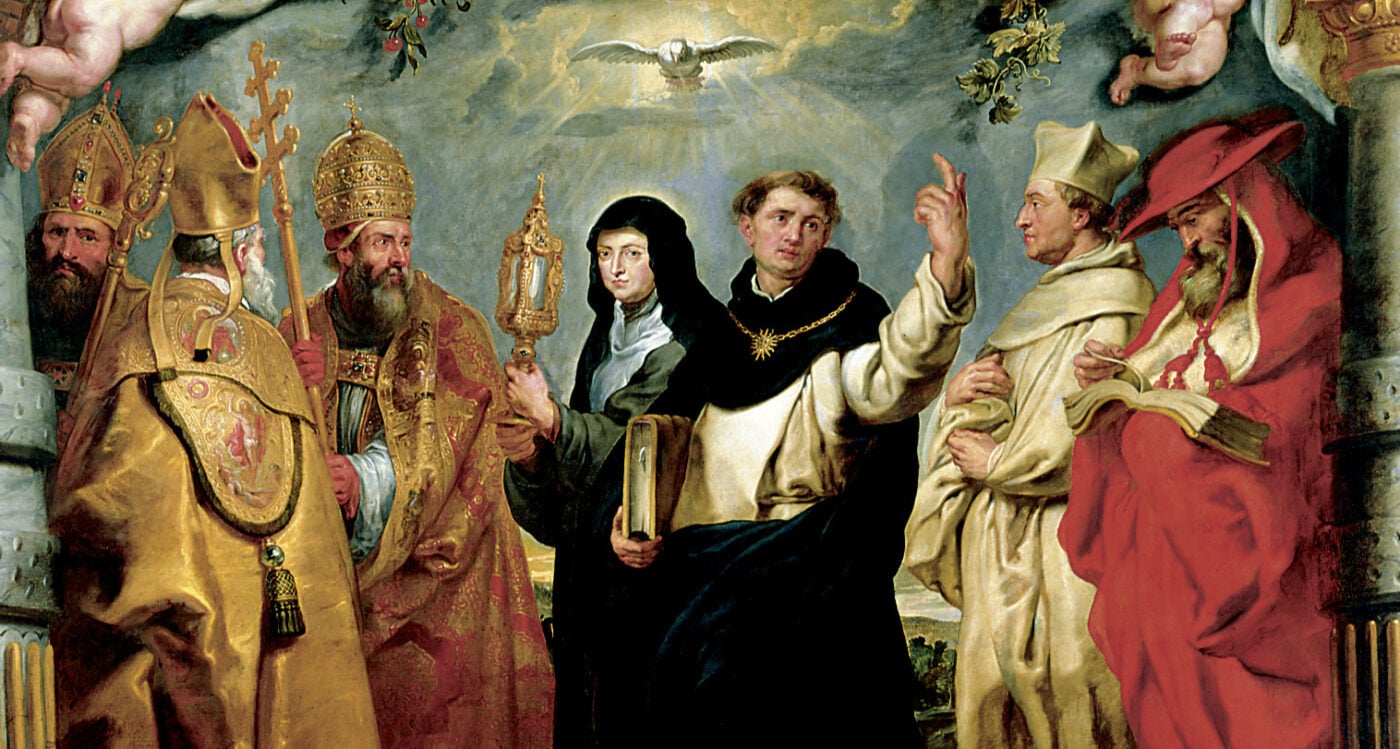
Second, we are to read the text in light of the living Tradition, which involves the saints, the Magisterium, and the Liturgy. What have the saints or the Church taught regarding this passage or theme? Does the Liturgy of the Mass shed any light on it?
Third, we should read the Bible as we keep in mind the “analogy of faith.” We ought to ask ourselves: What theological truths shed light on the passage? What theological implications follow from it?
The Spiritual Senses
Employing these principles as we think about the allegorical (Christological), moral (tropological), and anagogical (eschatological) senses, the spiritual senses, we are kept “on track” while we unravel the many layers of meaning contained in the Word of God.
With our readings this Sunday, here is a brief example of how these three principles and three spiritual senses can play out. (Afterwards, you might ponder what else opens for you.) In our Gospel, Jesus calls us “the light of the world.” Our first reading highlights that our shining forth with light demands upright living and working for righteousness. By living this way God’s light and glory breaks forth from us. There is a brightness that shines forth in living the virtues.
Turning to the saints for guidance, John Cassian, the 5th century monk, observes that, for us to be lightsome like this, our prayerful gaze has to be turned to things of the light, like pondering Scripture, since “the eye is the lamp of the body” (Mt. 6:22). Cassian notes that a watchful remembrance of God and His word “sees and casts light on all a person’s thoughts and actions and discerns everything that must be done” (Conferences 2.2.5).
We might further explicate our Gospel line about us being the light of the world by utilizing the spiritual senses. We might ponder how Jesus, most of all, is the Light of the world (an allegorical interpretation, but also stated explicitly in John 8:12). And that it is by abiding in Jesus and in His Word that we, too, can be light (moral interpretation). Moreover, the light of Jesus’ Word is something we savor in contemplative prayer, in our loving union with the Light. Living this out gives us a foretaste of the heavenly kingdom, as we work to build a community where the hungry are fed and justice and love reign (anagogical interpretation).
Be the Light of the World
God’s “Light” is such a rich concept, worthy of basking in during our prayer. We ought to meditate on how we are called to live as light to the world in our daily lives, shining with the virtues of Jesus, for He is the true Light of the World, who we reflect and who we ask to radiate forth from our lives.
Editor’s Note: This is the sixth article of a CE series on “Exegesis of the Word” by Fr. Ignatius Schweitzer, breaking open each Sunday’s readings for eight consecutive weeks. Catch up on previous articles here!
Photo by Jessica Mangano on Unsplash