





















Beyond Human: The Future According to Transhumanism


The desire to prolong one’s existence indefinitely, avoiding illness or suffering, and the aspiration for physical and intellectual improvement are recurring themes in human history. Providing concrete answers to these aspirations is the goal that is reflected today in the various manifestations of so-called transhumanism.
What is Transhumanism?
It is a movement and school of thought that emerged at the end of the 20th century. Transhumanism advocates the enhancement of human physical, mental, and behavioral capabilities through scientific and technological development.
According to this perspective, humanity is in the early stages of its evolutionary journey. The term “transhumanism” was defined and popularized by Julian Huxley in “In New Bottles for New Wine,” in which he stated in 1957:
The human species can, if it wishes, transcend itself—not just sporadically, an individual here in one way, an individual there in another way, but in its entirety, as humanity. We need a name for this new belief. Perhaps transhumanism will serve: man remaining man, but transcending himself, by realizing new possibilities of and for his human nature.
The Transhumanist Manifesto
In the “Transhumanist Manifesto,” Natasha Vita-More offers a description of what transhumanism is and the criteria that guide it.
The basic idea is to overcome the obstacles that come with the passing of the years, thus extending life and going beyond the measurement of age according to chronological criteria, which are considered discriminatory. Until aging is a “solved problem,” thanks to the use of nanomedicine and other technologies, they believe it is necessary to act on the enhancement of human capabilities. So we can say that in the future, they hope there will be a phase where there will be transhuman beings and later also posthuman beings.
Nick Bostrom describes the “transhuman” as a human being with enhanced faculties, while the “posthuman” does not specify whether it will still be a human being or an entirely artificial being. The posthuman will have a life expectancy of over 500 years, superior cognitive abilities, control over emotions, and an absence of psychological suffering.
The transhumanist movement expresses its ideas in a variety of fields. Natasha Vita-More specializes in the area of transhumanist art. After graduating with a degree in Fine Arts (1973), she continued her studies at the Academy of Fine Arts in Ravenna, Italy (1977), furthering her training in the artistic field. In line with her transhumanist vision, in 1996 she designed a prototype of what the body might look like in the future: the “First Posthuman.”
Is there a positive side to this?
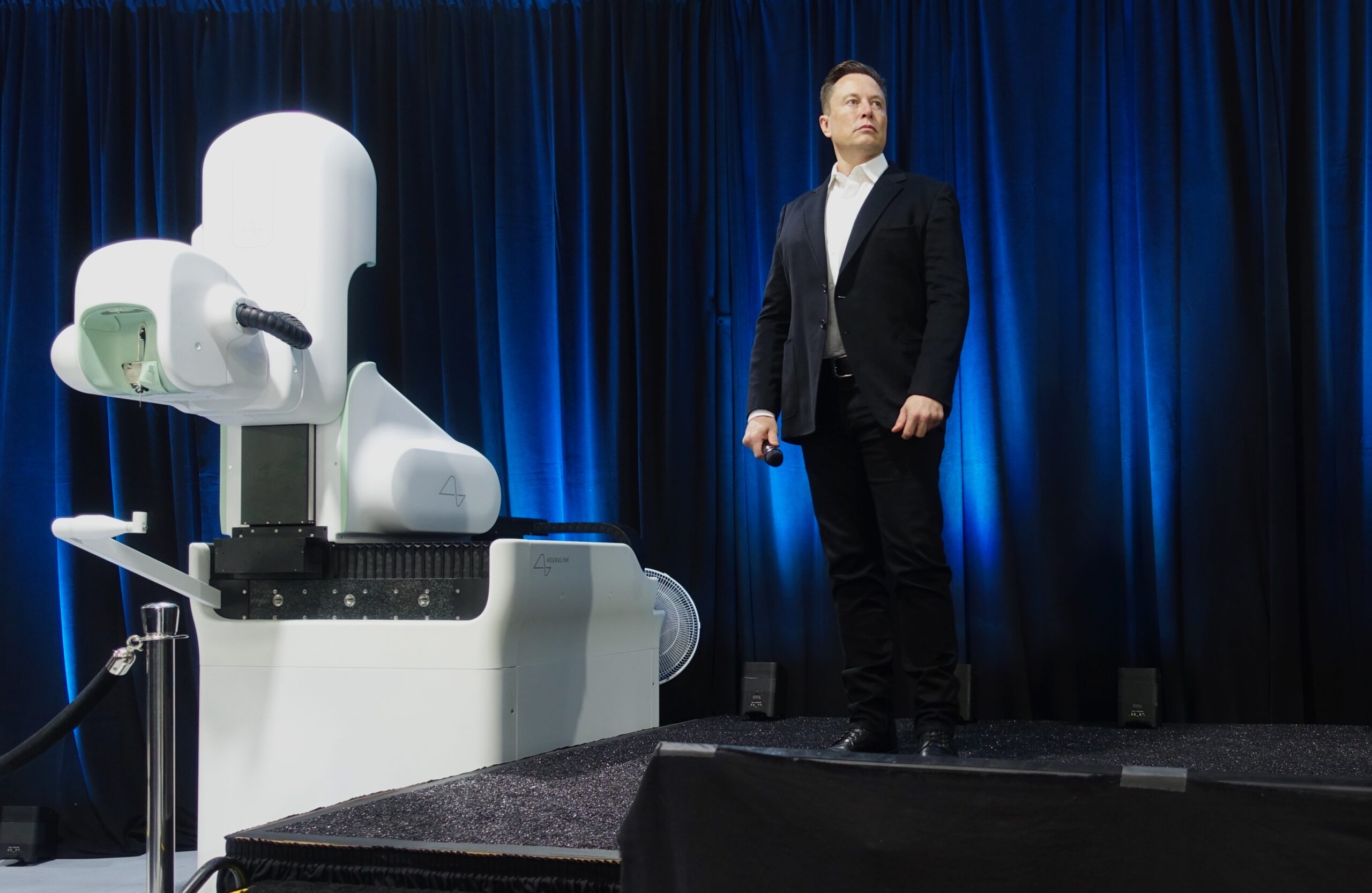
The drive for scientific and technological progress has its positive aspects. In the medical field, devices such as Neuralink, developed by Elon Musk, offer innovative solutions for people with severe motor difficulties. For example, Noland Arbaugh, a boy who became quadriplegic after an accident, can now use a computer directly with his thoughts thanks to the Neuralink implant. Neuralink is currently looking for volunteers with quadriplegia for a clinical study on its brain-computer interface. The system allows the cursor to be controlled by nerve impulses and aims to restore autonomy to patients and expand human capabilities.
Transhumanists promote medical technologies not only to cure diseases, but also to enhance human capabilities beyond natural limits. This poses a problem, as developments in genetics, neuroscience, nanotechnology, and artificial intelligence could soon radically transform humanity. Among the innovations envisaged are anti-aging drugs, nanodevices that replace cells, neuro-pharmaceuticals and neurochips to enhance the mind and memory or control objects with thought (see Neuralink), and even the uploading of memory to digital media. Finally, there are plans to create a Metabrain, an auxiliary brain to expand memory and intelligence.
“Pushing life beyond its limits?”
Research into life extension aims to improve health and increase longevity, but it also has tendencies similar to “existential obstinacy,” focusing on human immortality and the optimization of earthly life. Studies on post-human beings and advanced techniques for preserving the body reflect these perspectives, with the goal of a possible future “resurrection.”
Elena Postigo, a Spanish philosopher and bioethicist, effectively summarizes the fundamental ethical implications associated with transhumanist thinking:
From a bioethical point of view, the most serious implications of this theory are: the eugenic elimination of “imperfect” or malformed human beings (eugenic abortion and preimplantation diagnosis for selective purposes), the creation of “more perfect” human embryos, the elimination of equality among all human beings, the use of nanotechnology with human applications without first considering its consequences on humans (think, for example, of the deprivation, impairment, or control of freedom and consciousness), the cryogenization of human beings, etc. In addition to, fundamentally, the growth of a reductionist, efficiency-oriented mentality that does not respect the dignity of human beings in any situation.
When human nature is no longer enough
Similar to Pico della Mirandola’s Humanism, transhumanism considers humans to be malleable beings, seeing them as the work of indefinite nature. This idea contrasts with the Christian view, which holds that essence and corporeality are fixed and defined. In transhumanism, the body is considered modifiable and capable of integration with artificial intelligence, which is sometimes viewed as an obstacle to progress. Transhumanists tend to reject limitations such as illness, old age, and death.
It is important to note that medicine, scientific research, and experimentation would probably not have developed in the absence of the frailties inherent in the human condition. The limitations of being human have been a fundamental driving force, providing the stimulus and necessity that has guided progress. Rather than being simple obstacles to be eliminated, they have presented themselves as issues to be addressed and resolved.
Max More, in his famous “A Letter to Mother Nature,” refers to nature by saying, “we must say that you have in many ways done a poor job with the human constitution. You have made us vulnerable to disease and damage.” He then adds: “You held out on us by giving the sharpest senses to other animals. You made us functional only under narrow environmental conditions.”
Ramón Lucas Lucas, philosopher and bioethicist, emphasizes the physical limitations of humans: poorly protective skin, senses less developed than many animals, lack of organs of defense and attack, muscles and bones unsuited to endurance or speed, and the need for long-term protection after birth. Lucas Lucas emphasizes that the reduction of instincts makes humans free, since this lack is a necessary condition for acting rationally and not being governed by instincts, as animals are. The deficiency, therefore, is not a mistake but the basis of a higher perfection.
Furthermore, the transhumanist proposal promises an improvement in humanity from a moral standpoint as well, thanks to the use of certain pharmaceutical preparations, seeking to eliminate the true and real spiritual origin of a virtuous life. There is a risk that technological enhancement will compromise full human flourishing, privileging the prolongation of life or performance over values such as virtue, relationships, and a sense of limits. Transhumanist medicine reduces spiritual growth to “mere materialist enhancement.”
Transhumanism, while starting from noble intentions such as overcoming suffering, fighting disease, and seeking equity, proposes a vision of man radically different from the Christian one: it considers aging a disease to be eradicated, bodily identity as a property to be freely modified, the mind as a technical datum to be enhanced, and existence itself as a project to be artificially extended—forgetting that man is not a product to be optimized, but a creature endowed with intrinsic dignity, called not to self-creation, but to relationship with God, with others, and with creation, in a logic of gift and not of domination.
Photo by Rachael Ren on Unsplash