























Meditate on the Cross Daily and Take Up Your Own
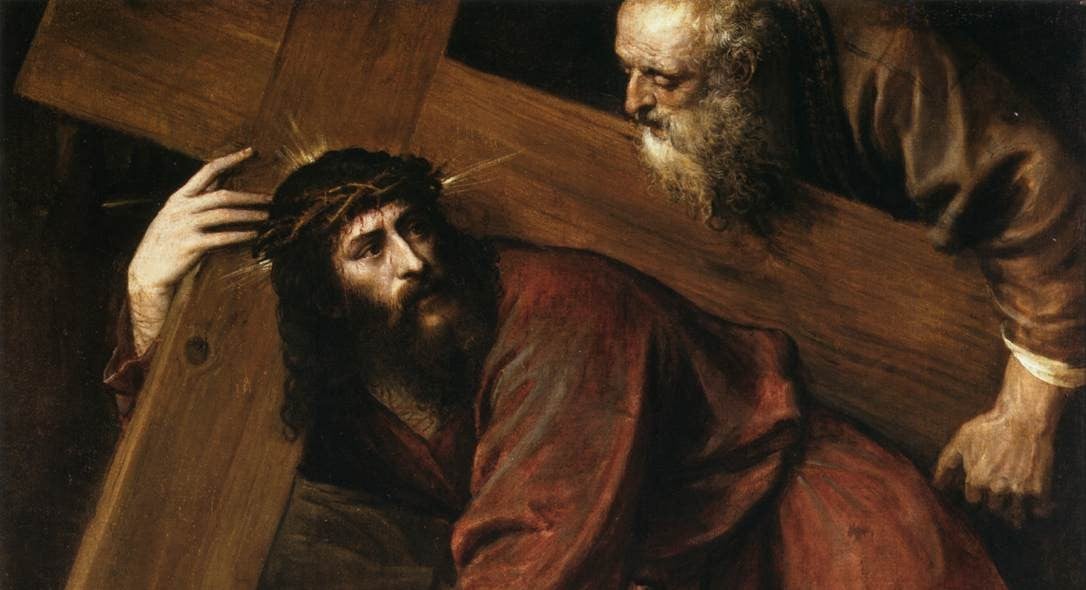
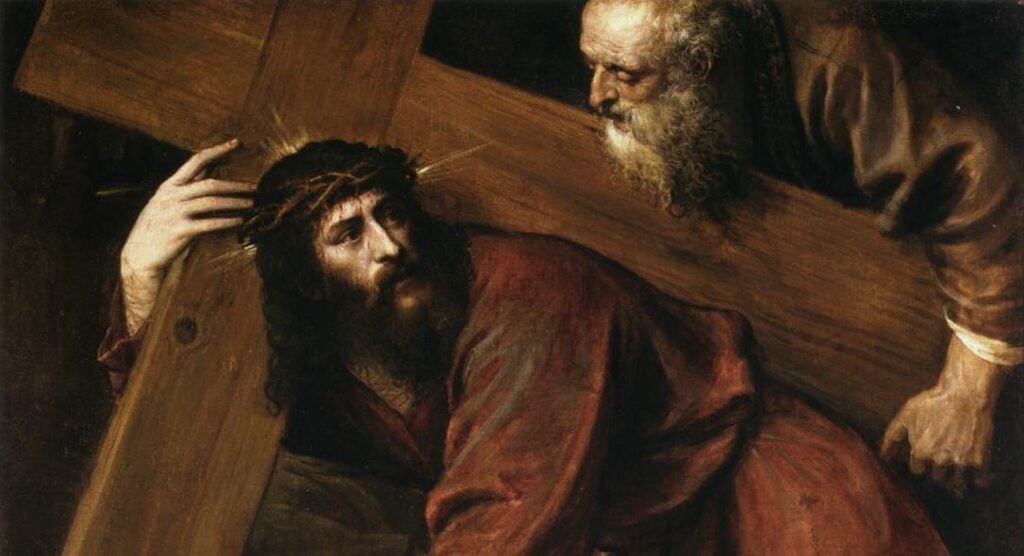
Whoever does not take up his cross and follow after me is not worthy of me. (Mt. 10:38)
There are a number of ways that we can approach prayer to welcome the grace of union with Christ more deeply into our hearts. One way is to make a good examination of conscience, asking the Holy Spirit to shed light on the faults, failings, and vices within us that we have been blind to. Another way is to simply “count our blessings,” most especially those that are hidden in our trials, by striving to recognize the hand of God in them, a hand which ever works all things for good. Additionally, we can take the time in the predawn hours each day to immerse ourselves in Scripture and in prayer, to study the life of Our Lord and to receive the daily guidance He has in store for us personally. Above all, we can unite our hearts to the Lord’s by faithfully receiving Him in the Eucharist at Mass. We can remain with the Eucharistic Lord all day and return to Him at any time by making a heartfelt Spiritual Communion.
While all these practices are indispensable for us to grow in holiness, and perhaps fairly obvious to us (though we are far from executing them perfectly), there is one practice that comparatively few Christians understand and engage in—at least not on a regular basis, and not to the extent that the Lord desires. In fact, it is a practice that many of us instinctively avoid. However, it is a practice which, St. Augustine tells us, “is worth more than a pilgrimage to Jerusalem, or a year of fasting on bread and water.” Goodness! What could possibly be worth more than this?
“A single tear shed at the remembrance of the Passion of Jesus.” – St. Augustine
For many of us, the meditation on Christ’s Passion can feel a little…sterile, if we are being honest. But even more problematic, the contemplation of Jesus’ scourging, mocking, and crowning with thorns; the unimaginable sorrow His sweet mother endured in witnessing it all; the humiliation of being stripped and hanging naked from a cross; all of it is so unpleasant. So horrifying!
Who likes to listen to stories of other people’s suffering? We do not want to believe that such torment could be possible for anyone—and so our instinct is to turn away. To go back to our “happy place” where we can pretend that we are immune to some of the things that other families have gone through. How can our souls be at rest if we spend our time thinking the worst? After all, what Jesus and His mother endured was indeed the worst. Why does our Church ask us to meditate upon this?
“He who desires to go on advancing from virtue to virtue, from grace to grace, should meditate continually on the Passion of Jesus.” – St. Bonaventure
The answer to this question lies in the word “meditate.” Meditation is vastly different from “thinking.” When we meditate on a subject, we examine the object of our meditation through the eyes of God. It is a form of prayer; as such, it is the Holy Spirit who reveals its hidden mysteries through His lens, as opposed to the distorted view which our own thoughts can bring. Unlike the mental anguish and distress which we experience when we think about the suffering of our loved ones, when we meditate upon Christ’s sufferings, our sorrow is accompanied by an inexplicable peace.
So, for example, our thoughts will tell us that Mary’s suffering was awful, and that Jesus’ death was painful and humiliating. And while our conclusions would indeed be true, when we meditate upon their suffering, we are shown a greater picture. We are shown that there is more to the story. We are shown just why the Friday that Jesus died is referred to as “Good,” and how Mary’s standing by her Son’s side all the way to Calvary is precisely the reason we can depend on her maternal care in our own sufferings now.
It is indeed good—very good—for us to meditate on the Passion of Christ “continually,” if we wish to advance “from virtue to virtue” and “from grace to grace.”
St. Augustine doesn’t just tell us that the remembrance of Christ’s Passion is worth more than a year of fasting or a pilgrimage to Jerusalem. He says that “a single tear shed” over Christ’s Passion is worth more. That is to say, our mediation upon the sufferings of Jesus (and His mother) is not meant to be sterile at all. We are not to study the last three days of Jesus’ earthly life as an academic exercise; we are to enter into it. To take part in His suffering; to unite it with our own. We are to study Jesus’ sacrifice on the Cross not just in the application of our minds but, more importantly, in the silence of our hearts.
How do we accomplish such a task?
If anyone wishes to come after me, he must deny himself and take up his cross daily and follow me. (Lk. 9:23)
We enter into Christ’s sufferings by following in Our Savior’s footsteps and taking up our cross. If we want to meditate upon the Passion of Christ in a deeper way, then the place to begin is to experience it for ourselves. We will never “shed a single tear” over Christ’s sufferings if we cannot relate to what Jesus went through, at least in some small way. It is for this reason that Jesus asks us to take up our daily cross, for it is by way of accepting our own cross that we are able to meditate upon His.
We can read about His Passion, and we can even look up at a crucifix to remind ourselves of the love He has for us. And we should engage in both of these practices—daily! But unless we ourselves know what it feels like to be rejected, humiliated, and abandoned—even to a much lesser degree—it will be all but impossible for us to have compassion for the One who was rejected for our sake. We simply cannot know what it is like if we have not been there ourselves.
So for today, let us look at the “daily” ways that others have mistreated us—or even rejected us—from a fresh perspective. Let us refrain from licking our wounds in self-pity, ruminating on how “unfair” it is, or analyzing and reanalyzing what we might have done to provoke the mistreatment. Rather, let us strive to accept our rejection as a loving gift from the hand of God, who seeks to unite us more deeply with His Son. By uniting our cross to the Cross of Christ, our meditation on His Passion will be “worth more than a pilgrimage to Jerusalem, or a year of fasting on bread and water” (St. Augustine).
Author’s Note: This article was adapted from a chapter in 26 Steps with the Eucharistic Lord: A Guide to Deeper Communion in Prayer.
Image from Wikimedia Commons