

















Psalm 112: A Standard for Men
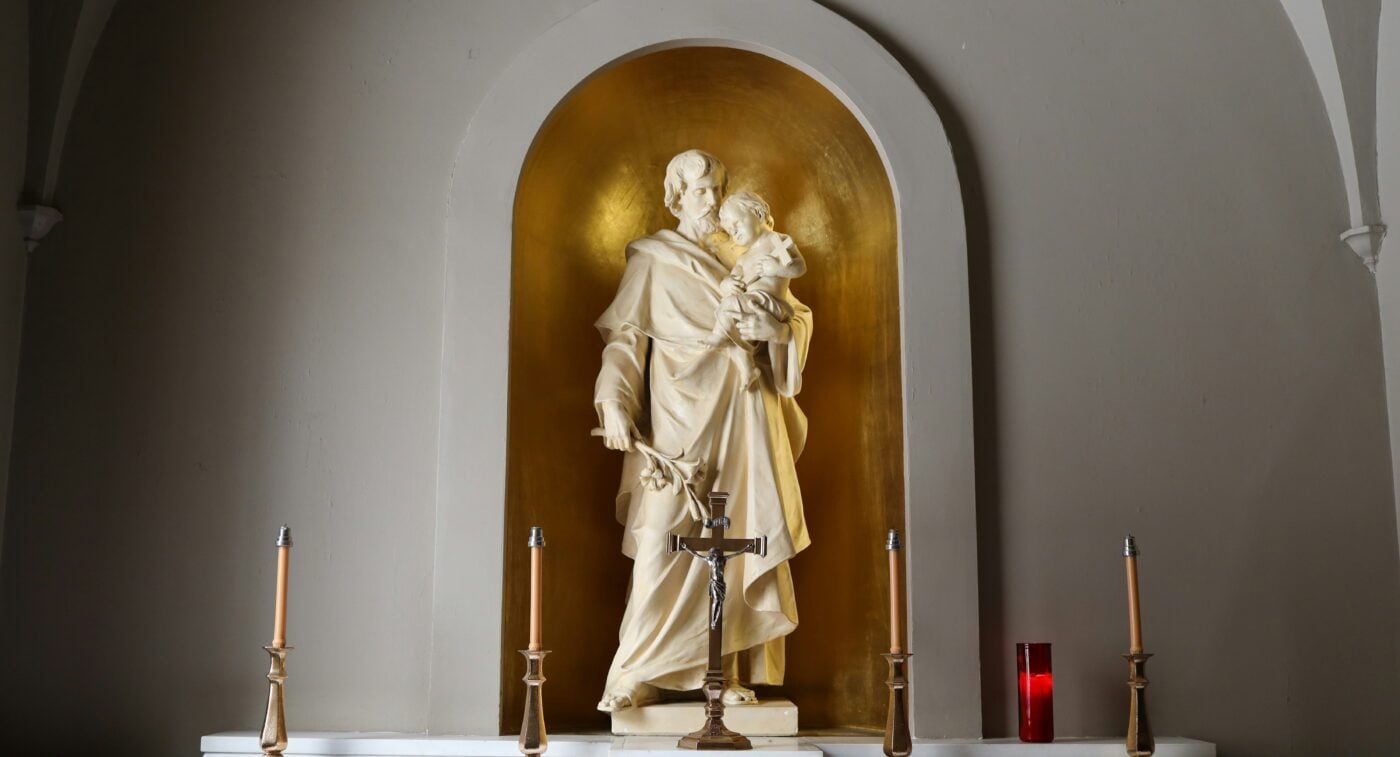
Throughout my adult life, I have spent a fair amount of time praying and meditating about being—or, more accurately, becoming—a good man, a good husband, and a good father. In recent years, by a great gift of Providence, I have become more devoted to the model of St. Joseph proposed by my Catholic faith. Yet, from the biblical text, the only description of Jesus’ earthly father we receive is that he was “a just man” who was “unwilling to put [Mary, his betrothed] to shame” (Mt. 1:18-19). (NOTE: “just” is also rightly translated as “righteous,” in both the Old and New Testaments.) With such a noble description, but with a dearth of words, I have pondered the standard by which Joseph was judged and described as a righteous man. How was St. Matthew, or anyone in first-century Judea, Galilee, or Palestine to know that Joseph should be described that way?
Psalm 112 is the best standard I have found, because it offers specific qualities to be measured in the search for right and fruitful relationship with the Lord. Pondering the psalmist’s words, I may legitimately assume that Joseph earned his description by exhibiting the qualities listed there. More importantly, I may assess and judge myself in any of my masculine roles by the qualities and habits expressed there.
ILLUMINATION THROUGH THE LAW
Psalm 112 opens, “Blessed is the man who fears the Lord, who greatly delights in his commandments” (Ps. 112:1 ESV). Immediately, this description of the blessed man calls my mind to the final verse of the Psalm 111 (“The fear of the Lord is the beginning of wisdom…”). Perhaps even more saliently, I recall the very first Psalm: “Blessed is the man…[whose] delight is the law of the Lord, and on his law he meditates day and night” (Ps. 1:2).
I cannot help but recall what the psalmist means by writing “the commandments” and “the law of the Lord.” I am reminded of Deuteronomy 4-6, which provides the clearest example of what “law” meant to Israel. That section delineates how they were to meditate on the Law, the specifics of the Decalogue, and how they were to apply it to their lives through generations. As an aspiring righteous man, I can take all this together and glean that entering into right relationship with God requires humility, filial piety, pondering God’s revelation and commands, and then acting likewise.
Because God speaks through His law, I receive light by meditating on it—studying and pondering it. That is why the psalmist writes, “Light dawns in the darkness for the upright” (v. 4). Illumination happens—the darkness that plagues my life is pushed back—because I entrust myself to God in a filial relationship when He invites me. That causes me to change my ways. And, thus, the darkness diminishes, and the light grows even more.
Being able to see better in the light with the eyes of my heart, I am strengthened for God-like action, that is, exercising habits that build up others. The righteous man, I learn, is “gracious” and “merciful” (v. 4); he “deals generously and lends”; he “conducts his affairs with justice” (v. 5); and “He has distributed freely; he has given to the poor” (v. 9). These are among the best social qualities I can possibly list, and no reasonable person of good will would argue otherwise. Indeed, as I help others encounter the Lord through works of justice and mercy, I am able to relate to Him more fully, too. Thus, the snowball-effect of righteousness gathers momentum.
WEALTH & RICHES
The Psalm also offers an opportunity to ponder the ways good works are rewarded. “Wealth and riches are in his house,” I read (v. 3). Economic blessings and rewards are certainly possible for a righteous man, but I know this is meant to be considered on a higher plane.
Reflecting on this verse, St. Augustine ruminates, “For [the righteous man’s] house is his heart; where, with the praise of God, he lives in greater riches with the hope of eternal life, than with men flattering, in palaces of marble, with splendidly adorned ceilings, with the fear of everlasting death.” With this comment, I am also reminded of Our Lord’s admonition to refrain from storing up earthly treasures, instead focusing on the treasures of the Kingdom (see Mt. 6:19-21). Thus, with the greater light I have received from the Lord, I am able to see a much wider range and depth of “wealth and riches.”
VIRTUE: THE UNSHAKEABLE FOUNDATION
Everything previous has already been immensely beneficial, but the primary message is still to come. In verses six through eight, the psalmist points to the foundation that allows all the other qualities to find their full flowering.
For the righteous will never be moved…
He is not afraid of bad news, his heart is firm, trusting in the Lord.
His heart is steady; he will not be afraid, until he looks in triumph on his adversaries.
Again, in his commentary, St. Augustine prayed with his readers: “Let our heart therefore be established, and shrink not, until we see beyond our enemies. […] we trust to see the good things of the Lord in the land of the living.” It should be clear to me that meditating on God’s law, knowing and living His commandments, results in virtue. Virtue, as the tradition tells us, is the firm, steady, and unshakable foundation that results from my understanding that God is more powerful than any situation or adversary, and that I can trust Him for my flourishing.
LEGACY & ETERNAL LIFE
The final idea I take away from Psalm 112 deals with legacy. The righteous man “endures forever,” the text tells me (v. 3); he “will be remembered forever” (v. 6); “his horn is exalted in honor” (v. 9). Righteousness will even be rewarded in future generations, as I read, “His offspring will be mighty in the land; the generation of the upright will be blessed” (v. 2). Pondering these passages helps me know that living in right relationship with God ripples outward to others, especially my children. The lessons in righteousness I speak and show to them will be—by God’s grace—the same lessons they provide to their children.
Still, it is not just my legacy in this world that I consider. The psalmist’s comment about enduring forever causes me to give attention to the question—the reality—of eternal life. I begin to ask about the end for which I was created, and I consider my desire to live beyond this world in eternal blessedness. That is the greatest legacy any of us can imagine.
All this leads me to conclude that anyone described as “just” or “righteous” must know and live the dispositions and habits described here. From the few details I can glean of St. Joseph’s life—those recorded briefly in Gospel accounts by St. Matthew and St. Luke—I can conclude that he knew Psalm 112, meditated on it, and enacted its prescriptions. Finally, because I desire to be a righteous man like St. Joseph in all my roles, I should take the same opportunity, frequently.
Photo by Saint John’s Seminary on Unsplash