






Amid U.S. foreign aid cuts, bishops call for solidarity between American, African Catholics

Amid severe cuts in U.S. foreign aid, Catholic bishops an ocean apart are advocating for deeper bonds between the U.S. and the peoples of the African continent — with God-given human dignity as central to that summons.
“As brother bishops, we address the Church in the United States and Africa with a call to renewed fraternity and mutual solidarity between our peoples,” declared a joint Feb. 2 statement by the Committee on International Justice and Peace of the U.S. Conference of Catholic Bishops and the Development Commission of the Symposium of Episcopal Conferences of Africa and Madagascar.
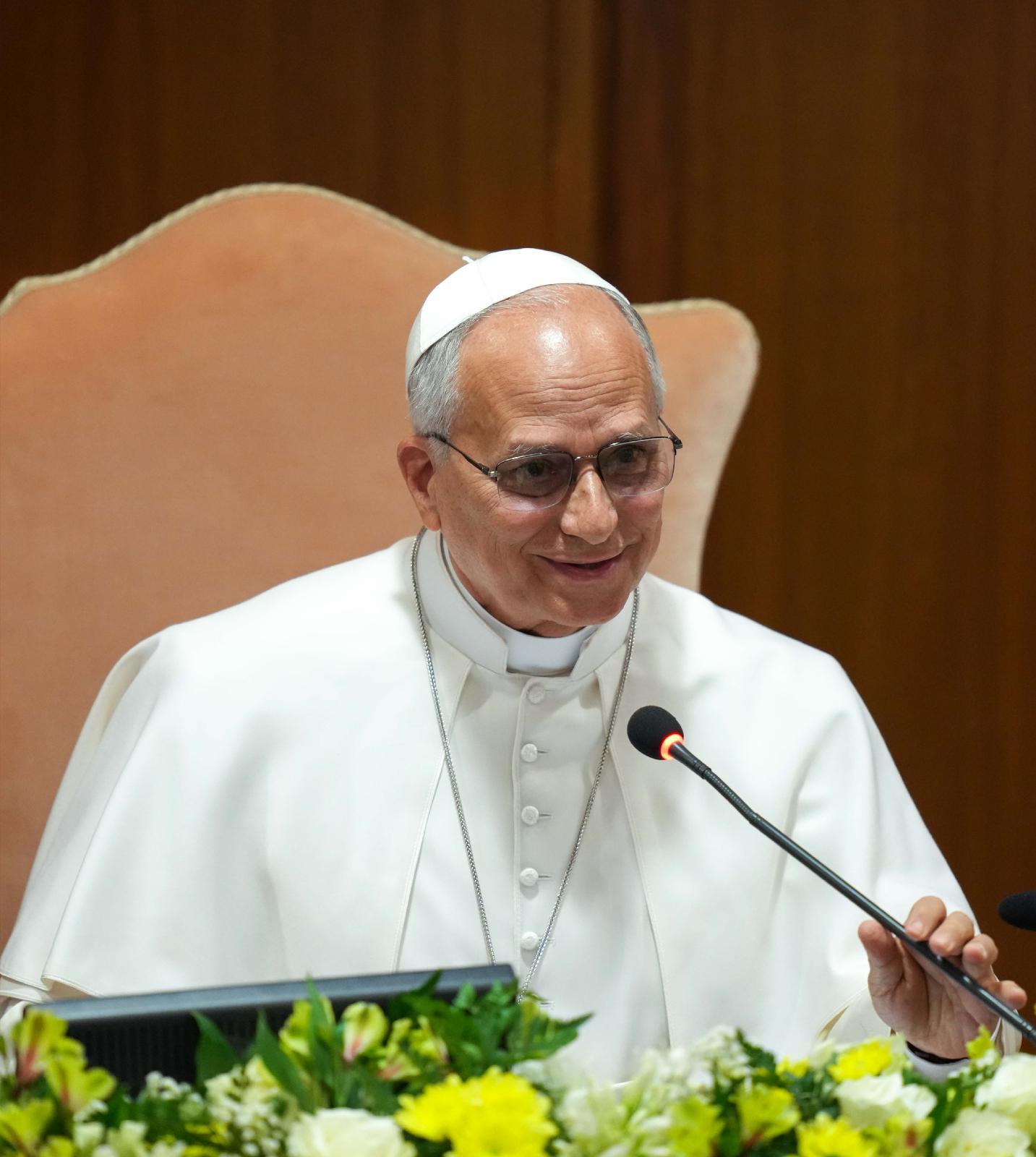
The document, titled “Brothers and Sisters in Hope,” was signed by Bishop A. Elias Zaidan of the St. Louis-based Maronite Eparchy of Our Lady of Lebanon of Los Angeles, chair of the USCCB’s Committee on International Justice and Peace; and by Bishop Stephen Dami Mamza of Yola, Nigeria, chair of SECAM’s Justice, Peace and Development Commission.
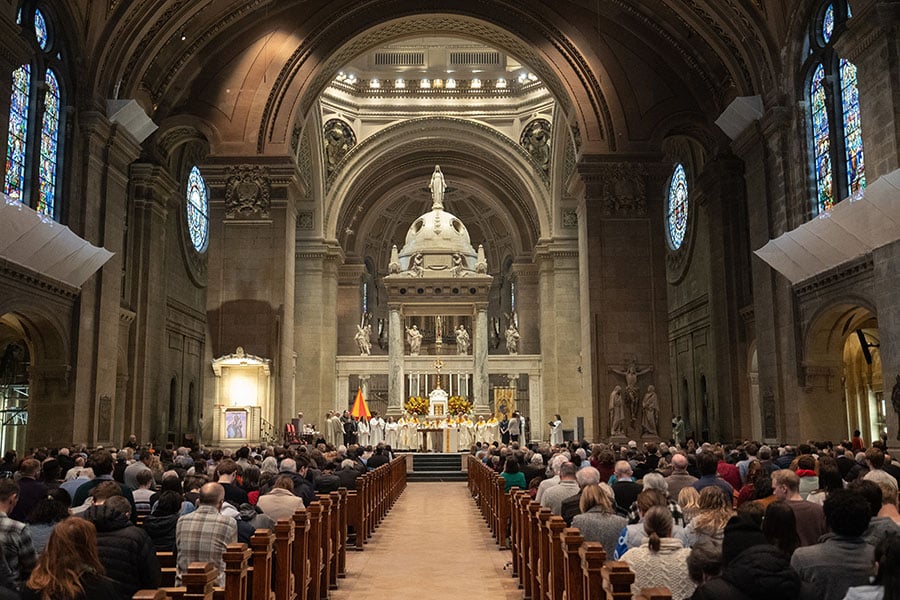
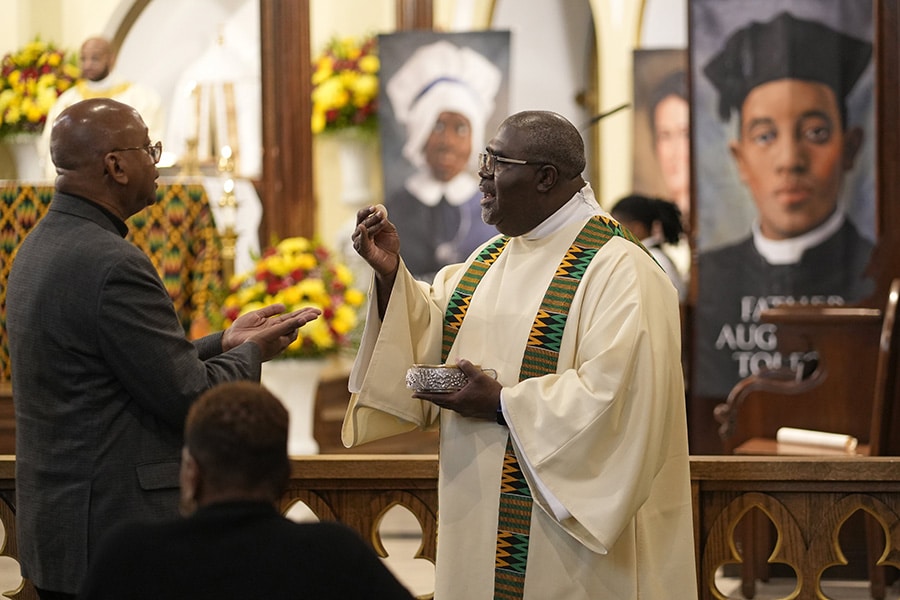
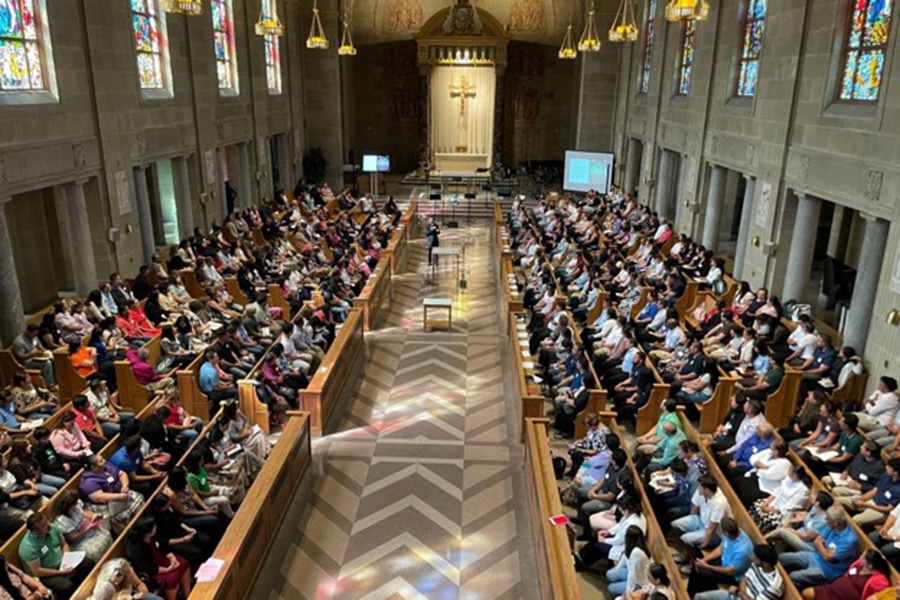
The statement preceded a Feb. 4 “Mass for Solidarity with the Bishops and Faithful of Africa” at the Basilica of the National Shrine of the Immaculate Conception in Washington, at which Bishop David J. Malloy of Rockford, Illinois, was principal celebrant, with Bishop Zaidan as concelebrant and Bishop Mamza as homilist.
The Mass and statement also come a quarter-century since the USCCB’s 2001 statement “A Call to Solidarity with Africa,” and the conference’s 2022 “A Renewed Call to Solidarity with Africa.”
Quoting St. John Paul II’s 1995 apostolic exhortation “Ecclesia in Africa” (“The Church in Africa”), Bishop Zaidan and Bishop Mamza stressed in their statement that “integral human development — the development of every person and the whole person, especially of the poorest and most neglected in the community — is at the very heart of evangelization.”
With “a significant reduction in U.S. international assistance programs,” the bishops offered “a vision of hope in Jesus Christ,” emphasizing they “remain committed to international humanitarian and development cooperation which saves and affirms human life, and which deeply respects the needs and values of local communities.”
The Trump administration’s foreign aid cutbacks have seen the African continent — which is on track to become the locus of the world’s Christian believers — lose billions in funding for disease prevention and response, mental health supports and other key initiatives.
Speaking to OSV News, Bishop Mamza noted that SECAM serves as an “uniting force” for Catholic leadership in Africa, a “very, very huge” pastoral territory.
Comprising about one-fifth of the earth’s landmass, Africa is home to 54 member states recognized by the United Nations, while the African Union counts 55 countries.
An estimated 1,000 to 2,000 languages are spoken on the continent, with sub-Saharan Africa now home to almost 31 percent of the world’s Christian population, surpassing Europe’s 22.3 percent, according to Pew Research Center.
The Catholic Church in Africa is “young” and “very, very vibrant,” said Bishop Mamza.
In their joint statement, he and Bishop Zaidan underscored that “the faithful of the U.S. and Africa are gifts to one another,” bound by an array of shared concerns, interdependencies and growth opportunities.
As Catholic teaching makes clear, that relationship is grounded in “the essence of the human being,” with its attendant “dignity” and “natural rights,” Bishop Zaidan told OSV News.
Regarding the African continent, “we’re there to support them and to help them in that integral development, in the fullest meaning of the term,” he said.
Echoing the joint statement, Bishop Zaidan traced several principles of Catholic social teaching which draws on papal, conciliar and Church documents to articulate the means of building a just society and living out holiness in modern life.
In particular, the statement focused on fostering the common good; acknowledging a shared responsibility to promote the inherent dignity of human life, with special concern for the most vulnerable; affirming the moral and human value of solidarity among the U.S. and African peoples; and promoting respect for subsidiarity, by which responsible stewardship is encouraged among local communities, with larger social institutions giving proportionate aid as needed.
Bishop Zaidan noted that such teaching “does not only cover Catholics,” but is intended “for the well-being of every human.”
And, he said, “as Catholics, we have the responsibility to preserve and take those values to the next level, and to help our brothers and sisters,” to provide a “good example of being true stewards of God’s gifts.”
In fact, said Bishop Mamza, “most of the things we have in Catholic social teaching are universal laws and natural laws that God himself created, and which almost every religion and culture respects.”
The statement delineated several specific points at which Catholic social teaching concretely intersects with the relationship between the U.S. and the African continent.
The bishops highlighted the church’s role in “delivering aid and building local capacity,” stating that Catholic institutions are “uniquely placed” to deliver international aid, which remains “crucial” to enhancing self-reliance in Africa’s civil and religious institutions.
Both Bishop Zaidan and Bishop Mamza said that advantage points to the high levels of trust enjoyed by the Catholic Church.
“I think the Church is the most trusted NGO (nongovernmental organization),” said Bishop Zaidan. “The interest of the Church is to serve the people and care for them. We don’t have an objective. It’s not like we’re running for government, to win votes.”
“As a matter of fact, the government borrowed the concept of aid from the Church,” said Bishop Mamza. “The Church has been doing this sort of thing from the beginning, from its foundation.”
Bishop Mamza added such trust remains, even amid “challenges in the Church.”
“I think it is also important for the government to understand the Church is a trusted partner, and the government should be prepared to work with the Church in order to reach the grassroots, which are not even known by the government,” he said.
True solidarity between the U.S. and Africa also “demands support for the family,” led by the marriage of man and woman and forming “the fundamental unit of society,” said the statement.
“International humanitarian and development cooperation should work in harmony” with what St. John Paul II described as the “acute sense of solidarity and community life” among African cultures, the document added.
Speaking to OSV News, Bishop Zaidan and Bishop Mamza also expanded on their statement’s call to climate justice and care for creation, with the document citing “the stark impacts of environmental injustice” on the African continent as “a cry to the American people, and the world,” for centralizing climate concerns in policy, international relations and daily life.
“Climate change is real, and the Church has come to realize that,” said Bishop Mamza. “And the Church is also prepared to do whatever possible in order to make sure we have a kind of conversion toward climate change. And that is part and parcel of the Gospel we preach now.”
Bishop Zaidan said that conversion “starts with each one individually.”
“Even little gestures to save and help the environment go a long way,” he said. “A little bit of recycling, paying attention to how much we spend on electricity and power — things like that are small gestures, but each one of us can do that at home. The earth and the universe are our common home, and the idea is not to exploit anybody.”
“If you could see the environmental damage that has been caused by multinational companies, with no compensation for local people,” lamented Bishop Mamza. “They can’t get fish any longer because the sea is polluted. They don’t have good drinking water, plants, vegetables — because the whole environment has been polluted.”
The joint statement also addressed the issue of critical minerals — such as lithium, graphite, cobalt, coltan, manganese, platinum, tantalum and bauxite — which are “essential to modern technology.”
Global demand for critical minerals has seen the dignity of local peoples “trampled,” said the statement, with mineral-rich regions becoming “hotspots for instability, violence, proxy wars, and various forms of child and forced labor.”
Bishop Mamza observed that “if you look at the unrest that is taking place in different African countries, most of the conflicts are a result of natural mineral resources on the ground.”
He added, “Sometimes you wonder … is it a curse to have mineral resources, or a blessing?”
Bishop Mamza said that “unfortunately, there are some in the West actually fanning the flames of crisis in some African countries because of natural resources.”
The joint statement urged “mutually beneficial trade dynamics between the U.S. and African countries … shaped by equity and deep respect for the rights and hopes of the poor.”
The statement also rejected “a one-sided vision of fraternity and solidarity that undervalues the tremendous contributions of the African Church and African diaspora communities to the life of the faithful” in the U.S.
As Africa’s Catholic bishops counter “long-entrenched conflicts, increasing religious extremism, mass displacement, and the continual loss of life,” the faithful in the U.S. “can draw inspiration from their witness in facing their own nation’s challenges,” while the Catholic Church in the U.S. can play a role in African peacebuilding, said the statement.
With more than 90 percent of U.S. Catholic dioceses relying on foreign-born clergy, African priests and religious “generously share their missionary gifts in service of the American Church, with a close and tangible presence every day,” the statement said.
Also enriching the Catholic Church in the U.S. are the work of African theologians and the witness of “African saints and modern-day martyrs,” the document noted.
“Together, we call for robust lifesaving and life-affirming U.S. assistance to the continent, grounded in thoughtful partnership, and pray for the flourishing of an ever-deeper fraternity,” said the bishops in their joint statement. “May the Lord bless our peoples, as we walk together as brothers and sisters in hope.”
Read More World News