
























LGBT Chastity and a Life Full of Love


It is said that one catches more flies with honey than with vinegar. This is true also regarding souls. The salvation of souls should be among our highest priorities, because they are among God’s highest priorities for man. It is the reason that the Father sent Jesus Christ to offer Himself as a sacrifice for our sins. It is the role of pastoral strategy to put this priority into practice, drawing men towards Jesus Christ, facilitating the conversion of life towards Him in union with the Blessed Trinity as adopted children of God, part of the Divine family.
Among those whom God desires as His children are men and women who experience strong, often exclusive homosexual inclinations. Many of us in western European and Anglosphere societies such as the United States and Canada are awash in messages which promote homosexual behaviors as good and treat views which dispute these messages as merely the product of irrational, socially created disgust.
Despite strong social and institutional pressures, we must hold firm to the teaching of both Sacred Tradition and Scripture which says that homosexual behaviors are gravely sinful. But we are often not so good at articulating the positive and deeply hopeful reason that a person with these inclinations should embrace Christ and His Church and live a life of celibate chastity for God, which many perceive and fear as a burden.
Of course, “vinegar” is sometimes necessary. It is necessary to give a firm “no” to false doctrines which lead people away from union with Christ. It is necessary to give the bitterness of vinegar to those who embark on a course that will take them away from their happiness and fulfillment in God, not out of hatred or disdain, but out of genuine love which is always inseparable from truth about reality. But it is also necessary to draw men toward Jesus Christ in whom they find their true fulfillment as persons. Every “no” has a deeper “yes” behind it.
The first fact which must be faced is that God loves gays and lesbians profoundly. He desires a deep, personal relationship with them in this life which leads to eternal life in Heaven, where the man or woman sees God face to face, and God delights in the one whom He has created and redeemed. Indeed, Scripture tells us in 1 Timothy 2:4 that “[God] desires all men to be saved and to come to the knowledge of the truth.”
Now, to this end, God gives every human being sufficient grace for conversion, and then to avoid mortal sin and be saved. The Council of Trent gives an infallible condemnation to the denial of this latter point: “If anyone says that the commandments of God are, even for one that is justified and constituted in grace impossible to observe, let him be anathema.” Pope St. John Paul II teaches in Veritatis Splendor:
But temptations can be overcome, sins can be avoided, because together with the commandments the Lord gives us the possibility of keeping them: “His eyes are on those who fear him, and he knows every deed of man. He has not commanded any one to be ungodly, and he has not given any one permission to sin” (Sir. 15:19-20). Keeping God’s law in particular situations can be difficult, extremely difficult, but it is never impossible.
If God desires that everyone be saved, and gives each person sufficient grace for this, then logically He gives the gay man or lesbian woman who experiences exclusive homosexual attractions the grace to avoid acting on these and to live a life of celibate chastity.
Celibacy for the sake of the Kingdom of God is, objectively speaking, a superior way of life because its aim is God directly with greater focus, and a gift given by God only to a few, to those called to be among His closest friends. Christ tells us in Matthew 19: “Not all men can receive this precept, but only those to whom it is given […] He who is able to receive this, let him receive it.” St. Paul tells us in 1 Corinthians 7: “I wish that all were as I myself am. But each has his own special gift from God, one of one kind and one of another.” Pope St. John Paul II says again in Familiaris Consortio: “the Church, throughout her history, has always defended the superiority of this charism to that of marriage, by reason of the wholly singular link which it has with the Kingdom of God.” Marriage is good, and a pathway to holiness which God calls many people, but celibacy for the Kingdom is better, and a more direct path to holiness. St. Thomas Aquinas teaches that the vowed celibate has a capacity for greater holiness than a married person, but that in practice, a married person may surpass them in holiness if they live their vocation well, and the celibate does so with mediocrity.
So the gay man or lesbian woman is called to celibate chastity, and this is a great gift. It allows for the space to have a deeper and more intense intimacy with and love of God, greater than many people could ever know. This love of God then spills over into love of others, for we come to love whom God loves. The life of a celibate homosexual is not one devoid of love, but full of it, yet love by a different path. The fact that God desires this life of intense communion with someone is a sign of His special love for that person.
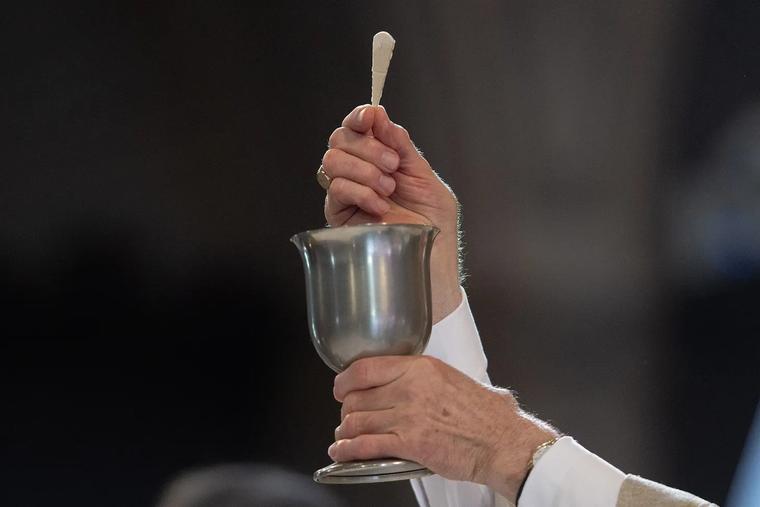
Indeed, the Catholic Church has means of grace given in the sacraments instituted by Jesus Christ which give vital help in living a celibate life. They also give an objective moral assurance of salvation. In confession, one knows that their sins are truly forgiven, and they obtain special grace to avoid these sins in the future. Wellsprings of virtue spring up as vice is healed at the root. In the Eucharist, Christ unites Himself to our souls in a special manner, cleansing us of daily faults, and giving us renewed strength to love God and neighbor.
A person who lives celibacy for the sake of the Kingdom has the space to cultivate a deeper and more intense love of God, but they also have unique opportunities to love their neighbor which are not available to married people. They have more money and time to do works of mercy. They can be present in the lives of others at key moments: weddings, funerals, illnesses, joys, and hardships. Quietly present in ways that no one else can be. Such a life does not go unnoticed, or unloved.
So, let this message go forth from our parishes towards those blinded by the gilded messages of contemporary western cultures, unaware of the true happiness which is their destiny: you are loved by God with a special love. You are called to be part of His inner circle, and to have a deep and close relationship with the Almighty, deeper than most people will ever know. In this, you will become a reflection of the love that God has for others. Your life will have meaning, purpose, and fulfillment. The world does not understand this. But you were born for it. Embrace your destiny in Christ.
Photo by Alexander Grey on Unsplash