




















The Old Man and the Sea: A Catholic Classic for Everyone


In the early 1990s while sitting at the bar of Bilbo’s Underground Tavern in Kalamazoo, MI, a fellow graduate student said Ernest Hemingway’s The Old Man and the Sea was “the most perfect novel ever written.” Such proclamations aren’t uncommon for graduate students, especially after a couple of beers, but with time I’ve come to realize my comrade might be right. Even though it’s impossible to prove such a claim, Hemingway’s short masterpiece, which won the 1953 Pulitzer Prize and helped him secure the Nobel a year later, has aged like fine wine. But did you know it was a Catholic book?
First published in Life Magazine, selling over five million copies in two days, it’s the story of Santiago, an old Cuban fisherman who has gone nearly three months without catching a marlin, and his friendship with a young boy, Manolin. Let’s start with the names: Santiago is Spanish for St. James, one of the apostles who was a fisherman, and Manolin is a shortened form of the Spanish name, Manuel, which comes from the Hebrew “Immanuel,” or “God is with us.” These names are not coincidences. Hemingway chose them as deliberately as he chose his first novel to be titled The Sun Also Rises and for the epigraph of that novel to be Ecclesiastes 1:4-7.
By now, any honest literary critic should be disabused of the myth that Hemingway was an atheist. Thanks to the groundbreaking work of H.R. Stoneback and those who have followed in his footsteps such as Matthew Nickel and Mary Claire Kendall, we know Hemingway took seriously his conversion to Catholicism, even if, as he admitted in a 1927 letter to Father Vincent Donovan, “I have never wanted to be known as a Catholic writer because I know the importance of setting an example—and I have never set a good example.”
For the better part of a century the author has received his wish. He remains best known for devotion to his craft and his hard-drinking, thrill-seeking persona. This has been true not only for the general population, who continue to enjoy the annual Papa Hemingway Look-Alike Contest, but also for other artists, as evidenced by Guy Clark’s song, “Hemingway’s Whiskey,” and Christine Whitehead’s novel, Hemingway’s Daughter. Both of these works are well done, especially Whitehead’s believable, fast-paced tale—praised by Mariel Hemingway—yet they don’t broach the subject of the Nobel laureate’s faith, which there’s evidence for in his life and fiction, especially The Old Man and the Sea.
Aside from the main characters’ names, we have a very Catholic setting: Cuba during the late 1940s, a decade before the Communist takeover of the country. This was the same Cuba Thomas Merton visited and wrote about in The Seven Story Mountain, stating that, in the mornings, “walking out into the warm sunny street, I could find my way quickly to any one of a dozen churches, new churches or as old as the seventeenth century,” and in these churches “every fifteen or twenty minutes a new Mass was starting at a different altar,” and “everywhere were Cubans in prayer.”

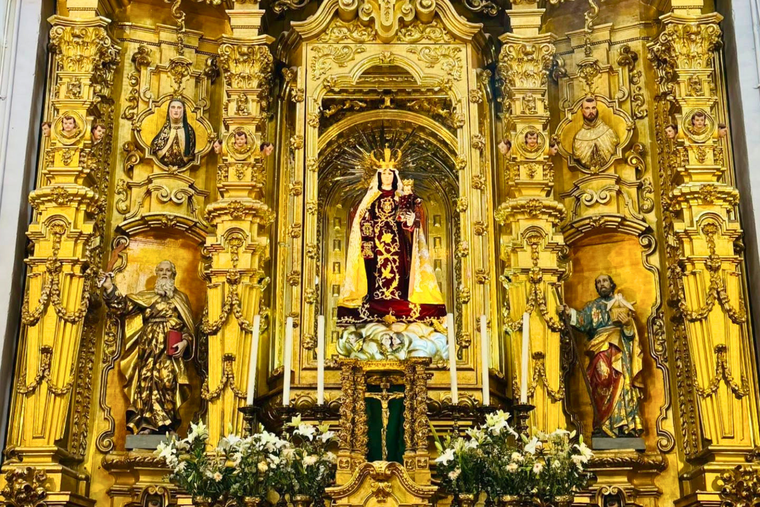
That doesn’t mean Santiago spent his mornings at Mass. Being a fisherman, he was out on the sea before daylight, and as with many marriages his late wife was the religious one. It’s her pictures of the Sacred Heart of Jesus and the Virgin of Cobre—the Blessed Virgin Mary’s name as patroness of Cuba—that are on a wall of his shack. He used to have a photo of his wife on the wall as well, “but he had taken it down because it made him too lonely to see it and it was on the shelf in the corner under his clean shirt.” So Santiago is, as Isaiah 53:3 says of Our Lord, “a man of sorrows, and acquainted with grief.” Early in the novella, Hemingway begins portraying the protagonist, whom today we would call a cultural Catholic, as a Christ figure.
In the opening pages we also learn Santiago is terribly poor. His shack consists of a single room and is made of sticks and palm fronds. He has “a bed, a table, one chair, and a place on the dirt floor to cook with charcoal.” There’s no plumbing or electricity, and his bed doesn’t even have a mattress; old newspapers are layered over the springs, and for a pillow he uses his rolled-up trousers. Furthermore, because he hasn’t caught a marlin in such a long time, he has no money to buy food and has to rely on donations Manolin gets from a local restaurant. His poverty is something else he shares with Jesus.
Yet the most important thing they have in common is their authentic manliness—their perseverance in the midst of physical, emotional, and spiritual suffering. This was a constant theme in Hemingway’s work. It’s demonstrated in the heroes of all of his novels and it’s the key to many of his short stories, including one of his finest, “The Undefeated,” which he wrote in 1925. In fact, the bulk of Hemingway’s canon can be seen as a warm-up for The Old Man and the Sea, wherein he dramatized perseverance more brilliantly than he ever had before.
Santiago used to take Manolin fishing with him, but the boy’s parents said the old man was bad luck and so he sets off alone to try to put an end to his losing streak. He goes far out into the ocean, well past the other fishermen, in his quest for marlin. This strategy succeeds when he hooks a giant one… and then the battle begins. For three days and nights, with a fishing line as thick as “a big pencil” wrapped around his back and chafing his bare hands, he struggles to bring the marlin close to the skiff where he can kill it. After finally doing so he ties it to the side of his skiff because it’s too large to be brought onboard—and before long he has to fight sharks that want to devour it.
During these epic confrontations Santiago increasingly becomes a Christ figure. His back pain is constant, devolving “into a dullness that he mistrusted,” his left hand cramps, and he bleeds from his forehead and from both hands. Yet he never complains. The most he does, frequently, is wish Manolin were with him. And although he doesn’t consider himself a religious person, he prays ten Our Fathers and ten Hail Marys and promises to make a pilgrimage to the Virgin of Cobre if he catches the marlin. At one point, when he sees another shark approaching, he says, “Ay,” and Hemingway writes:
There is no translation for this word and perhaps it is just a noise such as a man might make, involuntarily, feeling the nail go through his hands and into the wood.
Additionally, using the remarks and thoughts of Santiago, Hemingway gives readers some of his best advice about life and perseverance:
- Now is no time to think of what you do not have. Think of what you can do with what there is.
- It is silly not to hope. Besides I believe it is a sin.
- The thousand times that he had proved it meant nothing. Now he was proving it again. Each time was a new time and he never thought about the past when he was doing it.
- Man is not made for defeat. A man can be destroyed but not defeated.
These quotes apply both to our natural and spiritual lives. They can inspire people who pay their bills by working multiple low-paying jobs, patients recovering from surgery or struggling with a chronic disease, including addicts trying to make it through the day without taking a drink/shooting up, or even stay-at-home parents bowed down by the weight of domestic responsibilities. Such trials could induce a dark night of the soul, but as Russell Cunningham noted for the Guardian, “Hemingway’s words, in this slim volume, are consistently affecting, as steady a comfort as a lighthouse beam.”
I’ve taught this novella to college students who are all Christian athletes and they immediately identify with Santiago’s physical suffering because most of them have been injured during their career—and even if they haven’t, they know what it means to push themselves to exhaustion in pursuit of their goals. Like the aged fisherman, sweat has burned their eyes and they’ve been dizzy with fatigue. Yet in particular they understand that Hemingway’s masterpiece, with its heroic Christ figure, is a playbook for spiritual resilience, which if well learned, can help them achieve the ultimate victory.

Another Catholic aspect of The Old Man and the Sea is that Santiago resembles not only Our Lord but also St. Francis of Assisi, because Hemingway gives his protagonist a deep—though not disordered—love and respect for nature. Echoing the famous Italian mystic, Santiago often refers to animals and stars as brothers or friends. During a lull in his battle with the marlin, a warbler lands on his outstretched fishing line. Santiago notices the bird is tired and talks to it; he asks its age and if this is its first migration; he pities the warbler because he knows it’s prey for hawks. He says, “I am sorry I cannot hoist the sail and take you in with the small breeze that is rising. But I am with a friend.”
Yes, he is battling a friend. Although Santiago’s occupation pits him against the marlin, he sincerely admires it:
- You are killing me, fish, the old man thought. But you have a right to. Never have I seen a greater, or more beautiful, or a calmer or more noble thing than you, brother.
- How many people will he feed, he thought. But are they worthy to eat him? No, of course not. There is no one worthy of eating him from the manner of his behavior and his great dignity.
- Blessed Virgin, pray for the death of this fish. Wonderful though he is.
When after three days Santiago finally gets back to his village on the outskirts of Havana, it’s the middle of the night and everybody is in their home. He secures his skiff, removes the mast and wraps the sail around it, and then, as is his habit, he shoulders the mast so he can store it inside his shack. However, he’s so fatigued he falls on the way and lies “for some time with the mast across his shoulder.” When he first tries to stand, he can’t, and must sit there until he regains some strength. With no Simon of Cyrene to help him, he has to stop several times, sit on the ground and rest. Once inside the shack, he lies down on the newspaper-covered bed and sleeps.
Early in the morning Manolin looks inside the shack, as he’s been doing each day his friend has been gone, and when he sees Santiago’s bloody hands he begins crying. Then, in the most touching scene of the novella, we learn “He went out very quietly to go to bring some coffee and all the way down the road he was crying.” In fact, when one of the fisherman who was at the skiff examining the skeleton of the marlin, inquires about Santiago, this Cuban boy, who very much considered himself a man, says Santiago is sleeping and mustn’t be disturbed—and “He did not care that they saw him crying.”
Of course, a book about perseverance shouldn’t end there. In the closing pages Manolin vows to go fishing with Santiago again, and the old man, who despite his heroic efforts has just watched sharks devour his prize marlin, wants to be better prepared in the future and says, “We must get a good killing lance,” and tells the boy how to obtain one. Heavy winds will buffet Havana for the next three days—certainly a symbolic number—during which time Santiago will be in a type of Limbo, mending his wounds before rising and resuming his vocation as a fisherman. He has been badly beaten, but he is not defeated.

Contemporary commentators are fond of looking back on the twentieth century and praising the work of certain Catholic authors—a list that always ranges from a genteel lady in Milledgeville, Georgia, to a pipe-smoking professor at Oxford University. You know the list. It’s been repeated so often I don’t have to fill in the names. Yet rarely included is the kid from Oak Park, Illinois, who was raised a Protestant and wounded by a mortar in WWI, felt his soul go out of him, received extreme unction from a priest he knew and then began his journey to Rome.
No, he wasn’t genteel. He wasn’t a professor. And as he acknowledged, he wasn’t a good example. But he was an excellent writer. Ernest Hemingway should be listed among other great Catholic authors, and The Old Man and the Sea deserves a prime spot in the Catholic literary canon.
Moreover, this novella is small-c catholic, because it has universal appeal. It’s a terrific story, not a homily, a treasure to be enjoyed by people of diverse faiths or of no faith, by adolescents as well as academics—and it will be edifying for all of them, even upon rereading or by listening to Charlton Heston’s narration of it.
In a 1952 letter to his editor, Hemingway said, “I know that it is the best I can write ever, for all of my life I think. . . an epilogue to all my writing and what I have learned, or tried to learn, while writing and trying to live.”
Amen.
Title image by apasciuto on Flicker via Wikimedia Commons