

















Washington Roundup: High court to hear birthright citizenship case, OKs Texas congressional map

WASHINGTON (OSV News) — The Supreme Court on Dec. 5 said it would take up a case regarding the Trump administration’s executive order to end birthright citizenship for children born in the U.S. to parents without legal status or temporary visa holders.
On Dec. 4, the high court allowed Texas to use newly redrawn congressional maps favoring Republicans in the 2026 midterm elections.
The same week, a federal judge again blocked a provision of a law that would strip Medicaid funding from Planned Parenthood affiliates for one year and the House passed legislation aimed at protecting victims of trafficking.
Supreme Court takes up birthright citizenship case
In a brief order list on Dec. 5, the high court said it would take up the case, Trump v. Barbara, challenging his executive order limiting birthright citizenship.
An executive order Trump signed within hours of returning to the Oval Office in January sought to end the practice of birthright citizenship for children born in the U.S. to parents who do not have legal status or are temporary visa holders.
If implemented, the order would upend longstanding legal interpretation of the 14th Amendment, under which all children born in the U.S. are granted citizenship at birth. The 14th Amendment states, “All persons born or naturalized in the United States, and subject to the jurisdiction thereof, are citizens of the United States and of the State wherein they reside.”
The United States is one of at least 30 countries, including Canada and Mexico, in which the principle of “jus soli” or “right of soil” applies, which grants citizenship at birth without restrictions, regardless of the immigration status of the parents.
The order, which was blocked from going into effect amid legal challenges, directed federal agencies to stop issuing passports, citizenship certificates and other official documents to children born in the U.S. to parents without legal status or temporary visa holders.
In June, the Supreme Court limited the ability of federal judges to issue nationwide injunctions in a case related to the birthright citizenship order, however the court did not rule on the order itself at the time.
Arguments in the case are expected in the spring.
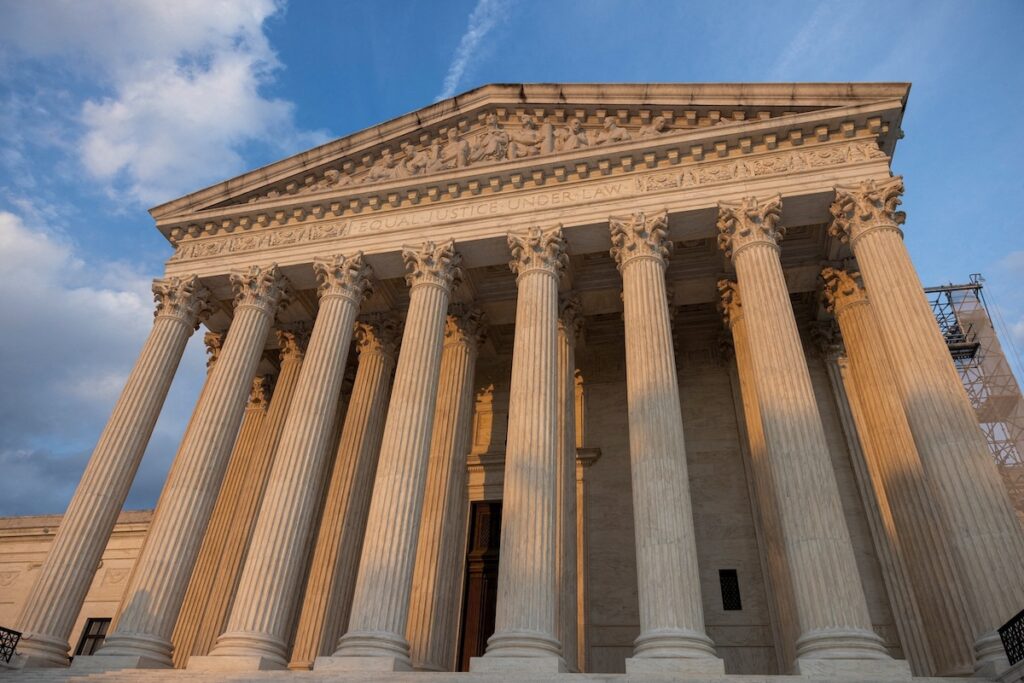
Supreme Court greenlights use of Republican-friendly Texas voting maps
The ruling paving the way for Texas to use the newly-redrawn congressional map supported by President Donald Trump will likely aid Republicans in their attempt to stay in control of Congress after next year’s elections.
Redistricting, or the process of allocating congressional representation, relies on data from the census for distributing House representation and drawing lines on congressional districts.
Gerrymandering is a term used to describe when these district lines are drawn in such a way as to benefit one party or sometimes a particular individual who holds it.
However, redistricting sometimes occurs later than in the wake of a census, which occurs once a decade. Sometimes states have to redraw their maps when courts say they have been unfairly gerrymandered. Sometimes courts have directed states to correct maps that disadvantaged some racial groups, for example.
The high court’s order — which came days before a Dec. 8 deadline for candidates to file to run for office in Texas — blocked a lower court decision that said the map was likely unconstitutional because it was drawn based on race, which federal law prohibits.
A majority of the justices ruled that the lower court “improperly inserted itself into an active primary campaign, causing much confusion and upsetting the delicate federal-state balance in elections.”
Justice Elena Kagan, in an opinion joined by Justices Sonia Sotomayor and Ketanji Brown Jackson, dissented from the ruling, arguing it “announces that Texas may run next year’s elections with a map the District Court found to have violated all our oft-repeated strictures about the use of race in districting.”
Trump has pushed Republican-led states to redraw their congressional maps to increase the chances of Republicans staying in control of the U.S. House next year. But some Democratic-led states, notably California, have launched similar efforts in response.
The court’s majority argued that “the impetus for the adoption of the Texas concurring map (like the map subsequently adopted in California) was partisan advantage pure and simple,” suggesting they may also ultimately uphold California’s map.
Federal judge again blocks provision of law that would strip Medicaid funding for Planned Parenthood affiliates for one year
A federal judge on Dec. 2 again blocked enforcement of a provision in the One Big Beautiful Bill Act, which Trump signed into law on July 4, that would have stopped Planned Parenthood from receiving Medicaid payments for a year.
The One Big Beautiful Bill Act, which enacted key items of Trump’s legislative agenda on issues including taxes and immigration, included a provision eliminating funds to health providers who also perform abortions — but just for one year.
The preliminary injunction blocks, for now, enforcement of the provision in 22 states — as well as the District of Columbia — whose Democratic attorneys general filed a lawsuit in response to the provision in July. However, the injunction granted the Trump administration one week to appeal.
U.S. District Judge Indira Talwani in Boston called the law “impermissibly ambiguous.”
A Planned Parenthood spokesperson in a statement argued Talwani “again recognized the ‘defund’ law for what it is: unconstitutional and dangerous.”
In a statement, Marjorie Dannenfelser, president of Susan B. Anthony Pro-Life America, which works to elect pro-life candidates to public office, said, “This fight is not over.”
“The pro-life movement will work tirelessly to ensure the Democrats do not prevail and taxpayers are never forced to pay a dime to prop up Big Abortion businesses,” he said.
House passes legislation aimed at protecting trafficking victims
The U.S. House on Dec. 1 passed bipartisan legislation aimed at helping those who have been the victims of human trafficking.
The legislation, the Trafficking Survivors Relief Act, would establish a process to vacate criminal convictions and expunge arrest records for certain offenses committed by victims of human trafficking for actions that occurred under duress or were otherwise related to their status as a trafficking victim.
Rep. Ann Wagner, R-Mo., who was among the lawmakers who spearheaded the bill, said in a Dec. 2 statement, “Victims of human trafficking are often revictimized by their traffickers who coerce them into committing crimes against their will, making it that much harder to escape from their abuse. This can leave them with a criminal record that follows them for the rest of their lives.”
“The Trafficking Survivors Relief Act would help survivors break that cycle of exploitation so they can reenter the working world and access critical support services,” she said. “Survivors of trafficking need every tool we can give them as they seek to find justice and hold the perpetrators accountable. I’ve been proud to champion the Trafficking Survivors Relief Act over multiple Congresses, and I look forward to the Senate taking up this bill so we can send it to the President’s desk.”
Rep. Ted Lieu, D-Calif., who co-sponsored the bill, added, “Survivors of human trafficking deserve justice and compassion, not criminalization.”
“For too long, survivors have faced criminal charges because of crimes they were forced to commit while being trafficked, making it harder for them to obtain housing, jobs, and the chance to rebuild their lives,” he said. “I am pleased that the House passed our bipartisan legislation to provide much-needed relief to trafficking survivors. I urge my Senate colleagues to pass this bill.”
Rep. Chris Smith, R-N.J., a Catholic who is a longtime lawmaker and the author of the landmark Trafficking Victims Protection Act of 2000, added in a statement, “Survivors should not have to constantly relive the trauma of their trafficking experiences through the unabating reminder of an indelible criminal record — all for actions they were forced to commit against their will.”
“This legislation helps to ensure that survivors have a real chance to rebuild their lives and experience a future free of exploitation,” he said.
Religious liberty watchdog says conditions in North Korea continue to deteriorate
Religious freedom conditions in North Korea continue to deteriorate, the U.S. Commission on International Religious Freedom said in a Dec. 4 report.
USCIRF, an independent, bipartisan U.S. federal government commission that monitors religious freedom around the globe, said in the report that North Korea, an insular society run by a totalitarian dictatorship, “remains one of the most dangerous places in the world for individuals from all religious backgrounds, and particularly for Christians, with even more draconian punitive measures being state-directed against traditional Korean shamanistic practices since the onset of the COVID-19 pandemic.”
The pandemic, it said, gave the communist regime “the opportunity to close its borders and to enact more draconian laws and punishments in attempts to reassert control over the North Korean population.”
China, the report added, “plays a major role in the maintenance of the North Korean regime’s repression of religion.”
“China has ramped up security measures, including using facial, gait, and voice recognition technologies to identify North Korean defectors within China’s borders who are attempting to flee through China to other countries, particularly to South Korea,” it said. “China continues to repatriate North Korean refugees despite the risk of arbitrary detention, torture, ill-treatment, enforced disappearance and sexual and gender-based violence.”
Organized religions, including Catholicism, “have almost disappeared from North Korea,” it said.

Trump participates in White House tree lighting ceremony
Trump on Dec. 4 participated in a ceremony lighting the national Christmas tree near the White House.
In comments at the ceremony, Trump said, “With the birth of Jesus, human history turned from night to day.”
“His word and his example call us to love one another, to serve one another and to honor the sacred truth that every child is specially made in the image of God,” the president said.
However, the same week, Trump sparked controversy by referring to Somali immigrants as “garbage” during comments at a Cabinet meeting at the White House on Dec. 2.
Although he did not name Trump, Bishop Daniel E. Garcia of Austin, Texas, chair of the Subcommittee for the Promotion of Racial Justice and Reconciliation, issued a statement Dec. 5 discouraging “language that denigrates a person or community based on his or her ethnicity or country of origin” as “incompatible with this truth.”
“I call on all — public officials, community leaders and individuals — to refrain from denigrating and dehumanizing language,” he said.
Kate Scanlon is a national reporter for OSV News covering Washington. Follow her on X @kgscanlon.
The post Washington Roundup: High court to hear birthright citizenship case, OKs Texas congressional map first appeared on OSV News.