











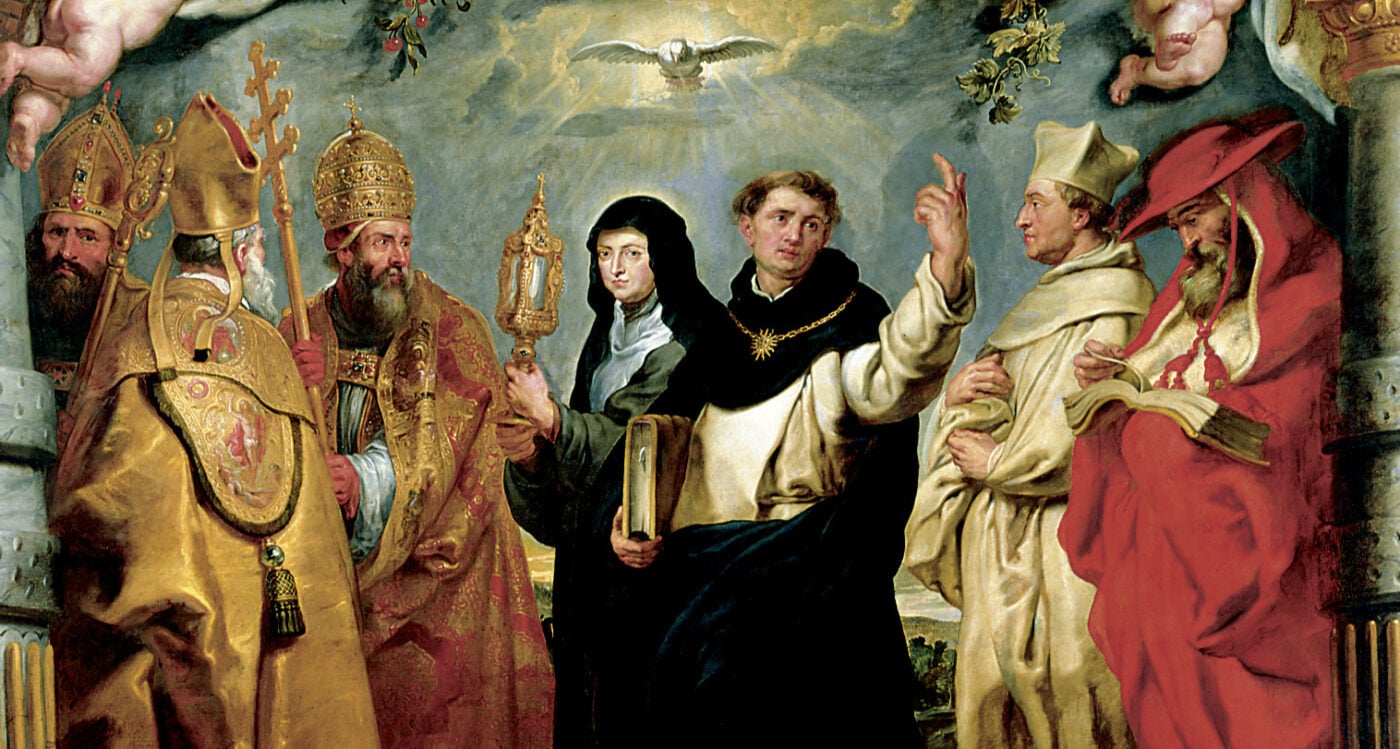

St. Jerome on the Treasures and Charisms of Women


St. Teresa of Avila used to carry a small piece of paper in her breviary that listed the 33 saints (or categories of saints, e.g. angels, patriarchs, martyrs, or saints of the Carmelite Order) to whom she was chiefly devoted (Apuntaciones, 8). At the top of the list was St. Joseph, which is not surprising given her ardent love for the Patron of the Universal Church. But a few saints after him, occupying a rather privileged place, stands St. Jerome.
St. Who?
Right, that is probably the spontaneous reaction of many a Catholic today, given that devotion to Jerome in the modern Church has long been superseded by more contemporary saints like Padre Pio or Carlo Acutis.
But in 16th century Catholic Europe, when Jerome was venerated as a cultural hero and stood at the vanguard of Counter-Reformation theology and spirituality, religious orders under his patronage flourished, countless churches and monasteries were dedicated to him, and his writings were assiduously read.
It was perhaps in Spain, above all, that this devotion reached its climax, hence his prominent position in St. Teresa’s list.
In her Vida, or autobiography, St. Teresa tells us that it was while reading the Letters of St. Jerome that she decided to become a nun (3,7). She also notes how she looked to St. Jerome’s example for strength in enduring spiritual aridity and facing battles with the devil (10,10). And in The Interior Castle, she held up St. Jerome for her nuns as a model of the holy fear we all should have at the consideration of the last judgment (VI, 9). Indeed, for St. Teresa, Jerome’s name was virtually synonymous with holiness itself (cf. Life, 38,1).
But there was probably another reason why Teresa held him in such esteem.
Since at least the Middle Ages, St. Jerome has been venerated by the Church as the doctor maximus, that is as her “greatest teacher” in explaining the Sacred Scriptures. What is often overlooked is that many of his letters and treatises expounding the sacred page were dedicated to women, usually consecrated virgins and widows, and often undertaken in response to explicit requests made by them to have puzzling passages clarified or even entire books explained.
Indeed, more than any Father of the Church, Jerome dedicated much of his scholarly and pastoral activity to women and, moreover, cultivated some of his most treasured friendships among them. He thus was able to articulate and underline the particular charisms that women—and consecrated women in particular—bring to the Church. And though he did not do this in a systematic or planned way, we nevertheless encounter several themes concerning the role of women in the Church that emerge through his correspondence with them.
Chief among these themes is that of spiritual maternity. For Jerome, women dedicated to a life of scriptural meditation, ascetic discipline, and prayer become quite naturally spiritual mothers who are able to guide, console, and encourage others by word, example, and intercession.
They are, moreover, able to convey the love and forgiveness of God in a tangible way that, though substantially different from, is nevertheless complementary to the sacramental absolution given by the priest.
We see this idea sketched out by Jerome in one of his earliest letters (Letter 11), written when he was in his early twenties, shortly after becoming a hermit in the Syrian desert. The letter is a short and enigmatic message, addressed to a community of nuns in Æmona (modern day Ljubljana), in which he seeks to be reconciled with them for some unknown conflict that arose between them. In doing so, he likens the nuns to the Good Shepherd and the father of the prodigal son—among other Scriptural representations of Christ. The message is clear: the nuns have the capacity to mediate the forgiveness of Christ for him.
More than through his words, however, St. Jerome showed this through his own life, through the veneration he had for holy women like St. Asella, who were genuine spiritual mothers to him.
Still, the charism of spiritual maternity is perhaps secondary in the eyes of Jerome to what is a higher disposition in women—their openness to God and potentially greater receptivity to Him, as is made perfectly clear in the case of the Blessed Virgin Mary. Women dedicated to a life of prayer and contemplation store up in themselves the knowledge, peace, and love of God, and thus become reservoirs of grace for a thirsty world. Or, to use Jerome’s words, they become sacred temples in whom Christ dwells and shine forth as precious ornaments and gems which He zealously defends (Letter 107).
Today’s world needs these temples and gems. It needs spiritual mothers like St. Teresa. Let us hope that a renewed interest in St. Jerome will raise them up for future generations.
Image from Wikimedia Commons