

















Man Is an Exception


You have to be careful how you talk about animals nowadays, especially domestic animals. They’ve taken on a sort of pseudo-human status. The internet has almost as many reels about dogs and cats as it does about people. And that’s understandable; animals are easier to have a relationship with than other humans. I mean, for starters, animals don’t speak! If they did, they would be much less popular, I’m sure.
But that doesn’t stop people from anthropomorphising pets. Books like, What is Your Cat Thinking and How to Talk to Your Dog are just the tip of the iceberg. There’s a whole world where the comparative value of human and animal life is debated. And there are actual subreddits like “DebateAVegan” where you can argue about animal rights versus human rights. One “ChangeMyView” subreddit posted the challenge, “There is no reason to value humans over animals,” and the debate was vigorous, with a good deal of support for animals being more important.
It’s so funny how opinions like this swing from one extreme to the other. It was just 30 years ago that the New Age movement was telling everyone that we are gods. That spawned a whole industry of books that’s still going today, with titles like, Proof that You’re God and Discovering Your Divinity, and my personal favorite, I Am a God.
This swing from being lower than a house pet to literally being a god reminds me of that saying that humanity is like a drunken man trying to mount a horse: first he falls off one side, and then he falls off the other.
This inability to place ourselves correctly in the food chain, or figure out where we belong in the hierarchy of living things, comes from the fact that we really don’t fit in anywhere. We are unique. We are one of a kind. Chesterton addressed this in his book All Things Considered in which he wrote:
Man is an exception, whatever else he is. If he is not the image of God, then he is a disease of the dust. If it is not true that a divine being fell, then we can only say that one of the animals went entirely off his head.
This is the reason we struggle so hard to understand ourselves—we’re a one-off. There’s no one else like us in all of creation. It’s kind of agonizing, in a way, to be a creature who can understand Quantum Physics and do the New York Times Crossword puzzle, but to not know why you’re here or how you got here. No wonder we envy the cat lying in the sunshine, or the dog who hasn’t a care in the world.
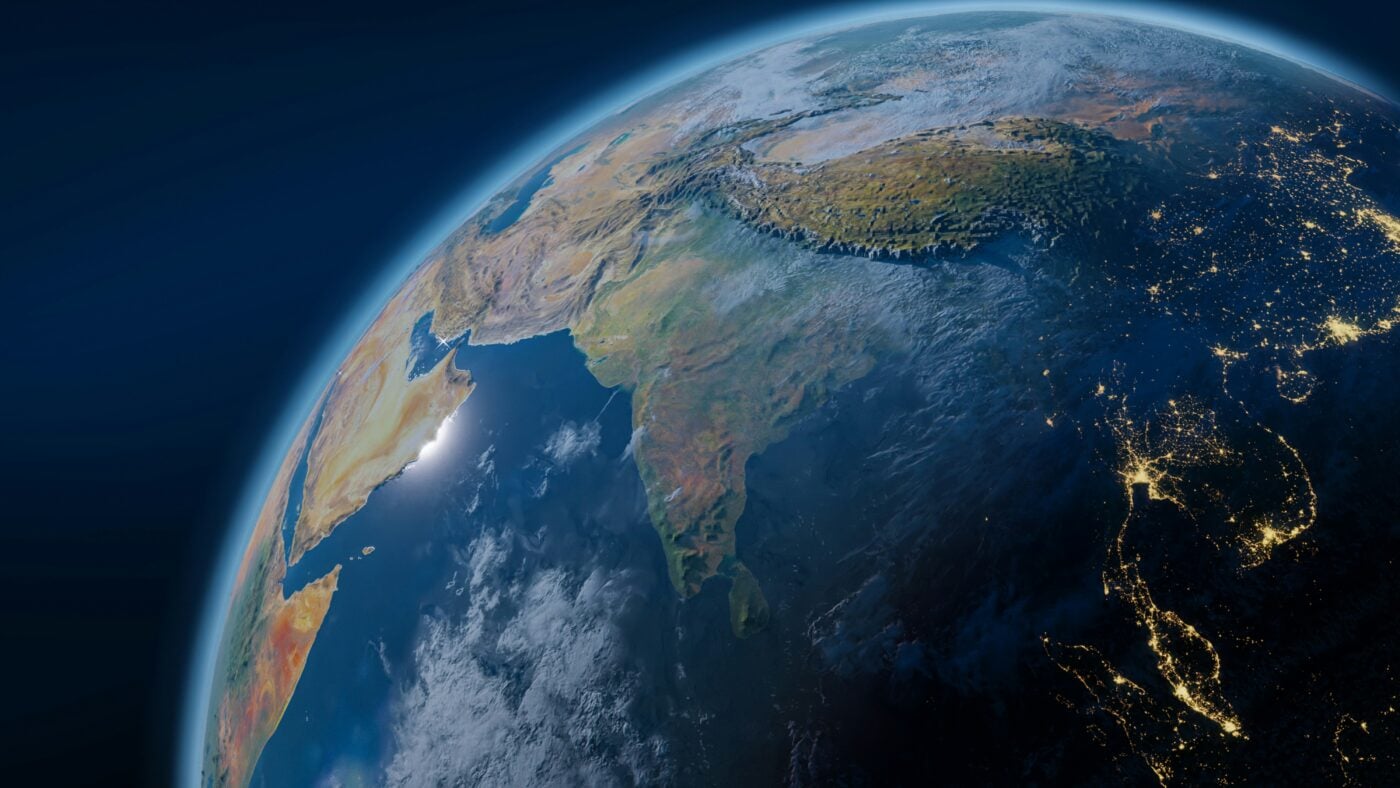
And although our pets give us comfort, they don’t completely cure the loneliness of our isolation. We are constantly looking out at the universe and asking, “Are we alone?” When we ask this question, we’re not asking, “Are there dogs on another planet?” We mean, is there anything like us humans out there? When we dream, and look up at the sky at night, and ponder our existence, we aren’t thinking of cats. We want to know, are we alone?
The answer is probably “yes.” Let’s face it, the universe is empty space. Voyager 1, which was launched in 1977, is now over 16 billion miles from earth. It takes a radio signal 24 hours to reach it. So far, it’s encountered nothing.
But wait! You say, how did it make it through the asteroid belt without being smashed to bits? I got news for you—there’s a lot of space out in space. You could drive a truck through the asteroid belt. Voyager 1 has spent fifty years rushing headlong at 38,000 miles an hour without a steering wheel, and it doesn’t have a scratch in the paint.
And it’s hardly making any headway. It just finally left our solar system in 2012. It would take 80,000 more years just to reach the nearest star. Even at the speed of light, it would take two and a half million years to reach just the next galaxy.
If something is out there, we’ll never know it. Unless, of course, it finds us. But think about that for a moment. If something can reach us, there’s no way it’s anything like us. Nothing human-like, with a physical makeup like ours and a life span of 80 years, is going to travel millions of light years to find us. So even if aliens do show up someday, they won’t be anything like us. We will remain unique, an exception to everything else around us.
William Shatner, Captain Kirk himself, realized how precious and unique we humans are when he finally went into outer space for real at the age of 90. As he recounted recently:
While I was looking away from Earth, and turned towards the rest of the universe, I didn’t feel connection; I didn’t feel attraction. What I understood, in the clearest possible way, was that we were living on a tiny oasis of life, surrounded by an immensity of death. I didn’t see infinite possibilities of worlds to explore, of adventures to have, or living creatures to connect with. I saw the deepest darkness I could have ever imagined, contrasting starkly with the welcoming warmth of our nurturing home planet.
Shatner probably doesn’t realize it, but he just turned the entire Copernican Revolution on its head. What he learned in space is what the Catholic Church knew all along—the Earth is the center of the universe. Copernicus may have been right about the motion of the planets, but not about the central role of Earth in the cosmos. Why? Because the Earth is where life is. The Earth is where we are. And that’s all that matters.
Humanity gives everything meaning, literally. When Berkley asked that famous question, “If a tree falls in the forest with no one around to hear it, does it make any noise?” he was onto something. If us humans do not notice or comment on something, it is “as if it never happened.”
Berkely built that question into the philosophy of subjective idealism, that “to be is to be perceived.” And while the Catholic Church would clarify that nature does exist independently of whether or not it is perceived by humans, no one can deny that a housecat does not ruminate on a theoretical tree falling in a theoretical forest. No black lab can turn a silly question into a complete philosophy.
Only humans can love trees and honor them with poems like:
I think that I shall never see
A poem lovely as a tree.
A tree whose hungry mouth is prest
Against the earth’s sweet flowing breast;
A tree that looks at God all day,
And lifts her leafy arms to pray;
A tree that may in summer wear
A nest of robins in her hair;
Upon whose bosom snow has lain;
Who intimately lives with rain.
Poems are made by fools like me,
But only God can make a tree.
Yes, humans are poetry-making, philosophizing, tree-loving exceptions, whatever else we are.
Now, if you’re wondering why I would even bother making this argument, be aware that human exceptionalism is being challenged, and not just by pet owners. Click here or here to see what I mean.
Our best defense against this nonsense is to celebrate our humanity, our exceptionalism, and our responsibility for all of creation.
“The glory of God is man fully alive,” as St. Irenaeus famously said. We give God glory when we embrace our exceptional gifts and the unique opportunities we have for a brief period on this Earth.
So let’s live our lives to the fullest, and let our joy, our flourishing, our wholeness reflect God’s divine presence and love to a world struggling to bear the weight of glory that comes with being made in the image of God.
Editor’s Note: For those seeking God in the chaos of the twenty-first century, Peter Giersch invites you to accompany him in his latest release, Talking of Michelangelo: Death, Judgment, Heaven, and Hell in the Burgundy Region, available from Sophia Institute Press.
Follow along for more in this series on “Chesterton and the Mystery of Man” here.
Photo by Tien Vu Ngoc on Unsplash