







The Fellowship of St. Joseph: A Model for Men’s Groups


The Fellowship of St. Joseph (“FOSJ”) is flourishing. FOSJ is a men’s group in Wilmington, Delaware, devoted to the spiritual development of its approximately two dozen members. Started during the COVID lockdowns, the group meets a pressing need among Catholic men hungry for Christ in an increasingly hostile and vacuous culture. Entering its sixth year, FOSJ continues to thrive, with members expressing gratitude for the insight, consolation, and joy of the meetings.
Here’s how we have achieved success, while avoiding the usual pitfalls that plague “men’s groups.”
1. Protected and Guided by Our Patron
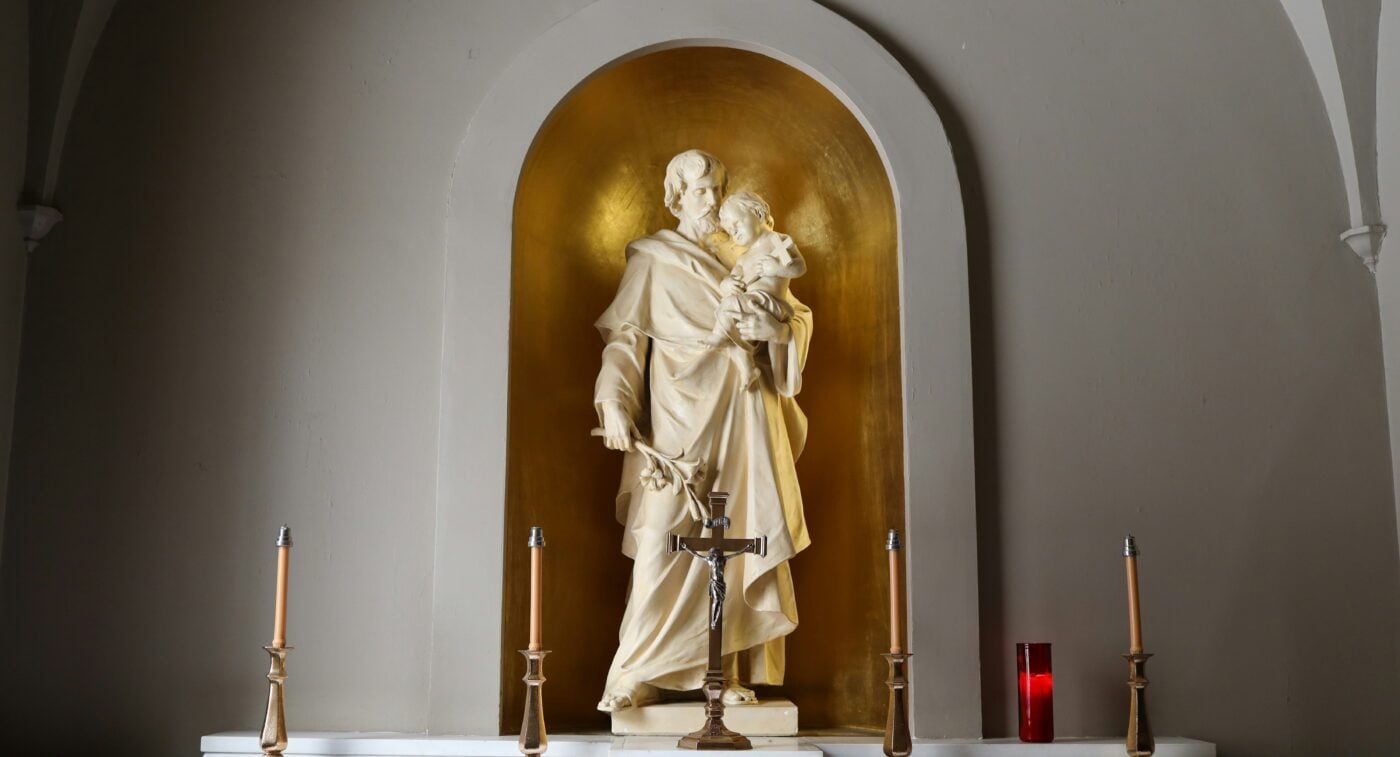
The FOSJ members, mostly married, seek to become better men—especially better husbands and fathers—by becoming better contemplatives. They voted to name St. Joseph their patron. The choice is apt. Seventy-one years ago, Pope Pius XII reflected, “[St. Joseph] personifies before God and the Church the dignity of the man who works with his hands but is always the provident guardian of you and your families,” when he declared May 1st the liturgical feast of St. Joseph the Worker. St. Joseph enjoyed these gifts because, in the words of St. Josemaria Escrivá, he was “the Master of the interior life” (The Forge, par. 554).
Silent and humble, St. Joseph received the divine gift of counsel, reacting swiftly to the voice of God’s angels to protect his family. St. Luke describes him as “marveling at the things being said about [Jesus]” (Lk. 2:33). As the model husband, father, and contemplative, he is the group’s fitting protector and guide to sanctification.
2. Clear and Narrow Mission
Lamenting her difficulty in “dealing with others,” St. Teresa of Avila confessed, “I feel as though I am among strangers, except when I am with those to whom I speak about prayer and the soul, for with these persons I am happy and consoled…” (Spiritual Testimonies, 1.6). More or less, that is the FOSJ mission, tacitly understood by every member: we meet one evening per month to “speak about prayer and the soul.”
Conducted as an informal seminar, FOSJ sessions have focused on, among other topics, the Letter of James, the Beatitudes, Tobit, the practice of the presence of God (Brother Lawrence of the Resurrection), suffering, humility, demons, hell, heaven, the Infancy Narratives, Aquinas on virtue, and contemplative and meditative prayer. Every topic is addressed with an eye toward “the spiritual life,” i.e., the relationship between each member and God.
FOSJ is not a support group, although we pray for each other and meetings often spawn follow-up coffees between members to address personal problems. We do not directly address marital, parental, financial, or employment problems, although our members become better husbands, fathers, and employees by bettering their interior lives. FOSJ is not a political group, although our discussions are informed by and touch upon the moral and political state of the country and the world. FOSJ is not a service group, although our members are actively involved in the community and discussions often spark interest in service. And FOSJ is not a John Bly association of men desperate for masculine companionship and male “bonding,” although our friendships are furthered by our mutual quest to know and serve Christ.
3. Clear Need
That we are living in dark times in the Church and society is clear. We are living in, to quote St. Edith Stein, “a spiritually impoverished generation.” Openly antagonistic to faith and cluttered with noise, material excess, and rank stupidity, Western society leaves little room for—indeed, increasingly does not tolerate—prayer and spiritual development. And the financial, sexual, and heretical scandals of the clergy—as well as their depleted numbers—have forced Catholics to look elsewhere for spiritual direction.
Narrowly defined men’s groups, such as FOSJ, help to fill this gap. Fr. Donald Haggerty, one of the great spiritual writers of our time, has noted that “the desire for serious prayer” and “greater depths of interiority in the spiritual life” “has taken place precisely at a time of crisis in the Church.” Wounded and helpless in the face of Church scandals and largely deprived of spiritual directors, lay people have turned to each other to advance in the spiritual life. Far from a turn away from the Church, Haggerty observes, “this desire for deeper relations with God in prayer is clear evidence that Christ remains one with his Church through all times” (Spiritual Enigmas, 20).
4. Mission-Aligned Members
Each member understands and embraces FOSJ’s mission. They have brought others on board who are looking to deepen their relationship with God as well.
On the other hand, some men have attended, realized the mission, and chosen to no longer attend. Others have asked about joining, been informed of the mission, and chosen not to attend. We mercifully have been spared put-upon gripers, gadflies, or “leadership” personalities. The membership process has been self-selective; we have not had to screen out potential members or ask current members to leave.
5. Ownership
Although FOSJ’s founders make the trains run on time—securing meeting spaces (e.g., the church hall) and setting dates—FOSJ is member run. To date, most of the members have led sessions, selecting the topics, readings, and questions for discussion. If solicited, the founders offer comments, but the members are serious, studious, and intelligent enough to prepare for and lead the sessions without babysitting.
6. Doctrinally Formed Members
FOSJ is filled with mature men instructed in the Faith and living out their vocations. FOSJ members include two deacons, a parish priest, a seminarian, two former high school theology teachers, and a former theology professor. Most of the other members are highly educated—engineers, attorneys, executives—and have tackled the works of spiritual giants, like St. Teresa of Avila, St. Thomas Aquinas, or St. John Henry Newman, on their own.
FOSJ members are not mainly looking to be catechized or to find friends. As a result, we avoid the perils of combining “formation” and “friendship,” as Robert B. Greving thoughtfully identified in his column “Why Your Catholic Men’s Group Should Eventually Fold.” Faith and friendships are enriched, not created, by the group.
7. Once-a-Month
Aware of the strain a “men’s group” can place on family and work obligations, FOSJ meets only one evening a month for two hours. Faithful members at times cannot attend due to work or family obligations, which is expected. But on average, 10 to 15 of the approximately two dozen members can meet each month. The sacrifice is minimal, and according to the group, most spouses are supportive of the brief time away.
The bad news is we are living in dark times. The good news is that the darker the times, the more generous God is with those who turn to Him. As St. John of the Cross observed in the turbulent, post-Reformation 16th century, “The Lord has always revealed to mortals the treasures of his wisdom and his spirit, but now that the face of evil bares itself more and more, so does the Lord bare his treasures more” (The Sayings of Light and Love, 1). The Fellowship of St. Joseph is one place where the Lord is bearing those treasures.
Image from Wikimedia Commons