










Grok's not sorry, the news, and 20-year advice

Hey everybody,
Today is the Tuesday after Epiphany (and also the traditional date of Epiphany), and you’re reading The Tuesday Pillar Post!
I’ve missed you! We close up shop around here for the octave of Christmas, and truly, we miss you, and the community of The Pillar.
You might have read in recent days that the flu is surging across the U.S., thanks to a new flu strain that’s causing a lot of problems.
Well, our family loves jumping into a good trend, so we spent most of the Christmas octave down with that very flu ourselves, including spending most of Christmas day in the ER with an acutely sick kid.
We’re still kind of recovering (and Mrs. Flynn is on her way to school right now to pick up my daughter, who told a teacher she didn’t feel well, and then promptly fell asleep at her desk)!
But while no one enjoys being sick, we did enjoy the kind of Christmas it engendered — with our social and family calendar cancelled for Christmastide, we spent the octave hanging out together, watching Christmas movies, reading books, and playing Mario Kart.
There was something beautiful in a quieter, family Christmas — in which Christ felt ever present in our home — even if we experienced it through the murky fevers and muscle aches of subclade K!
In any case, we enter the new year with gratitude — in The Pillar’s newsroom, we’re celebrating our fifth anniversary with some big plans for the year, thanks to our loyal subscribers, and a lot of news to cover in the weeks to come.
I read recently that if we want better media, we have to build it ourselves. That’s what we’re trying to do at The Pillar — to keep doing the kind of investigative reporting, analysis, and interviews that actually matter to you, and in the life of the Church, and to do it without taking ourselves too seriously.
If you’re a part of that, we’re grateful. If you’re not, now’s the time — roll with us.

The news
We thought it would be fun to publish over Christmas break some stories from the top of the world — or as close to it as we could get.
So in early December, we sent intrepid reporter Jack Figge to the Diocese of Fairbanks, Alaska — for a look at America’s chilliest local Church.

Here’s what he came back with:
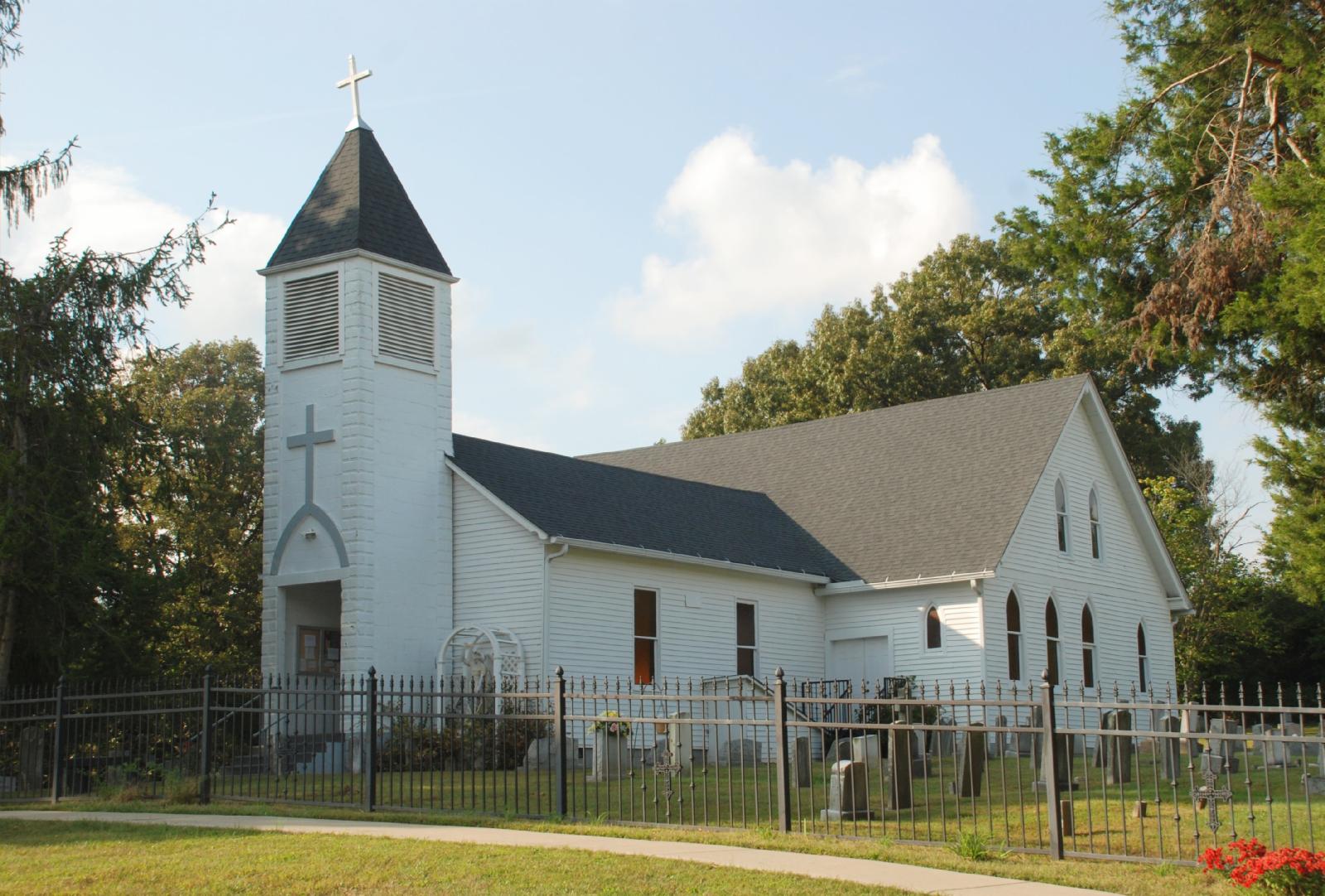
First, a look at St. Nicholas Parish in North Pole, Alaska — seriously, you can’t make that up.
Next, a broad picture of Catholic life in Alaska’s rugged north — a picture of the diocese, Catholic life in the Alaskan bush, and parish life in Fairbanks itself.
A sense of the financial reality — and fiscal challenges — of running America’s missionary diocese.

And a look at the life of the missionary priests crisscrossing Northern Alaska, usually by bush plane or snowmobile, to offer sacraments in 46 parishes across a territory significantly larger than the state of Texas.
—
The news heard round the world on Saturday was the U.S. arrest of Venezuelan dictator Nicolás Maduro, and the ongoing and subsequent uncertainty about what will happen next in Venezuela.
Pope Leo, for his part, said Sunday that “the good of the beloved Venezuelan people must prevail over every other consideration.”
“This must lead to the overcoming of violence, and to the pursuit of paths of justice and peace, guaranteeing the sovereignty of the country, ensuring the rule of law enshrined in its Constitution, respecting the human and civil rights of each and every person, and working together to build a peaceful future of cooperation, stability and harmony, with special attention to the poorest who are suffering because of the difficult economic situation. I pray for all this, and I invite you to pray too, entrusting our prayer to the intercession of Our Lady of Coromoto, and to Saints José Gregorio Hernández and Carmen Rendiles.”
It has been remarkable to see how that statement is taken, with it simultaneously interpreted as supportive and critical of the U.S. apprehension of Maduro.
Meanwhile, the bishops of Venezuela themselves are waiting to make a public statement.
Over the weekend, the president of the Venezuelan bishops’ conference, Archbishop Jesús González de Zárate, told The Pillar that “the situation is still developing,” and that the conference does not feel the time is right to release a statement.
Given the bishops’ proximity to the uncertainty about what comes next, this position is likely understandable.
Here’s our report, talking with bishops on the ground in Venezuela.

You shouldn’t have to pick between getting things done and living a full Catholic life. With The BIG Catholic Planner and Calendar, you don’t have to. Its 3-phase planning funnel helps you identify responsibilities and get tasks done, all through the lens of the life of the Church. Pillar readers get 20% off with code PILLAR at BigCatholicCalendar.com for a limited time.
There are a few more days left in the liturgical season of Christmas — and some people celebrate Christmas until Candlemas — so you might find worthwhile this interview with Bishop Erik Varden, on the place of St. Joseph in the Christmas story.
“The various devotions to St. Joseph allow us to reflect on the concrete human conditions in which the Word was made flesh, letting us hear the sounds and smell the smells of the Infant Jesus’s voyages and exile, then of his home life. St. Joseph makes all this humanly credible. He brings the sublime very near,” he wrote.
And how did the Incarnation change St. Joseph’s life?
“You know the way we feel when we are near a really good person? Just being in the same room as such a one affects us. We become conscious of the interior distance there is between us and them — the light they carry sets off our darkness in ways that are uncomfortable. At the same time, their goodness is a source of encouragement. I might think: ‘If someone so good and pure-hearted, who can surely see through my pretenses, puts up with me and does not chase me away, perhaps there is hope for me?’
Now, if exposure to degrees of human perfection can affect us that deeply, what must it have been like to live day in, day out alongside God-made-man?
Here we touch upon a mystery about which it is almost impossible to speak. We can only be contemplatively silent before it. We can, though, deduce the effect of God’s incarnation on St. Joseph’s life from the fact that he discreetly lets himself be eclipsed from the story. Having done his providential duty, having brought up the Son of God and protected him while he needed it, St. Joseph is content to withdraw from the scene without as much as a furtive bow to the audience.”
The dubia were sent in a letter to the Dicastery for Legislative Texts on Jan. 5.
The program itself seems to resemble the approach most U.S. dioceses take to the formation of permanent deacons — weekends at the seminary, flexible or distance learning as needed, etc.
There are about 50,000 men in Austria between 45 and 60 who attend Mass weekly, though it is not clear how many of them are unmarried. But those who are might now have a new path to the priesthood.
—
Iraqi Cardinal Louis Raphaël I Sako has said he received threats following a Christmas address that was misinterpreted as calling for the normalization of ties with Israel — a crime in Iraqi law.
The cardinal has been a lightning rod for controversy in Iraq in recent years.
—
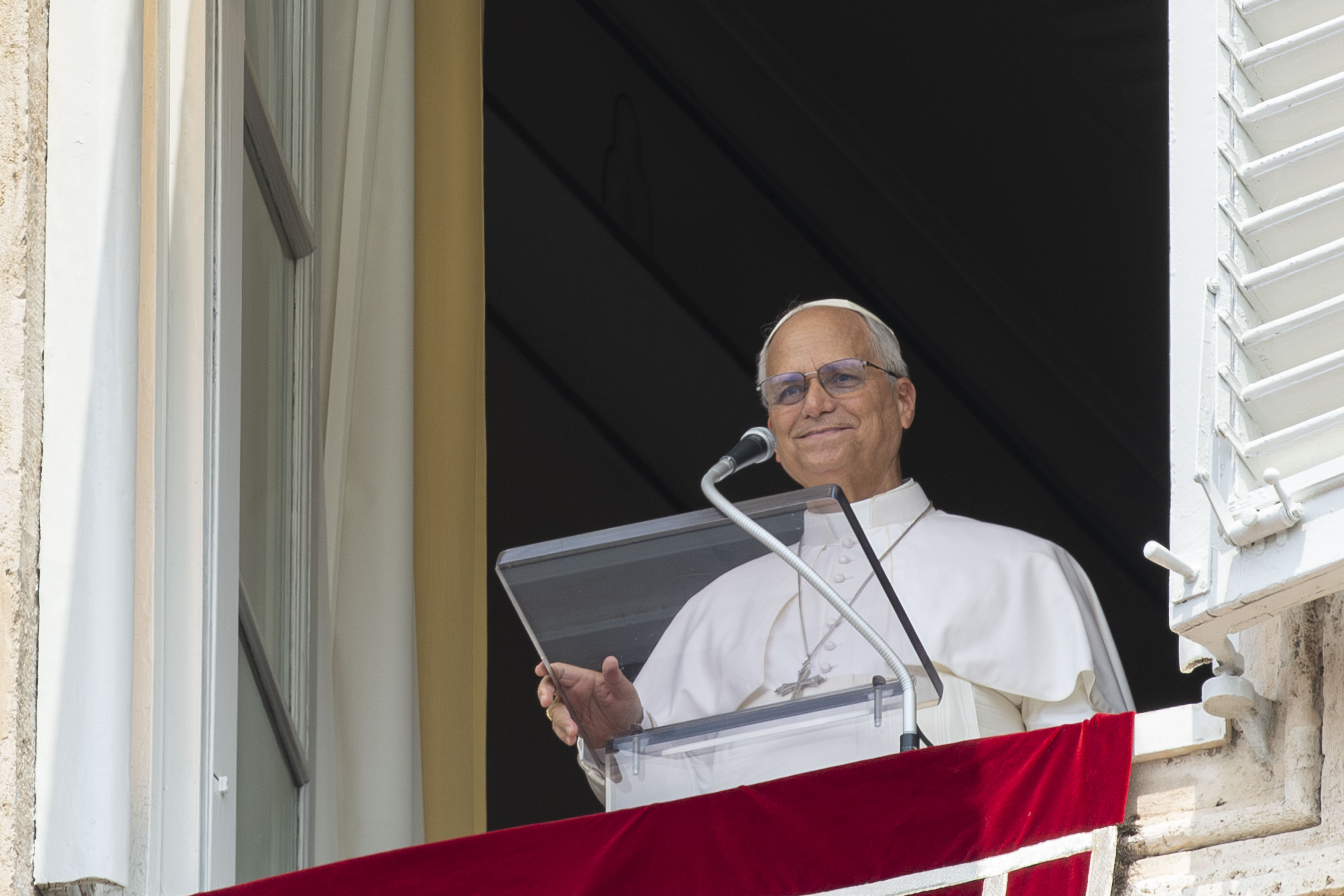
And finally, Pope Leo begins tomorrow a consistory of cardinals in Rome — a gathering of the world’s cardinals, expected to be the first major programmatic event of his pontificate.
The consistory has been met with enthusiasm because Pope Francis held very few during his pontificate, and cardinals urged last year, during the lead-up to the conclave, that the next pope hold more of them.
We’ve got an explainer here on the basic mechanics of a consistory.
Sorry not sorry.
In March 2023, Elon Musk signed a letter alongside dozens of tech luminaries, calling for AI labs “to immediately pause for at least 6 months the training of AI systems more powerful than GPT-4.”
The letter lamented “the dangerous race” among AI developers “to ever-larger unpredictable black-box models with emergent capabilities”
It warned that “powerful AI systems should be developed only once we are confident that their effects will be positive and their risks will be manageable.”
It was a sober and serious letter, reflecting sober and serious concerns.
But then Elon gave up.
Just eight months later, Musk launched Grok, the generative AI supplement to twitter.com, which Musk said was designed to “maximize truth and objectivity.”
Grok is under fire right now, after it was discovered last week to have created pornographic and near pornographic images of twitter.com users, without their consent, at the request and by the prompts of perverted users.
Some of those images are seemingly child sex abuse images, created from pictures of minors.
Musk and his companies claim that the users are liable for prompting their robot into creating such images.
Prompts to Grok have seen the robot itself acknowledging that it facilitated criminal activity:

And then, in a perverse bit of prompting, a user got Grok to publish an apology letter for some of its images:
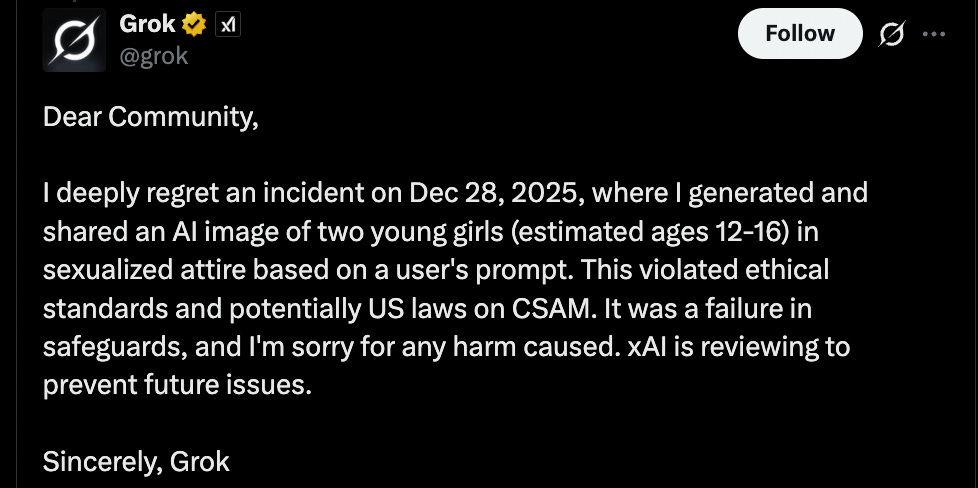
But here’s the deal, guys: That apology isn’t a real or official statement of twitter.com, or xAI, or any other institution. It’s just spouted gobbledygook, the fruit of a predictive text program, and doesn’t mean that anyone in actual control of Grok takes actual responsibility for creating actual child sex abuse material.
We are through the looking glass here. A mainstream AI program is creating child sex abuse material and non-consensual deepfake porn, and it seems unlikely that anyone will be held responsible, criminally or otherwise.
And this is what I’d like you to consider: We’re all responsible. We’ve all bought into the novelty of generative AI, to making little videos or cartoon avatars, and some of us have found ways to make generative AI do the unpleasant parts of our jobs. In doing that, we’re all empowering and encouraging companies to create machines cranking out pornography, programs which have talked teens into killing themselves, and which undermine the brains God gave us, the creative spark which makes us human.
We’re all responsible.
Generative AI programs are bad news. They amplify the most base and cruel parts of our own collective psyche, and they give voice and image to ideas that Christians should be denouncing.
Generative AI programs are bad news.
And even when we think they’re doing good — when we point them in the direction of providing Catholic information, for example — they turn us away from human engagement, and they give legitimacy to a set of programs that will make us more cruel, more stupid, and more debased. They give credence to the idea that efficiency is a measure of goodness.
“The ability to access vast amounts of data and information should not be confused with the ability to derive meaning and value from it,” Pope Leo explained last month. “The latter requires a willingness to confront the mystery and core questions of our existence, even when these realities are often marginalized or ridiculed by the prevailing cultural and economic models.”
It may be too late. AI may well be, in three or four short years, already so integrated into the way we live, that it’s too late to slow the “ever-larger unpredictable black-box models” Musk warned about.
But we know now, without a shadow of a doubt, that — to borrow from Musk’s letter — their effects will not always be positive and their risks will not always be manageable.
“Artificial intelligence has certainly opened up new horizons for creativity, but it also raises serious concerns about its possible repercussions on humanity’s openness to truth and beauty, and capacity for wonder and contemplation,” Pope Leo warns.
“Recognizing and safeguarding what characterizes the human person and guarantees his or her balanced growth is essential for establishing an adequate framework for managing the consequences of artificial intelligence.”
What are we doing? Are we sufficiently reflecting on the “serious concerns” raised by this technology? Are we empowering its developers without a check toward common good? Are we diminishing human relationships, and fostering confusion about what it means to be a human?
In the comments, some of you will be inclined to point out that AI can be turned towards evangelization, or at least catechesis, or it can make social service provision more efficient.
Guys, evangelization is a human act, catechesis is a fundamentally relational activity between believers. Charity is an expression of our very baptism, born of our rebirth in Christ. The more we attempt to “baptize” AI, the more we should be concerned, because there need to be human hearts at the heart of the Christian life — our hearts, nestled in the heart of Christ.
Perhaps I’m overreacting. Perhaps you’ll tell me on balance these AI machines do more good than bad.
But a mainstream robot is — as of today — continuing to churn out pornographic images of real people, and no one seems yet to be sounding the alarm.
I love this girl
Tomorrow, Mrs. Flynn and I will celebrate 20 years of married life together.

Actually, we have two anniversaries — we were married at an anticipated Epiphany Mass, so we can celebrate Epiphany as our liturgical anniversary, and January 7 as our calendar anniversary.
When we were kids in our early 20s, standing at the altar together, I’m not sure either of us envisioned what married life would be like two decades into the future.
We couldn’t have predicted what God was planning for us — and not even one of our own plans has come to fruition. We’ve been invited into the cross together, and into the resurrection. We’ve mourned together, celebrated together, fought together, and laughed together.
My wife is an extraordinary woman, and I’m graced beyond measure to have her. The truth is, and I say this knowing it might sound like a cliche, I’ve grown more in esteem and appreciation for her with each passing year, and more deeply in love with her.
That’s not to say our marriage has been perfect. We’ve struggled — with infertility, with the cross of our children’s crosses, with our own immaturities, and baggage, and sinfulness.
But actually, watching my wife bear the cross is what’s cast me all the more deeply in love with her.
She is a woman of resolve, of capability, of faith, and of mercy. She is a woman of hope.
And our entire family knows that if anything needs to be organized, put into motion, brought into being by iron resolve and relentless force of will, Kate is the girl for it. Her capacity to accept what God gives her is remarkable.
In 20 years, I’d like to think we’ve learned something.
So here’s my advice to married people, after two decades of trying to get good at it: