





















The Disciple Who Remained: How the Apostles Chose Judas’ Replacement


Every year on May 14th, the Church celebrates the feast of the Apostle who came late to the party: St. Matthias. Biblically, we know very little about this man, but legend and tradition tell us he was full of zeal. Upon being chosen to be counted among the Twelve, he devoted his life to preaching and was eventually martyred for the Faith. It is difficult to comment on these legends and traditions, as the accounts vary, but historically, Scripture gives us a great resource from which we can learn about Matthias.
It is written in the Book of Psalms…“May another take his office.” (Acts 1:20)
The first thing we learn about Matthias is that he became an Apostle not because the Eleven were simply looking for “extra” help, and not because Matthias had submitted a job application in the hopes of securing a position; rather, he was chosen to replace Judas. The Apostles needed specifically twelve men—the number symbolic of the twelve tribes of Israel. And so, Matthias would have been chosen primarily as a symbolic gesture, and only secondarily for any assistance he could provide.
In choosing Judas’ replacement, the Eleven would have been looking to ensure that this time, their twelfth man would not fail them, as Judas had. But how could they guarantee this? Nobody had seen what was coming in Judas’ action—except Jesus Himself. Each and every one of the Apostles was blindsided by Judas’ betrayal. If the Apostles worked closely in friendship with Judas for three years and had no idea what was in his heart, how could they possibly determine such a thing when it came to anyone else?
Therefore, it is necessary that one of the men who accompanied us the whole time the Lord Jesus came and went among us, beginning from the baptism of John until the day on which he was taken up from us, become with us a witness to his resurrection. (Acts 1:21-22)
Peter narrows down their list of choices by proposing the following criterion: the one selected must be one who had remained loyal to discipleship from the very beginning. After all, of the one hundred twenty disciples now gathered around the Eleven, there was no small number who were among the “many” that had left when Jesus preached on His Eucharistic flesh and blood (Jn. 6:66).
We can assume that some of these would have come back in repentance and sorrow upon witnessing the resurrection of Christ. Still, Peter had no time to wait and see if their loyalty would last when the going would get tough once again. He needed someone who had already proven himself, someone he knew could withstand the storms that were sure to come, someone whose loyalty and conviction were that great.
Incredibly, that criterion narrowed the choice down to just two men:
Joseph called Barsabbas, who was also known as Justus, and Matthias. (Acts 1:23)
Whether one of these two men was more qualified than the other in terms of eloquence, wisdom, charity, or any other virtue, Scripture does not tell us. We do know that Joseph was given the nickname “Justus,” which likely tells us something about his moral integrity.
From a human point of view, Justus’ qualities may have had an edge over those of Matthias, but Peter and the others were not seeking to measure the hearts of their candidates based on their personal qualities. They were not looking at resumes or conducting interviews. The only data these Apostles needed to collect was whether these prospective replacements had remained. It was this that would tell them all they needed to know about what was in their hearts.
Then they prayed, “You, Lord, who know the hearts of all, show which one of these two you have chosen to take the place in this apostolic ministry from which Judas turned away to go to his own place.” (Acts 1:24-25)
Of course, narrowing the selection down to two choices would have helped immensely; but still, it was two choices—not one. This was a hugely important decision; this was no time for misjudgment! The Apostles had done everything in their human power to make the best possible decision; there was nothing more that could be done. It would be in God’s hands now.
Then they gave lots to them, and the lot fell upon Matthias, and he was counted with the Eleven Apostles. (Acts 1:26)
After all their prudent discernment and ardent prayer, it seems that the Apostles arrive at their decision in such a strange way. We might even say, a rather pagan way! Isn’t “casting lots” another word for divination—a forbidden practice for Christians? Of course, when the Apostles cast lots, their intention was neither to seek knowledge of the future nor to “take a gamble.” They were seeking to understand what the Lord wanted of them now. In other words, they did everything in their power to discern to the best of their ability, and now, they entrusted the outcome of their efforts 100% to the Lord—even if the Lord’s choice was to pick another Judas.
This is why the casting lots was neither irresponsible nor an “easy” way out of performing the due diligence necessary in making a prudent decision. For the ancient Israelites, casting lots was a time-tested act of trust. Once the lot pointed to the man for the position, the Apostles would not question their decision again—no matter what.
Into the bag the lot is cast, but from the LORD comes every decision. (Prv. 16:33)
From that day forth, Matthias would be counted among the other Apostles, just as surely as if Jesus Himself had called him from the beginning.
And in fact, Jesus had. From the moment of Matthias’ baptism, Jesus must have had His eye on him from among the sea of seventy-two disciples who followed Him wherever he went. He may well have looked at Matthias, perhaps from a distance, and simply smiled, knowing the plan that was to come.
Matthias was just one of two loyal disciples “from the beginning” who stayed by Jesus’ side, even when he was apparently unnoticed, hidden, unimportant. But Jesus noticed. And Matthias’ remaining would have surely filled our dear Lord’s heart with joy.
We can imagine that as Jesus hung on the Cross with great sorrow in His heart at the betrayal of the man He once called “friend,” it could well have been the thought of Matthias that consoled Him in that terrible heartache.
Matthias, therefore, might have been chosen by the Apostles for his symbolism…but the loyalty he offered in reparation for Judas’ betrayal was not symbolic at all.
It was not you who chose me, but I who chose you and appointed you to go and bear fruit that will remain. (Jn. 15:16)
Author’s Note: Adapted from: 26 Steps with the Apostles: A Journey into Christian Mission (coming summer 2026).
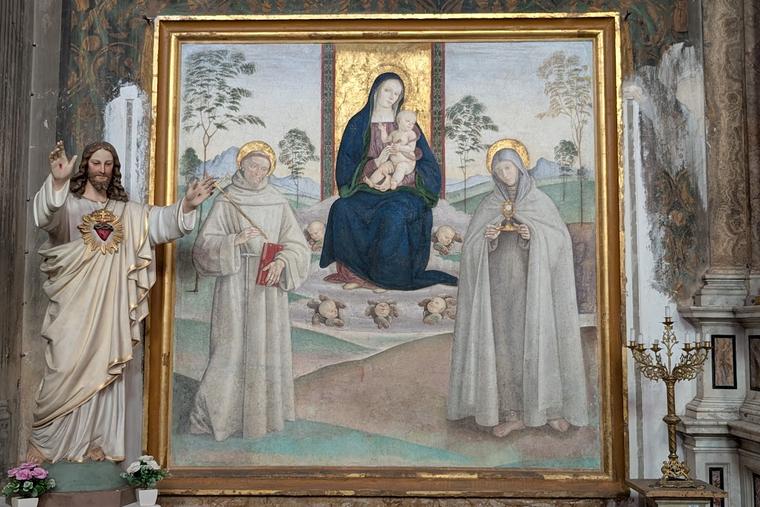
Image from Wikimedia Commons