












Restoring the Ascension to Thursday: A Strong Step in Renewing Catholic Culture


One of my tasks while working at the Vatican’s Secretariat of State was to handle letters written to the pope from bishops throughout the world. I would briefly summarize their contents before forwarding them to the Holy Father so that he might decide how to respond. Although the range of concerns expressed by shepherds across the globe was vast, one was virtually universal: the transfer of Holy Days of Obligation to Sunday.
One bishop went so far as to link these transfers to a “crisis of culture,” and another to a “deep, abiding indifference toward the sacramental life.” One high-ranking cardinal asserted that “the transferal of Solemnities to Sundays, done under the pretense of tying the mysteries they commemorate more closely to Christ’s Resurrection and the Lord’s Day, is nothing less than a theological canard and a complete caving into the cultural desire for convenience, be it on the part of the laity, be it the clergy. This is a wrong that could easily be righted, and must be righted speedily and promptly.”
And yet, the only U.S. ecclesiastical provinces in which the Ascension is celebrated on a Thursday are Boston, Hartford, New York, Omaha, and Philadelphia. The rest transfer it to the succeeding Sunday. Several members of the hierarchy with whom I’ve spoken believe that celebrating the Ascension on Sunday actually enhances—not diminishes—its significance. I simply haven’t found that to be the case when talking with the faithful.
The reality is that many Catholics in the U.S. go to Mass not knowing whether it’s the 18th Sunday in Ordinary Time or the 3rd Sunday of Easter. They have a vague notion of what it means to be in the seasons of Advent and Lent. When they are handed a palm branch, they’re reminded that Easter comes in a week. But when it comes to the Ascension, only those who read the bulletin or listen attentively to the announcements know it’s one week away from the 6th Sunday of Easter.
How different it would be if they had to mark it in the calendars! How much more meaningful if they had to plan their Thursday around it!
It’s true that the Ascension is intimately tied to the Resurrection. But there’s little reason to believe that the average Catholic will perceive the connection more clearly by celebrating it on Sunday rather than Thursday. Indeed, the need to go out of one’s way to attend Mass on Thursday would seem to connect both the Ascension—and the Resurrection—more closely to everyday life. I have vivid memories of attending Mass on Holy Days of Obligation as a child, certain that whatever mystery was being celebrated—be it the Ascension, the Epiphany, the Immaculate Conception, or the Assumption of Mary—was very important.
In the case of the Ascension, Leo the Great reminds us of its central lesson: “the nature which had been laid in the tomb was to sit on God the Father’s throne” (sermon 73). Leo goes on to explain that the Ascension gives us a deeper love for the sacraments: “that which till then was visible of our Redeemer was changed into a sacramental presence, so that faith might be more excellent and stronger” (ibid.). If nothing else, celebrating the Ascension on Thursday would remind us that the grace of the Most Holy Eucharist is hardly limited to one day of the week. It pervades our entire lives at home, at work, and at play.
Celebrating the Ascension on Thursday would also signify a stronger connection of the entire Easter Season with the Paschal Triduum. We would never think of transferring the Mass of the Lord’s Supper to Easter Sunday. Indeed, the beauty of Holy Week is that it lays out the mysteries of the passion, death, and resurrection of Jesus over time, stretching Christ’s redemptive work across a duration both chronological and spiritual. That’s not to say that it’s absolutely imperative that the Ascension be celebrated precisely forty days after the Lord’s resurrection (though the span of those forty days is itself significant), but rather that the Lord’s ascent into heaven stands as an integral part of the Easter mystery bridging the Resurrection to Pentecost. Besides, the intervening period between the Ascension and Pentecost is at the very root of the devotional practice of novenas.
In a culture eager to subject the human body to cybernetic manipulation and to take sexual differentiation as inconsequential (if not as an injustice) to human existence, nothing could be more important than highlighting the destiny of the body for the world to come. After Jesus’s resurrection, “his glory remains veiled under the appearance of ordinary humanity,” but his “final apparition ends with the irreversible entry of his humanity into divine glory” (CCC 659). That is precisely where we are headed, and that is precisely what a Thursday celebration of the Ascension would remind us of.
It would certainly help us carry the joy of Easter Sunday all the way through Pentecost.
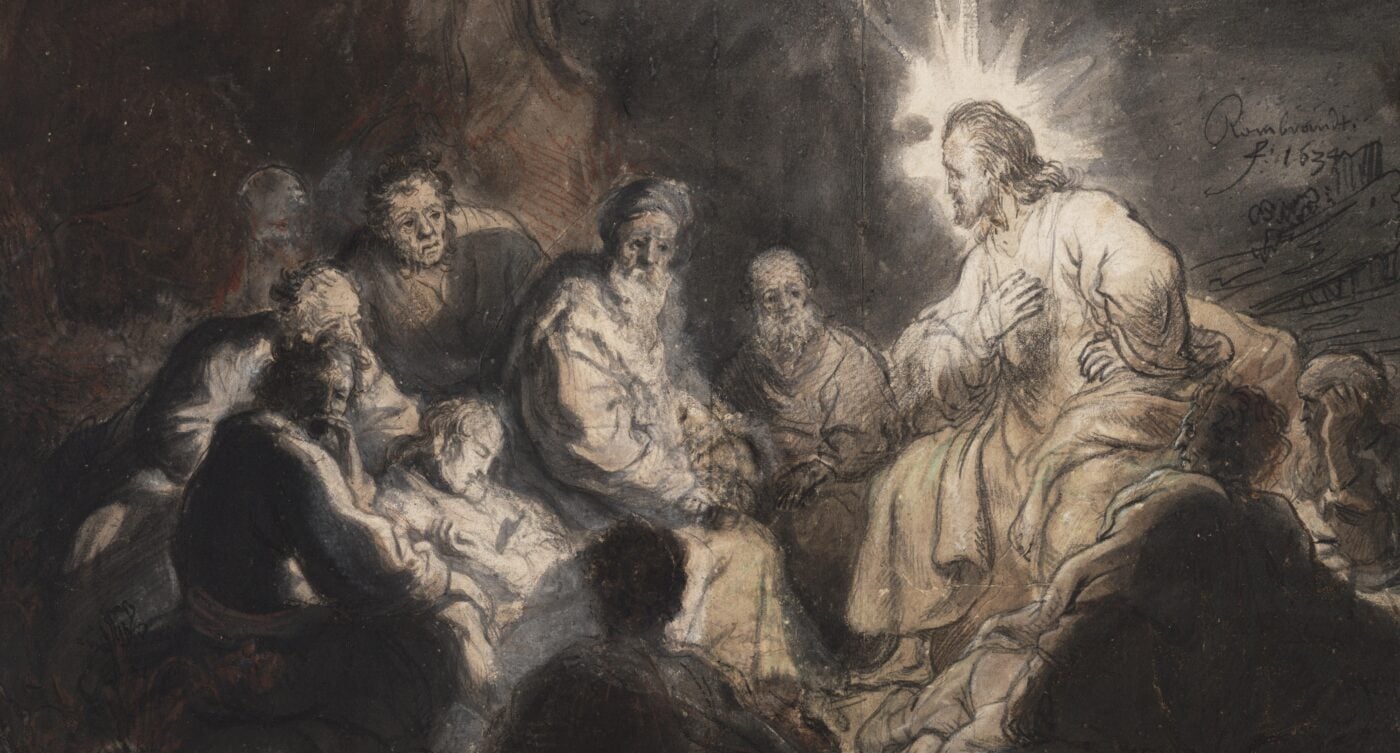
On Good Friday, the church was bare, the tabernacle empty, and images covered. On the Ascension, the church is adorned in Easter white, and the faithful ring out their Alleluias. Both Good Friday and the Ascension take place on a hill: the former Calvary, the latter Bethany. Jesus extends His hands both times: on the cross at Calvary, and to bless His disciples in Bethany. Finally, Jesus was raised on high both times: on Calvary, by the hands of evil men, and in Bethany, by the hand of God the Father.
Perhaps most importantly, Good Friday and the Ascension both evoke ambivalent feelings.
As we kneel before a crucifix, it is sad to remember the suffering and pain our Savior endured on the cross, but it gives us peace and hope to know that He truly died for our sins. When we meditate on the Ascension, we join the disciples in their grief that Jesus is departing from them, but we also share their joy that His departure means they will receive power through the Advocate.
Celebrating the Ascension on Thursday would help us integrate the admixture of sorrow and joy it brings into our everyday lives.
As you drive away from campus after helping your college-bound daughter unpack, you are sad to leave her behind, but you are proud of her accomplishments and happy that a new world will open before her. As you embrace your husband before he flies off for a military tour, you are sad and anxious because you will miss him and fear for his safety, but you are proud of his bravery and sense of duty. As you mourn the loss of a parent, you are both sad of losing a dear one, but happy that mom or dad now rests in the bosom of Abraham.
In short, if Good Friday is worth a Friday, then the Ascension is worth a Thursday. For it is only by accepting Good Friday and the Ascension that we can accept such partings in faith.
Author’s Note: If you would like to express a desire to see the Ascension and other transferred solemnities restored to their rightful place, here’s where you can write:
His Eminence Cardinal Arthur Roche
Prefect of the Dicastery for Divine Worship
and the Discipline of the Sacraments
00120 Vatican City State
EUROPE
(NB: It is very important NOT to write “Italy” on the envelope!)
Image from Wikimedia Commons