















Eucharistic Adoration: A Power Like No Other


Recently I have been pondering the fact that adoration of the Blessed Trinity is the most powerful human act we can make. It is more powerful than anything we can do with our own hands and with all the gadgets and tools of the world. Of course, our physical senses cannot measure this power; it is a truth that rests within the sphere of our Christian Faith. Nevertheless, it is worth pondering the depth of the spiritual effect of one heart surrendered in adoration of God.
We could be tempted in our contemporary societal frenzy for entertainment and economic production to think that sitting in silent adoration of the Lord is useless. It seems to entertain little and produce nothing. We are almost trained by our Western culture to be suspicious of “wasting time” in silence and prayer.
Wouldn’t it be better to get out into the world to do some kind of social work? Active service seems far more immediate in results, more helpful and rewarding. Of course, the Christian way of life overflows in a myriad of charitable ministries towards a broken humanity. However, it is also true that Christ first called His disciples to intimacy with Him before He sent them out on mission.
Transformed in Him
All acts of adoration of God are powerful, but the greatest act of adoration possible for the human soul is to participate in the praise and worship of the Holy Sacrifice of the Mass. This act has untold blessings on all of creation and upon ourselves. Because of baptism, the baptized soul is able to spiritually enter the great mystery of the Holy Mass—the soul is able to spiritually unite with Jesus’ offering of His adoration to the Father in the power of the Holy Spirit. Holy Mass gives us an opportunity to thank God with the most perfect praise for the abundance of gifts He has given to us.
Baptism also allows the soul to spiritually receive the effects of such adoration. This is fulfilled in the ultimate blessing of Holy Communion where the soul finds the greatest source of its transformation in Christ. What began in baptism, our participation in God’s inner life through Christ, increases through the divine communion wrought by our Eucharistic Lord. Christianity is more than just an imitation of Jesus; it is Jesus living His very life in and through His disciples.
Eating the Bread of Life strengthens Jesus’ influence over our hearts as His presence grows in our souls. Holy Communion is thus the greatest source of sanctifying grace from which flows all the gifts of the Holy Spirit and the virtues needed to transform our hearts in Christ.
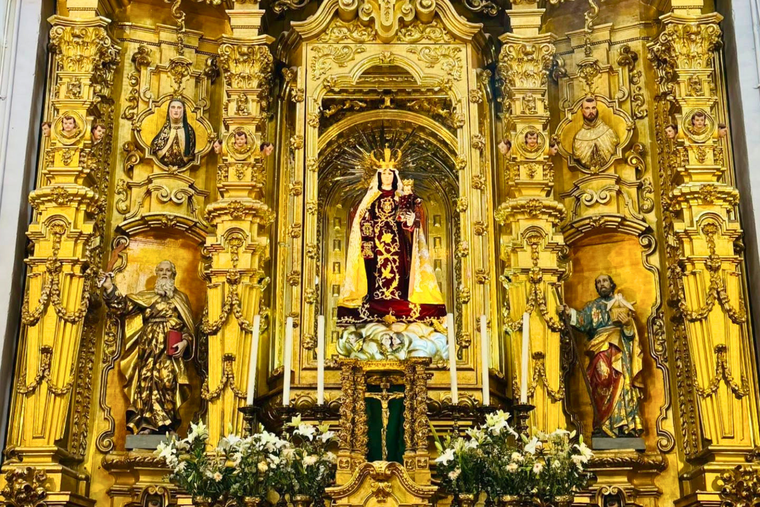
It is important to know that our transformation does not end with Holy Communion because when we adore Christ in the Blessed Eucharist outside of Holy Mass, all the gifts and graces of Holy Communion continue to mature and intensify. St. John Paul II taught this very clearly in his encyclical Eucharistia de Ecclesia. He even quoted St. Alphonsus di Ligouri, saying: “Of all devotions, that of adoring Jesus in the Blessed Sacrament is the greatest after the sacraments, the one dearest to God and the one most helpful to us.”
The Universal Effects of Divine Intimacy
There is no doubt in my mind that the reason so many Eucharistic Adoration chapels have emerged in the life of the Church is because the faithful have experienced the power of this adoration and the taste of divine intimacy that this adoration produces in the soul. In a homily for Corpus Christi in 2012, Pope Benedict XVI wonderfully portrays this intimacy:
If I am truly to communicate with another person I must know him, I must be able to be in silence close to him, to listen to him and look at him lovingly…love and true friendship are always nourished by the reciprocity of looks, of intense, eloquent silences full of respect and veneration, so that the encounter may be lived profoundly and personally rather than superficially.
What is extraordinary is what God will do with our intimacy with Him. God allows our adoration not only to transform us but also to overflow into all the world. Just as marital love brings into the world the life of a soul, our intimacy with God gives birth to unimaginable graces as wide as God is infinite. Peter Kreeft, the well-known Catholic philosopher and theologian, articulates this thought in a way few quotes ever do:
Restoration of adoration of the Sacrament will heal our church, and thus our nation, and thus our world. It is one of Satan’s most destructive lies that sitting alone in a dark church adoring Christ is irrelevant, impractical, a withdrawal from vital contemporary needs. Adoration touches everyone and everything in the world because it touches the Creator, who touches everything and everyone in the world from within, in fact, from their very center. When we adore, we plunge into the center of the hurricane, “the still point of the turning world”; we plug into infinite dynamism and power. Adoration is more powerful for construction than nuclear bombs for destruction.
Writing to the Bishop of Liege, Pope St. John Paul II also pens a gem of Eucharistic spirituality. Like Kreeft, the saintly pope draws our attention to the universal effects of adoration:
Closeness to the Eucharistic Christ in silence and contemplation does not distance us from our contemporaries but, on the contrary, makes us open to human joy and distress, broadening our hearts on a global scale…Through adoration the Christian mysteriously contributes to the radical transformation of the world and to the sowing of the Gospel. Anyone who prays to the Savior draws the whole world with him and raises it to God.
Brothers and sisters, are you willing to raise the whole world up to God? Are you willing to be a Eucharistic adorer to release a power in this universe like no other?
Author’s Note: For more on transformation by the Eucharist, check out this author’s new book, coauthored with Dan Burke and Fr. Ignatius Schweitzer, How to Be His: A 33-Day Dedication to Our Eucharistic Jesus, available from Sophia Institute Press.
Image from Wikimedia Commons