







A Final Lesson in This Jubilee Year: To Have Hope Is To Be Poor


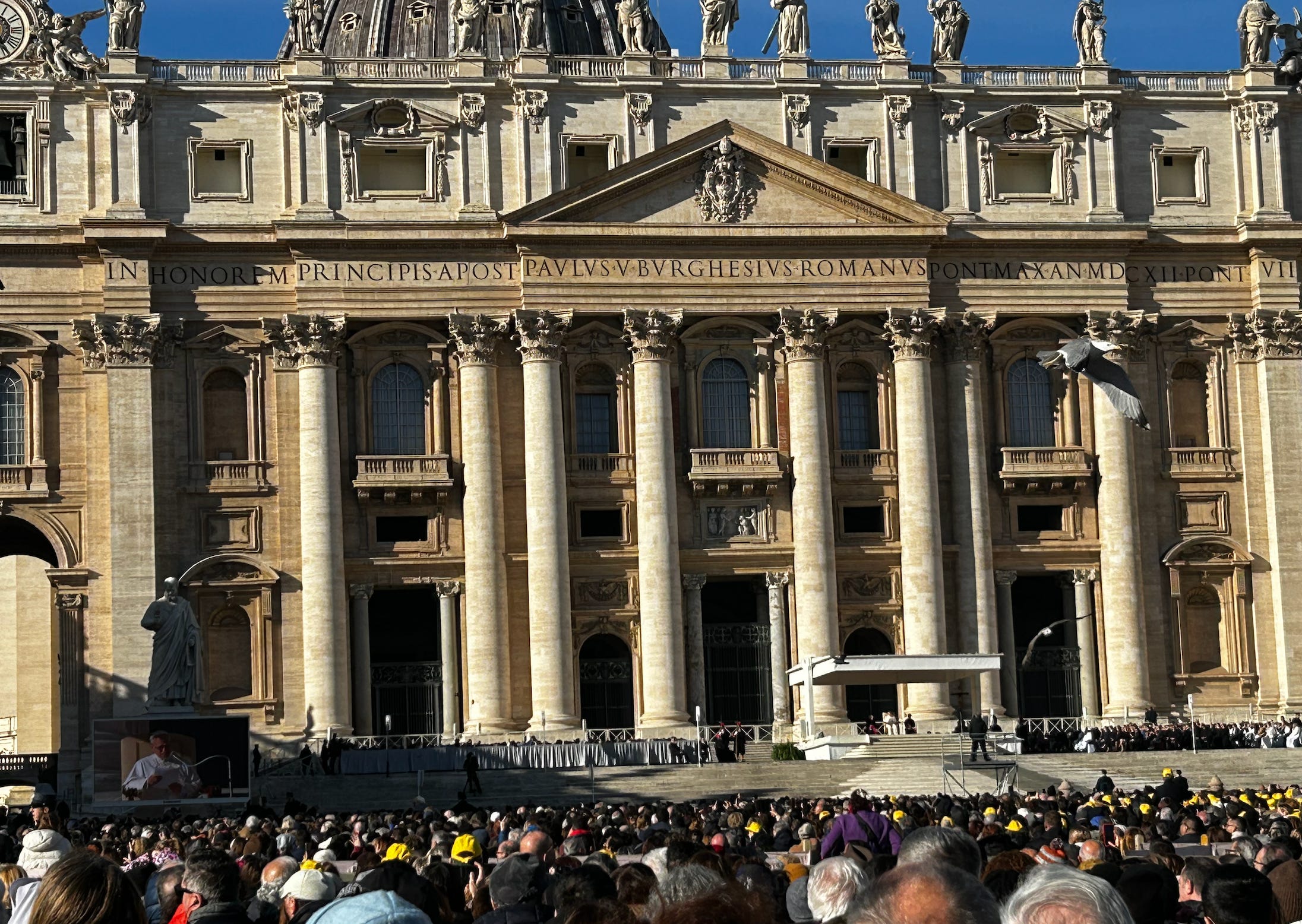
The Year of Hope, inaugurated by Pope Francis on Christmas Eve of 2024, reaches its conclusion on January 6th. It’s not the first time the Jubilee doors were opened by one pope and closed by another. Benedict XVI announced his resignation in the middle of the Year of Faith, leaving his successor to end it in November of 2013. Similarly, Pope Leo will seal the Holy Door of St. Peter’s Basilica on the Solemnity of the Epiphany.
The Jubilee is not the only bridge between the present pontificate and the last. An encyclical bridges them too—a close reading of which brings to the foreground the ardent hope both Francis and Leo have placed at the center of this celebration.
“I share the desire of my beloved predecessor,” Leo wrote in Dilexi Te—an encyclical begun by Francis and finished by Leo himself—“that all Christians come to appreciate the close connection between Christ’s love and his summons to care for the poor, for ‘in this call to recognize him in the poor and the suffering, we see revealed the very heart of Christ, his deepest feelings and choices, which every saint seeks to imitate’” (3).
The statement encapsulates three inseparable aspects of hope we can carry beyond this Jubilee year. First, the essential link between the love of Christ and care for the poor, something Francis began to elaborate in the most profound encyclical of his pontificate, Dilexit Nos (2024); second, the poor as the very locus where the heart of Christ is revealed; and third, the saints’ imitation of Christ precisely by becoming poor to serve the poor.
Though neither is short, the insights of Dilexi Te are not fully perceived unless one first reads Dilexit Nos, and the message of Dilexit Nos doesn’t reach its apex unless one reads Dilexi Te.
What do both have to do with hope? Why can’t hope be fully understood without some understanding of poverty?
Francis explains in a wonderful little book, entitled Hope Does Not Disappoint (not to be confused with his autobiography, entitled Hope), in which he notes that those who live on a full stomach have no need of hope. It is rather the poor who witness hope, for the poor are not contaminated by a desire to possess everything, but only what they need. The poor, as Francis noted in his 2013 encyclical Evangelii Gaudium, are the protagonists of “the most beautiful and spontaneous joys that I have seen in the course of my life” (7).
If we want to be numbered among this most privileged audience of the Gospel, we, too, must become poor just as Jesus makes clear in the first beatitude (Lk. 6:20). Francis eschewed any attempt to mitigate the material aspect of Jesus’ teaching that “blessed are the poor” by riffing on the tag-line “…in spirit.” Francis stressed that it is by being in need— in real need—that our eyes are opened to God’s care for us.
Only the poor really know that the Lord will never abandon them. Accordingly, when St. Paul goes to Jerusalem to meet the apostles, his one criterion for authenticity was “we were to be mindful of the poor, which is the very thing I was eager to do” (Gal. 2:10). To do otherwise would have made the communities Paul established indistinguishable from pagan communities marked by self-centeredness and a disregard for the lowly. The first Christian communities attested to the dignity of the poor by treating them as subjects rather than objects, precisely because God “made himself poor” (2 Cor. 8:9).
That led Francis to what I believe to be the key insight of his entire pontificate: the thing that made Christianity so radically different from pagan religion was that Christians were not simply called to pull the poor out of poverty, but to walk together with them in poverty (cf. Sir. 7:32). Put plainly, “for the Church, the option for the poor is primarily a theological category rather than a cultural, sociological, political, or philosophical one” (Evangelii Gaudium, 198).
Francis utilized a neologism devised by Dr. Adela Cortina to designate the contrary of the Christian conception of poverty: “aporophobia,” or a “rejection, aversion, fear, and contempt towards the poor and helpless.” Pope Francis stressed that the Year of Hope reminds us that “in a culture that has placed wealth at the forefront and often sacrifices the dignity of people on the altar of material goods, (the poor) swim against the tide, highlighting that what is essential for life is something else entirely” (Message for the World Day of the Poor, 2024).
The poor Francis had in mind were not only those who lacked the basic necessities of life but those who had no access to public schools or universities and those without any opportunity to obtain scientific expertise. What most threatens the hope intrinsic to Christian poverty is an individualistic lifestyle that places all responsibility for the poor’s condition on the poor themselves. Francis chided the passivity with which we accept what is happening around us, because such an attitude makes it possible for inequality and social injustice to grow. “To be pilgrims of hope,” he taught, “means to lend a hand to the poor, to look them in the face and to accept them.”
By expanding our definition of “poverty,” we easily see that the poor are not living on the other side of the world but right in our midst. “Each day we meet people who are poor or impoverished; they may even be our next-door neighbors,” wrote Francis (Spes Non Confundit, 15). He continues:
“It is scandalous that in a world possessed of immense resources…the poor continue to be ‘the majority of the planet’s population, billions of people…one often has the impression that their problems are brought up as an afterthought, a question which gets added almost out of duty or in a tangential way…they frequently remain at the bottom of the pile.’” (Spes Non Confundit, 15; cf. Laudato Si’, 49)
To conclude this Year of Hope, it is only fitting that we heed the appeal of Leo and his predecessor to not only care for the poor, but to be poor; to not only pull them out of poverty, but to join them in it.